Clinical Knowledge › Internal medicine › Cardiology and angiology › Valvular heart disease and endocarditis
Aortic regurgitation
Aortic regurgitation (AR) is diastolic backflow of blood from the aorta into the left ventricle through an incompetent aortic valve. It results either from disease of the leaflets (bicuspid valve, rheumatic disease, endocarditis, calcific degeneration) or from dilatation of the aortic root (hypertension, ageing, Marfan and other heritable aortopathies, dissection, aortitis). Chronic AR imposes both volume and pressure overload: the ventricle dilates and hypertrophies eccentrically, so patients may remain asymptomatic for many years while the LV silently deteriorates. Signs include a collapsing pulse, wide pulse pressure, displaced hyperdynamic apex and an early diastolic murmur at the left sternal edge, heard best with the patient leaning forward in expiration. Acute severe AR (endocarditis, type A dissection) overwhelms a non-dilated ventricle, causing pulmonary oedema and shock with few classic signs, and needs urgent surgery. Echocardiography defines mechanism, severity and LV size. Surgery is indicated for symptoms or LV dysfunction or dilatation; vasodilators help only for blood pressure control.
Patient case, mechanism, investigations, management, flashcards and exam-style questions.Open the lesson →
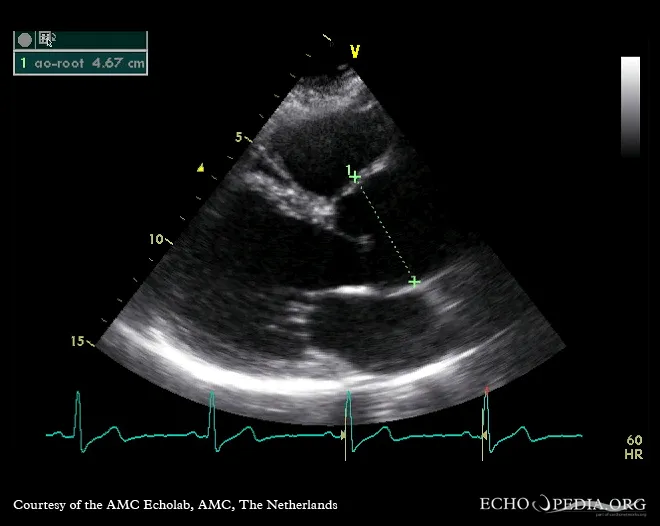
Key facts
- Two mechanisms: leaflet disease (bicuspid, rheumatic, endocarditis) or aortic root dilatation (hypertension, Marfan, dissection, aortitis)
- Chronic AR causes combined volume and pressure overload with eccentric LV hypertrophy and a long asymptomatic phase
- Murmur: high-pitched, blowing early diastolic decrescendo at the left sternal edge, loudest sitting forward in held expiration
- Peripheral signs: collapsing (water-hammer) pulse, wide pulse pressure, Corrigan, de Musset, Quincke and Duroziez signs
- Acute severe AR (endocarditis, type A dissection) presents with pulmonary oedema and shock and needs emergency surgery
- Severe AR on echo: vena contracta above 6 mm, EROA 30 mm² or more, regurgitant volume 60 mL or more, holodiastolic flow reversal in the descending aorta
- Surgery for symptomatic severe AR, or asymptomatic AR with LVEF 50% or less or LVESD above 50 mm (LVESDi above 25 mm/m²)
- Never use an intra-aortic balloon pump in significant AR: it increases regurgitation
Differential diagnosis
| Condition | Clues | Key test |
|---|---|---|
| Pulmonary regurgitation (Graham Steell murmur) | Early diastolic murmur louder on inspiration with signs of pulmonary hypertension | Echocardiography |
| Mitral stenosis | Low-pitched mid-diastolic rumble at apex with opening snap; tapping apex | Echocardiography |
| Austin Flint murmur of severe AR | Apical mid-diastolic rumble without opening snap or loud S1 | Echocardiography showing normal mitral leaflets |
| Patent ductus arteriosus | Continuous machinery murmur below left clavicle with collapsing pulse | Echocardiography |
| High-output states (anaemia, thyrotoxicosis, AV fistula) | Bounding pulse and flow murmurs without diastolic murmur | FBC, TFTs, echocardiography |
| Aortic dissection | Tearing chest or back pain, pulse deficit, new AR murmur | CT aortography or TOE |
Exam pearls
Guideline
2025 ESC/EACTS Guidelines for the management of valvular heart disease, 2020 ACC/AHA valvular heart disease guideline, 2023 ESC endocarditis guideline and 2024 ESC aortic disease guideline
References
- Praz F, Borger MA, Lanz J, et al.. 2025 ESC/EACTS Guidelines for the management of valvular heart disease. Eur Heart J 2025.
- Otto CM, Nishimura RA, Bonow RO, et al.. 2020 ACC/AHA Guideline for the Management of Patients With Valvular Heart Disease. Circulation 2021.
- Delgado V, Ajmone Marsan N, de Waha S, et al.. 2023 ESC Guidelines for the management of endocarditis. Eur Heart J 2023.
- Mazzolai L, Teixido-Tura G, Lanzi S, et al.. 2024 ESC Guidelines for the management of peripheral arterial and aortic diseases. Eur Heart J 2024.
- Bonow RO, Lakatos E, Maron BJ, Epstein SE.. Serial long-term assessment of the natural history of asymptomatic patients with chronic aortic regurgitation and normal left ventricular systolic function. Circulation 1991.
- Vahl TP, Thourani VH, Makkar RR, et al.. Transcatheter aortic valve implantation in patients with high-risk symptomatic native aortic regurgitation (ALIGN-AR): a prospective, multicentre, single-arm study. Lancet 2024.
Related topics
By Dr Khalid Seidi (B.Sc., M.D.) · MedEd World Clinical Knowledge library. Original teaching content checked against current guidelines (November 2026); confirm the latest local guidance before clinical use. Not a substitute for clinical judgement.