Clinical Knowledge › Internal medicine › Cardiology and angiology › Valvular heart disease and endocarditis
Tricuspid and pulmonary valve disease
Disease of the right-sided valves is common but often overlooked. Tricuspid regurgitation (TR) is usually secondary: the annulus dilates because of left heart disease, pulmonary hypertension, atrial fibrillation or a pacemaker lead, while primary causes include endocarditis in people who inject drugs, rheumatic and carcinoid disease, Ebstein anomaly and trauma. Severe TR causes fatigue, oedema, ascites and congestive liver disease, with giant v waves and a pansystolic murmur that increases on inspiration. Tricuspid stenosis is rare and mostly rheumatic or carcinoid. Pulmonary stenosis is usually congenital and treated by balloon valvuloplasty, whereas significant pulmonary regurgitation mainly follows repair of tetralogy of Fallot and leads to RV dilatation, arrhythmias and the need for surgical or transcatheter pulmonary valve replacement. Echocardiography is the key test. Severe TR is repaired at the time of left-sided valve surgery, isolated severe TR needs Heart Team assessment, and transcatheter tricuspid repair or replacement now improves symptoms in high-risk patients.
Patient case, mechanism, investigations, management, flashcards and exam-style questions.Open the lesson →
Key facts
- Most TR is secondary (functional) to RV and annular dilatation from left heart disease, pulmonary hypertension or AF; device leads are a growing cause
- Severe TR signs: giant cv waves in the JVP, pansystolic murmur at the lower left sternal edge louder on inspiration (Carvallo sign), pulsatile liver, peripheral oedema
- Echo grading extends beyond severe to massive and torrential; severe TR: vena contracta 7 mm or more, EROA 40 mm² or more, hepatic vein systolic flow reversal
- Repair severe TR (and consider repair of moderate TR with annulus 40 mm or more) during left-sided valve surgery
- Transcatheter tricuspid therapies (edge-to-edge repair, valve replacement) improve symptoms and quality of life in high-risk patients without severe RV dysfunction or pre-capillary pulmonary hypertension
- Right-sided endocarditis in people who inject drugs: tricuspid valve, Staphylococcus aureus, septic pulmonary emboli
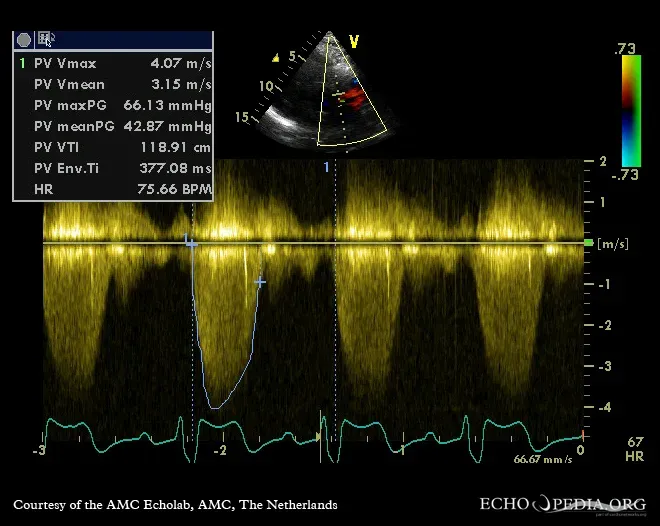
- Pulmonary stenosis is usually congenital (Noonan syndrome, rubella); balloon valvuloplasty for a peak gradient above about 64 mmHg (peak velocity over 4 m/s)
- Severe pulmonary regurgitation after tetralogy of Fallot repair: replace the pulmonary valve before irreversible RV dilatation and dysfunction
Differential diagnosis
| Condition | Clues | Key test |
|---|---|---|
| Mitral regurgitation | Pansystolic murmur at apex radiating to axilla, no inspiratory increase | Echocardiography |
| Ventricular septal defect | Harsh pansystolic murmur at left sternal edge with thrill | Echo with colour Doppler |
| Constrictive pericarditis | Raised JVP with Kussmaul sign, ascites, pericardial knock | Echo, CT/MRI, catheterisation |
| Cirrhosis of the liver | Ascites and oedema without raised JVP | Liver tests, ultrasound, JVP assessment |
| Atrial septal defect | Pulmonary flow murmur and fixed split S2 | Echo with bubble study |
| Pulmonary hypertension | Loud P2, RV heave, functional TR and PR | Echo, right heart catheterisation |
| Restrictive cardiomyopathy | Raised JVP, biatrial enlargement, normal valves | Echo strain, MRI, biopsy |
Exam pearls
Guideline
2025 ESC/EACTS valvular heart disease guidelines, 2020 ACC/AHA valvular heart disease guideline, 2020 ESC and 2025 ACC/AHA adult congenital heart disease guidelines, and 2023 ESC endocarditis guideline
References
- Praz F, Borger MA, Lanz J, et al.. 2025 ESC/EACTS Guidelines for the management of valvular heart disease. Eur Heart J 2025.
- Otto CM, Nishimura RA, Bonow RO, et al.. 2020 ACC/AHA Guideline for the Management of Patients With Valvular Heart Disease. Circulation 2021.
- Baumgartner H, De Backer J, Babu-Narayan SV, et al.. 2020 ESC Guidelines for the management of adult congenital heart disease. Eur Heart J 2021.
- Gurvitz M, Krieger EV, Fuller S, et al.. 2025 ACC/AHA/HRS/ISACHD/SCAI Guideline for the Management of Adults With Congenital Heart Disease: A Report of the American College of Cardiology/American Heart Association Joint Committee on Clinical Practice Guidelines. Circulation 2025.
- Sorajja P, Whisenant B, Hamid N, et al.. Transcatheter repair for patients with tricuspid regurgitation. N Engl J Med 2023.
- Hahn RT, Makkar R, Thourani VH, et al.. Transcatheter valve replacement in severe tricuspid regurgitation. N Engl J Med 2025.
Related topics
By Dr Khalid Seidi (B.Sc., M.D.) · MedEd World Clinical Knowledge library. Original teaching content checked against current guidelines (November 2026); confirm the latest local guidance before clinical use. Not a substitute for clinical judgement.