Clinical Knowledge › Internal medicine › Cardiology and angiology › Valvular heart disease and endocarditis
Mitral regurgitation
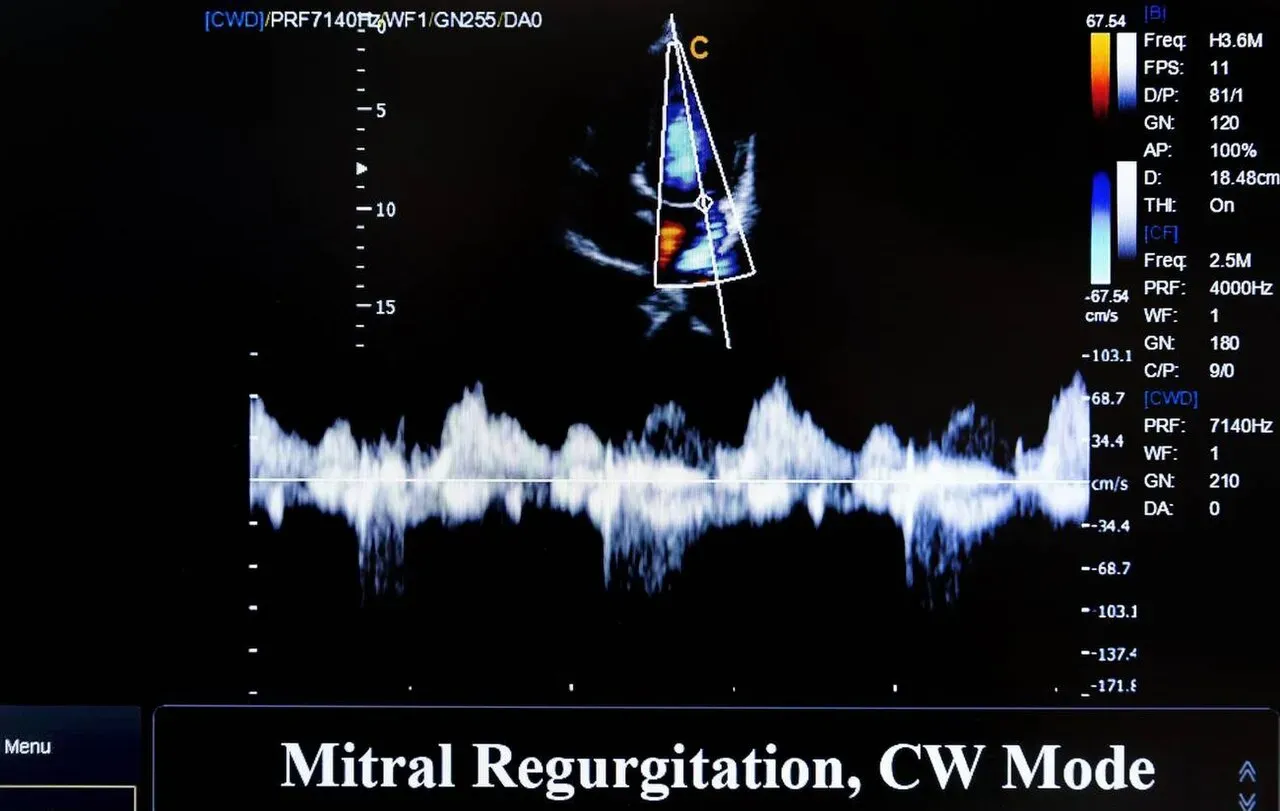
Mitral regurgitation (MR) is systolic backflow of blood from the left ventricle into the left atrium. Primary (degenerative) MR results from disease of the valve apparatus itself, most often mitral valve prolapse or flail leaflet from myxomatous degeneration, and also from rheumatic disease and endocarditis. Secondary (functional) MR occurs with structurally normal leaflets when the ventricle dilates after myocardial infarction or in cardiomyopathy (ventricular MR), or when the annulus enlarges with atrial fibrillation (atrial MR). Chronic MR causes volume overload and LA and LV dilatation, often silently. Acute severe MR, from papillary muscle rupture or chordal rupture, causes sudden pulmonary oedema and shock. The typical sign is a pansystolic murmur at the apex radiating to the axilla. Echocardiography defines mechanism and severity. Primary severe MR is treated with surgical repair when symptoms, LV dysfunction or atrial fibrillation and pulmonary hypertension appear; secondary MR is treated first with heart failure therapy and then, in selected patients, transcatheter edge-to-edge repair.
Patient case, mechanism, investigations, management, flashcards and exam-style questions.Open the lesson →
Key facts
- Primary MR = abnormal valve (prolapse, flail, rheumatic, endocarditis); secondary MR = abnormal ventricle or atrium with normal leaflets
- Murmur: pansystolic, apical, radiating to the axilla; soft S1 and S3 in severe MR
- Acute severe MR (papillary muscle or chordal rupture, endocarditis) causes pulmonary oedema and shock with a soft or absent murmur
- Severe MR on echo: EROA 40 mm² or more, regurgitant volume 60 mL or more, vena contracta 7 mm or more
- In MR an LVEF of 60% or less already indicates LV dysfunction because ejection into the low-pressure LA flatters LVEF
- Primary severe MR: surgery (repair preferred) for symptoms, LVEF 60% or less, LVESD 40 mm or more, or AF and pulmonary hypertension
- Secondary MR: optimise heart failure therapy and CRT first; TEER for persistent symptomatic severe MR in selected patients (COAPT)
- Posteromedial papillary muscle rupture typically follows inferior MI because it has a single blood supply
Differential diagnosis
| Condition | Clues | Key test |
|---|---|---|
| Aortic stenosis | Ejection systolic murmur at right upper sternal edge radiating to carotids; slow-rising pulse | Echocardiography |
| Tricuspid regurgitation | Pansystolic murmur at left lower sternal edge, louder on inspiration; giant v waves | Echocardiography |
| Ventricular septal defect | Harsh pansystolic murmur at left sternal edge with thrill; post-MI VSR | Echocardiography |
| Hypertrophic obstructive cardiomyopathy | Systolic murmur louder with Valsalva; SAM may cause MR | Echocardiography |
| Mitral valve prolapse without significant MR | Mid-systolic click and late systolic murmur only | Echocardiography |
| Acute pulmonary oedema from ischaemia without MR | Pulmonary oedema with wall-motion abnormality and no regurgitant jet | Echocardiography, troponin, angiography |
Exam pearls
Guideline
2025 ESC/EACTS Guidelines for the management of valvular heart disease and 2020 ACC/AHA valvular heart disease guideline
References
- Praz F, Borger MA, Lanz J, et al.. 2025 ESC/EACTS Guidelines for the management of valvular heart disease. Eur Heart J 2025.
- Otto CM, Nishimura RA, Bonow RO, et al.. 2020 ACC/AHA Guideline for the Management of Patients With Valvular Heart Disease. Circulation 2021.
- Feldman T, Foster E, Glower DD, et al.. Percutaneous repair or surgery for mitral regurgitation. N Engl J Med 2011.
- Stone GW, Lindenfeld J, Abraham WT, et al.. Transcatheter Mitral-Valve Repair in Patients with Heart Failure. N Engl J Med 2018.
- Obadia JF, Messika-Zeitoun D, Leurent G, et al.. Percutaneous Repair or Medical Treatment for Secondary Mitral Regurgitation. N Engl J Med 2018.
- Anker SD, Friede T, von Bardeleben RS, et al.. Transcatheter Valve Repair in Heart Failure with Moderate to Severe Mitral Regurgitation. N Engl J Med 2024.
Related topics
By Dr Khalid Seidi (B.Sc., M.D.) · MedEd World Clinical Knowledge library. Original teaching content checked against current guidelines (November 2026); confirm the latest local guidance before clinical use. Not a substitute for clinical judgement.