Clinical Knowledge › Internal medicine › Basics of internal medicine › Palliative care
Bereavement and grief
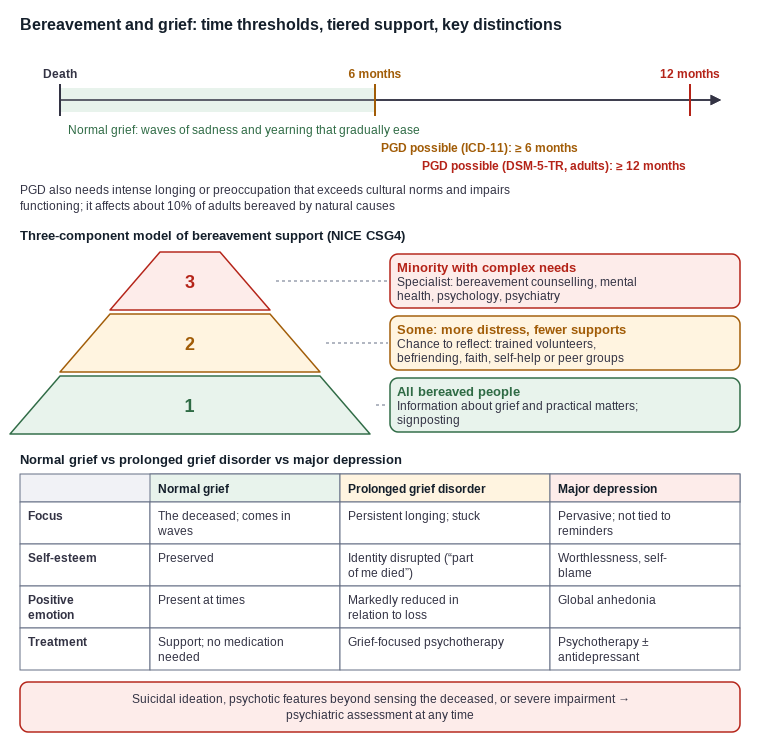
Bereavement is the objective state of having lost someone close through death; grief is the emotional, cognitive, physical and behavioural response to that loss; mourning is its social and cultural expression. Most people experience intense but adaptive grief: waves of sadness and yearning, disturbed sleep, poor appetite, guilt and even fleeting hallucinations of the deceased, which gradually ease over months. About one in ten bereaved adults develops prolonged grief disorder, now recognised in ICD-11 (persisting at least 6 months) and DSM-5-TR (at least 12 months), with intense longing or preoccupation and functional impairment; it responds to targeted grief-focused psychotherapy. Bereavement also raises the risk of depression, suicide, cardiovascular events and death, particularly in the early weeks. Doctors support the bereaved by breaking news of a death well, explaining what happens next (certification, medical examiner or coroner, registration), screening for risk, offering tiered support and recognising when grief has become a disorder or masks depression.
Patient case, mechanism, investigations, management, flashcards and exam-style questions.Open the lesson →
Key facts
- Bereavement = the loss; grief = the reaction; mourning = cultural and social expression of grief
- Normal grief includes sadness, yearning, crying, insomnia, anorexia, guilt, anger and brief perceptions of the deceased's voice or presence
- The dual process model describes healthy oscillation between loss-oriented and restoration-oriented coping; grief is not a fixed sequence of stages
- Prolonged grief disorder: ICD-11 requires at least 6 months after the death; DSM-5-TR requires at least 12 months in adults
- About 10% of adults bereaved by natural causes develop prolonged grief disorder; rates are higher after sudden, violent or child deaths
- DSM-5 removed the 'bereavement exclusion': major depression can be diagnosed during grief if criteria are met
- Bereavement increases risk of death (especially in widowers and in the early months), myocardial infarction, depression and suicide
- First-line treatment for prolonged grief disorder is grief-focused psychotherapy; antidepressants treat comorbid depression rather than grief itself
Differential diagnosis
| Condition | Clues | Key test |
|---|---|---|
| Normal (acute) grief | Waves of sadness and yearning that gradually ease; self-esteem preserved; functioning returning | Clinical assessment over time |
| Prolonged grief disorder | Persistent longing or preoccupation with the deceased, identity disruption, inability to re-engage, beyond 6 (ICD-11) or 12 (DSM-5-TR) months | Validated tools such as the PG-13-R or Inventory of Complicated Grief |
| Major depressive disorder | Pervasive low mood and anhedonia not tied to reminders, worthlessness, psychomotor change | PHQ-9; clinical interview |
| Post-traumatic stress disorder | Intrusive memories of a traumatic death, avoidance and hyperarousal | Trauma history; PCL-5 |
| Adjustment disorder | Distress after a stressor not meeting other criteria, usually resolving within months | Clinical assessment |
| Alcohol or substance misuse | Increased drinking or sedative use as coping | AUDIT; collateral history |
| Physical illness with depressive symptoms | Weight loss, fatigue, low mood (hypothyroidism, malignancy) | Examination, TSH, FBC as indicated |
Exam pearls
Guideline
WHO ICD-11 (2022) and APA DSM-5-TR (2022) criteria for prolonged grief disorder; NICE CSG4 Improving supportive and palliative care for adults with cancer (2004) three-component bereavement support model; national death certification guidance (e.g. statutory medical examiner system in England and Wales, 2024)
References
- Shear MK.. Clinical practice. Complicated grief. N Engl J Med 2015.
- Stroebe M, Schut H, Stroebe W.. Health outcomes of bereavement. Lancet 2007.
- Lundorff M, Holmgren H, Zachariae R, Farver-Vestergaard I, O'Connor M.. Prevalence of prolonged grief disorder in adult bereavement: a systematic review and meta-analysis. J Affect Disord 2017.
- Shear K, Frank E, Houck PR, Reynolds CF 3rd.. Treatment of complicated grief: a randomized controlled trial. JAMA 2005.
- World Health Organization. International Classification of Diseases 11th Revision (ICD-11): 6B42 Prolonged grief disorder. WHO 2022.
- American Psychiatric Association. Diagnostic and Statistical Manual of Mental Disorders, Fifth Edition, Text Revision (DSM-5-TR). American Psychiatric Association Publishing 2022.
Related topics
By Dr Khalid Seidi (B.Sc., M.D.) · MedEd World Clinical Knowledge library. Original teaching content checked against current guidelines (November 2026); confirm the latest local guidance before clinical use. Not a substitute for clinical judgement.