Clinical Knowledge › Internal medicine › Basics of internal medicine › Palliative care
Care of the dying patient
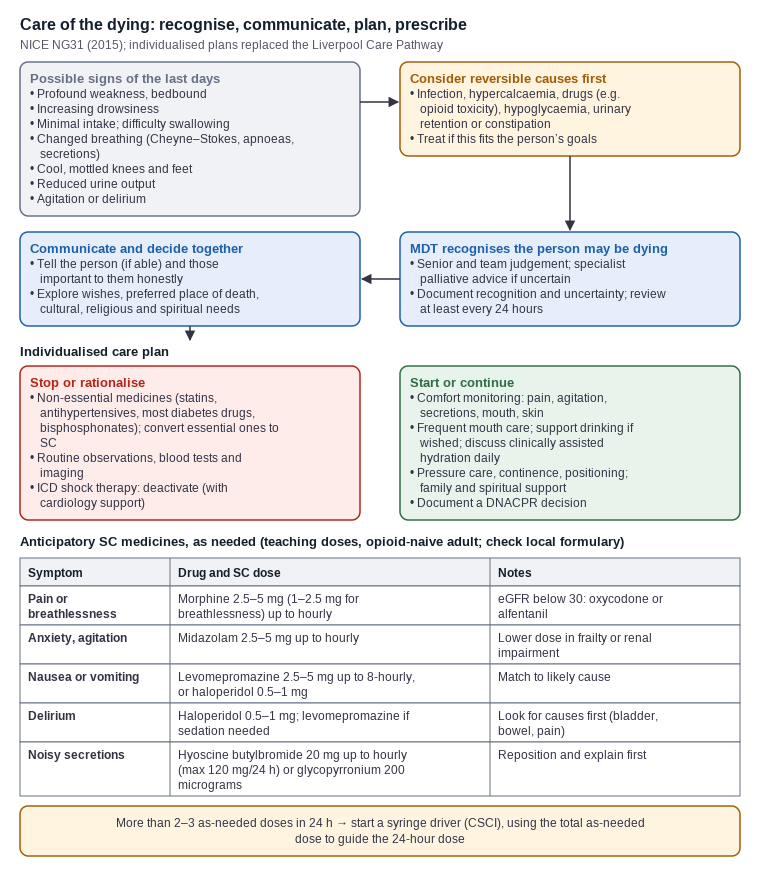
Most deaths in hospital are expected, and caring well for a dying person is a core skill of every ward doctor. The process starts with recognising that a person may be in the last days of life: increasing weakness and drowsiness, reduced intake, difficulty swallowing, changes in breathing, mottled cool peripheries and agitation, after reversible causes have been considered. Recognition is a team judgement, carries uncertainty and is reviewed at least daily. The person (if able) and those important to them are told sensitively, involved in decisions and supported. An individualised plan replaces routine observations, blood tests and non-essential medicines with comfort-focused care, mouth care, support to eat and drink as wished, and a reviewed decision about clinically assisted hydration. Anticipatory 'just in case' medicines are prescribed subcutaneously for pain, breathlessness, nausea, agitation and respiratory secretions, and a syringe driver is used if repeated doses are needed. NICE NG31 (2015) and the five priorities of 'One chance to get it right' (2014) replaced the Liverpool Care Pathway after the 2013 Neuberger review. Proportionate palliative sedation for refractory suffering follows the revised EAPC framework (2024).
Patient case, mechanism, investigations, management, flashcards and exam-style questions.Open the lesson →
Key facts
- Recognising dying is a multidisciplinary judgement made after excluding reversible causes; it involves uncertainty and should be reviewed at least every 24 hours
- Signs of the last days: profound weakness, bedbound, drowsiness, minimal intake, difficulty swallowing, changed breathing pattern, mottled cool peripheries, reduced urine output
- The Liverpool Care Pathway was phased out after the 2013 Neuberger review; care now follows individualised plans (NICE NG31, One Chance to Get it Right)
- Stop non-essential medicines, routine observations and blood tests; deactivate ICD shock function; make and document a resuscitation decision
- Anticipatory SC medicines (teaching doses, opioid-naive): morphine 2.5–5 mg, midazolam 2.5–5 mg, levomepromazine 2.5–5 mg or haloperidol 0.5–1 mg, hyoscine butylbromide 20 mg, all as needed
- Clinically assisted hydration does not routinely relieve symptoms at the end of life (Bruera 2013) but should be discussed and reviewed individually; always support oral intake and mouth care
- Prophylactic hyoscine butylbromide reduced death rattle in the SILENCE trial (13% vs 27%); repositioning and explaining to families come first
- Palliative sedation for refractory suffering must be proportionate, with midazolam first-line (EAPC 2024)
Differential diagnosis
| Condition | Clues | Key test |
|---|---|---|
| Sepsis | Fever or hypothermia, new source, rapid decline | Cultures, lactate if treatment is appropriate |
| Hypercalcaemia | Drowsiness, thirst, confusion | Adjusted calcium |
| Opioid toxicity | Pinpoint pupils, myoclonus, recent dose rise or AKI | Clinical; renal function |
| Hypoglycaemia | Drowsiness or agitation in diabetes or liver failure | Capillary glucose |
| Hypoactive delirium from drugs | Recent sedatives or antimuscarinics | Medication review |
| Urinary retention or constipation | Restlessness, palpable bladder, loaded rectum | Bladder scan, rectal examination |
| Non-convulsive seizures or raised intracranial pressure | Brain tumour or metastases, fluctuating consciousness | Clinical; imaging only if it would change care |
Exam pearls
Guideline
NICE NG31 Care of dying adults in the last days of life (2015), with 'One chance to get it right' (2014) and the revised EAPC framework on palliative sedation (2024)
References
- National Institute for Health and Care Excellence (NICE). Care of dying adults in the last days of life (NG31). NICE, London 2015.
- Leadership Alliance for the Care of Dying People. One chance to get it right: improving people's experience of care in the last few days and hours of life. Leadership Alliance for the Care of Dying People, London 2014.
- Independent Review of the Liverpool Care Pathway. More care, less pathway: a review of the Liverpool Care Pathway. Department of Health, London 2013.
- Bruera E, Hui D, Dalal S, et al.. Parenteral hydration in patients with advanced cancer: a multicenter, double-blind, placebo-controlled randomized trial. J Clin Oncol 2013.
- van Esch HJ, van Zuylen L, Geijteman ECT, et al.. Effect of prophylactic subcutaneous scopolamine butylbromide on death rattle in patients at the end of life: the SILENCE randomized clinical trial. JAMA 2021.
- Hui D, Frisbee-Hume S, Wilson A, et al.. Effect of lorazepam with haloperidol vs haloperidol alone on agitated delirium in patients with advanced cancer receiving palliative care: a randomized clinical trial. JAMA 2017.
Related topics
By Dr Khalid Seidi (B.Sc., M.D.) · MedEd World Clinical Knowledge library. Original teaching content checked against current guidelines (November 2026); confirm the latest local guidance before clinical use. Not a substitute for clinical judgement.