Clinical Knowledge › Internal medicine › Basics of internal medicine › Palliative care
Principles of palliative care
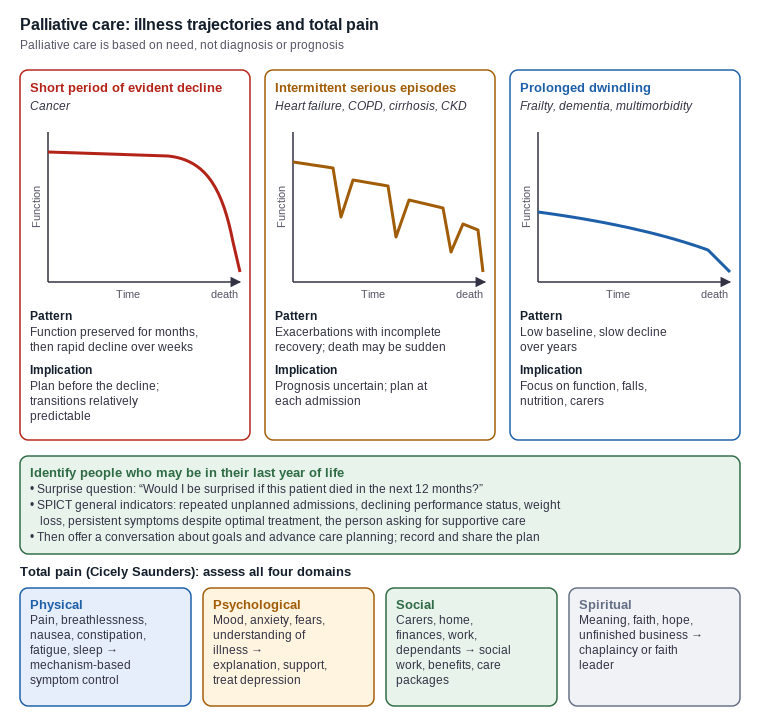
Palliative care is an approach that improves the quality of life of people with life-threatening or life-limiting illness, and of their families, by preventing and relieving suffering through early identification, careful assessment and treatment of pain and other physical, psychological, social and spiritual problems. It is defined by need, not by diagnosis or prognosis: it applies to cancer, organ failure, neurological disease, frailty and dementia, and can run alongside disease-modifying treatment. Every ward doctor delivers generalist palliative care; specialist teams support complex cases. Key skills are recognising who may be in the last year of life (the 'surprise' question, SPICT), understanding illness trajectories, assessing 'total pain', treating symptoms by mechanism, communicating honestly about uncertainty, and planning ahead with the patient. Early specialist palliative care in advanced cancer improves quality of life and mood and reduces aggressive end-of-life care (Temel 2010; ASCO 2024). Ethical anchors are patient autonomy, proportionality of treatment, and the doctrine of double effect. Worldwide, most people who need palliative care, and especially opioid analgesia, still lack access.
Patient case, mechanism, investigations, management, flashcards and exam-style questions.Open the lesson →
Key facts
- WHO defines palliative care as improving quality of life for patients and families facing life-threatening illness by preventing and relieving suffering: physical, psychosocial and spiritual
- Palliative care is based on need, not prognosis: it can start at diagnosis and run alongside curative or life-prolonging treatment
- Three typical trajectories: cancer (plateau then rapid decline), organ failure (stepwise exacerbations with incomplete recovery) and frailty/dementia (long slow dwindling)
- The 'surprise' question ('Would I be surprised if this patient died in the next 12 months?') and SPICT help identify people who may be in their last year of life
- 'Total pain' (Cicely Saunders) combines physical, psychological, social and spiritual distress; assessment must cover all four
- Temel 2010: early palliative care in metastatic NSCLC improved quality of life and mood, reduced aggressive end-of-life care and was associated with longer survival
- Doctrine of double effect: giving medicines with the intention of relieving suffering is ethical even if a foreseen but unintended effect could hasten death; proportionate opioid doses rarely do
- Generalist palliative care is every clinician's job; specialist palliative care is for complex physical, psychological or ethical problems
Differential diagnosis
| Condition | Clues | Key test |
|---|---|---|
| Reversible acute illness in a frail patient | Sudden decline with a treatable trigger (sepsis, hypercalcaemia, drug toxicity) | Bloods, cultures, calcium, medication review |
| Last days of life | Progressive gradual decline over days, bedbound, minimal intake, no reversible cause | Clinical recognition by MDT; review regularly |
| Hypercalcaemia of malignancy | Drowsiness, confusion, thirst, constipation, nausea | Adjusted calcium |
| Opioid toxicity | Drowsiness, myoclonus, pinpoint pupils, hallucinations, especially with AKI | Clinical; renal function |
| Depression | Persistent low mood, hopelessness, anhedonia beyond expected sadness | Screening questions; HADS or PHQ-9 |
| Delirium | Acute fluctuating confusion and inattention | 4AT or CAM; search for cause |
| Malignant spinal cord compression | New back pain, leg weakness, sphincter disturbance | Urgent whole-spine MRI |
Exam pearls
Guideline
ASCO Palliative Care for Patients With Cancer guideline update (2024), with the WHO definition of palliative care and NICE NG142 End of life care for adults: service delivery (2019)
References
- World Health Organization. National cancer control programmes: policies and managerial guidelines (2nd edition), including the WHO definition of palliative care. WHO, Geneva 2002.
- Sanders JJ, Temin S, Ghoshal A, et al.. Palliative Care for Patients With Cancer: ASCO Guideline Update. J Clin Oncol 2024.
- Temel JS, Greer JA, Muzikansky A, et al.. Early palliative care for patients with metastatic non-small-cell lung cancer. N Engl J Med 2010.
- Knaul FM, Farmer PE, Krakauer EL, et al.. Alleviating the access abyss in palliative care and pain relief: an imperative of universal health coverage: the Lancet Commission report. Lancet 2018.
- Sallnow L, Smith R, Ahmedzai SH, et al.. Report of the Lancet Commission on the Value of Death: bringing death back into life. Lancet 2022.
- Highet G, Crawford D, Murray SA, Boyd K.. Development and evaluation of the Supportive and Palliative Care Indicators Tool (SPICT): a mixed-methods study. BMJ Support Palliat Care 2014.
Related topics
By Dr Khalid Seidi (B.Sc., M.D.) · MedEd World Clinical Knowledge library. Original teaching content checked against current guidelines (November 2026); confirm the latest local guidance before clinical use. Not a substitute for clinical judgement.