Clinical Knowledge › Internal medicine › Basics of internal medicine › Palliative care
Breaking bad news
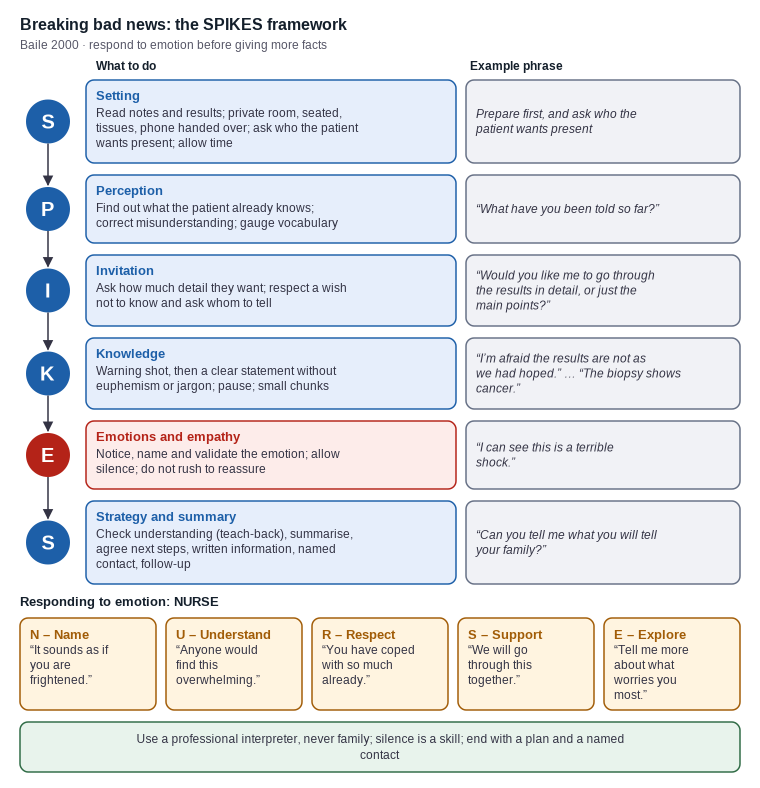
Bad news is any information that drastically and negatively alters a person's view of their future: a cancer diagnosis, a poor prognosis, a serious complication, a death, or a medical error. How it is delivered shapes the patient's understanding, trust, psychological adjustment and later decisions. The most widely taught framework is SPIKES: Setting, Perception, Invitation, Knowledge, Emotions and empathy, Strategy and summary. Core skills are preparation, a private setting with the right people present, finding out what the patient already knows and wants to know, a warning shot, giving information in small chunks without jargon, pausing for silence, responding to emotion before giving more facts (for example with NURSE statements), checking understanding and agreeing a clear plan with support. Honesty is required by professional codes worldwide, but the amount and pace of disclosure follow the patient's wishes; cultural preferences for family involvement are explored with the patient, not assumed. Professional interpreters, never family members, should be used.
Patient case, mechanism, investigations, management, flashcards and exam-style questions.Open the lesson →
Key facts
- Bad news is information that drastically and negatively changes a person's view of their future
- SPIKES: Setting, Perception, Invitation, Knowledge, Emotions/Empathy, Strategy and Summary (Baile 2000)
- Ask before you tell: establish what the patient knows and how much they want to know
- Give a warning shot ('I'm afraid the results are not what we hoped'), then deliver news in short, plain sentences
- Use the word 'cancer' or 'died' clearly; euphemisms cause misunderstanding
- Respond to emotion with empathy before adding information; patients retain little once distressed
- Use a professional interpreter, not family members or children, for serious conversations
- Patients have a right to information but may decline it; withholding against their wishes is only justified to prevent serious harm, not to avoid upset
Differential diagnosis
| Condition | Clues | Key test |
|---|---|---|
| Shock and numbness | Silence, 'I can't take this in', asks few questions | Pause; check understanding; offer a follow-up appointment |
| Denial | Rejects the news or asks for repeat tests without reason | Do not force acceptance; gently revisit over time |
| Anger | Blames clinicians or the system | Acknowledge the emotion; avoid defensiveness |
| Collusion request | Family asks you not to tell the patient | Explore their fears; ask the patient how much they want to know |
| Anxiety or acute distress | Tearful, tachycardic, catastrophising | Name the emotion, sit with silence, offer support and written information |
| Impaired capacity or cognition | Cannot understand or retain the information | Assess capacity; involve family or advocate; simplify and repeat |
| Language barrier | Limited English or hearing impairment | Professional interpreter or communication aids |
Exam pearls
Guideline
ASCO consensus guideline on patient–clinician communication (2017), GMC Good medical practice (2024) and Decision making and consent (2020), and NICE CSG4 Improving supportive and palliative care for adults with cancer (2004)
References
- Baile WF, Buckman R, Lenzi R, et al.. SPIKES – a six-step protocol for delivering bad news: application to the patient with cancer. Oncologist 2000.
- Gilligan T, Coyle N, Frankel RM, et al.. Patient-clinician communication: American Society of Clinical Oncology consensus guideline. J Clin Oncol 2017.
- Fallowfield L, Jenkins V.. Communicating sad, bad, and difficult news in medicine. Lancet 2004.
- General Medical Council. Good medical practice. GMC 2024.
- General Medical Council. Decision making and consent. GMC 2020.
- National Institute for Health and Care Excellence (NICE). Improving supportive and palliative care for adults with cancer (CSG4). NICE cancer service guidance 2004.
Related topics
By Dr Khalid Seidi (B.Sc., M.D.) · MedEd World Clinical Knowledge library. Original teaching content checked against current guidelines (November 2026); confirm the latest local guidance before clinical use. Not a substitute for clinical judgement.