Clinical Knowledge › Internal medicine › Basics of internal medicine › Palliative care
Syringe drivers and end-of-life medications
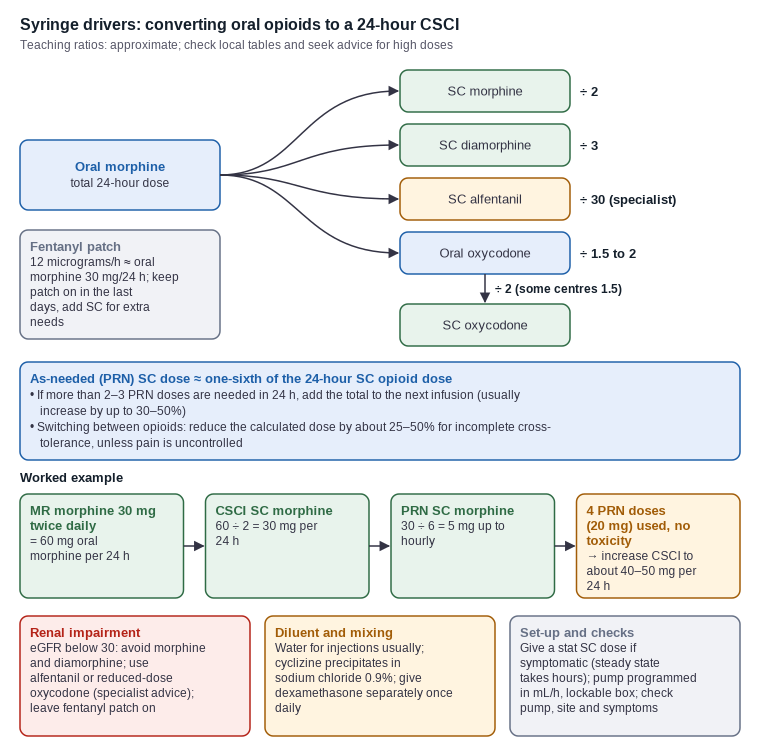
A syringe driver is a small battery-powered pump that delivers a continuous subcutaneous infusion (CSCI) of medicines over 24 hours. It is used when a person can no longer take or absorb oral medicines (vomiting, dysphagia, bowel obstruction, reduced consciousness, the last days of life) and needs continuous symptom control; it is not required simply because someone is dying if they can still swallow. The core end-of-life medicines are an opioid for pain and breathlessness (morphine, oxycodone, or alfentanil in severe renal impairment), midazolam for anxiety, agitation and seizures, an antiemetic (levomepromazine, haloperidol, cyclizine or metoclopramide) and an antisecretory antimuscarinic (hyoscine butylbromide or glycopyrronium). Safe use needs correct opioid conversions (for example oral morphine to SC morphine, divide by 2), an as-needed dose of about one-sixth of the 24-hour opioid dose, compatible drug combinations, water for injections as the usual diluent, a suitable site, and regular checks of the pump, site and symptoms. Older pumps set in millimetres per hour caused fatal rate errors, which led to the 2010 NPSA alert and modern lockable pumps programmed in millilitres per hour.
Patient case, mechanism, investigations, management, flashcards and exam-style questions.Open the lesson →
Key facts
- CSCI delivers drugs over 24 hours via a SC cannula; plasma levels take several hours to reach steady state, so give a stat SC dose if symptoms are present at set-up
- Indications: unable to take or absorb oral medicines and needing continuous symptom control; not automatically required for every dying patient
- Opioid conversions (teaching; check local guidance): oral morphine to SC morphine divide by 2; oral morphine to SC diamorphine divide by 3; oral oxycodone to SC oxycodone divide by 2
- As-needed SC opioid dose is about one-sixth of the 24-hour SC opioid dose
- Severe renal impairment (eGFR below 30): avoid morphine and diamorphine; use alfentanil or reduced-dose oxycodone; leave fentanyl patches in place
- Water for injections is the usual diluent; cyclizine precipitates in sodium chloride 0.9%; dexamethasone is usually given separately as a once-daily SC injection
- Sites: upper arm, anterior chest wall, abdomen, anterior thigh, or scapula in agitated patients; avoid oedema, irradiated or broken skin and bony prominences
- Older millimetre-based drivers caused fatal rate errors; NPSA 2010 required pumps programmed in mL per hour with lockable boxes
Differential diagnosis
| Condition | Clues | Key test |
|---|---|---|
| Opioid toxicity | Drowsiness, pinpoint pupils, myoclonus, hallucinations | Clinical; renal function; reduce dose |
| Under-dosing after conversion | Pain or breathlessness soon after starting CSCI | Check conversion and as-needed use |
| Infusion site reaction | Red, hard, painful site; slow absorption | Inspect site; resite, consider more dilution |
| Pump or line failure | Volume not reducing, occlusion alarm, leakage | Check pump log, line and cannula |
| Drug precipitation | Cloudy or crystallised syringe or line | Discard; check compatibility |
| Disease progression | Rising symptom needs despite correct delivery | Clinical review and titration |
Exam pearls
Guideline
NICE NG31 Care of dying adults in the last days of life (2015) and NICE CG140 strong opioids (2012), with the NPSA safer ambulatory syringe drivers alert (2010) and EAPC opioid recommendations (2012)
References
- National Institute for Health and Care Excellence (NICE). Care of dying adults in the last days of life (NG31). NICE, London 2015.
- National Patient Safety Agency (NPSA). Safer ambulatory syringe drivers (Rapid Response Report NPSA/2010/RRR019). NPSA, London 2010.
- Dickman A, Schneider J.. The Syringe Driver: Continuous Subcutaneous Infusions in Palliative Care (4th edition). Oxford University Press 2016.
- Caraceni A, Hanks G, Kaasa S, et al.. Use of opioid analgesics in the treatment of cancer pain: evidence-based recommendations from the EAPC. Lancet Oncol 2012.
- Fallon M, Giusti R, Aielli F, et al.. Management of cancer pain in adult patients: ESMO Clinical Practice Guidelines. Ann Oncol 2018.
- National Institute for Health and Care Excellence (NICE). Palliative care for adults: strong opioids for pain relief (CG140). NICE, London 2012.
Related topics
By Dr Khalid Seidi (B.Sc., M.D.) · MedEd World Clinical Knowledge library. Original teaching content checked against current guidelines (November 2026); confirm the latest local guidance before clinical use. Not a substitute for clinical judgement.