Clinical Knowledge › Internal medicine › Haematology and oncology › Transfusion and cellular therapy
Blood groups and compatibility testing
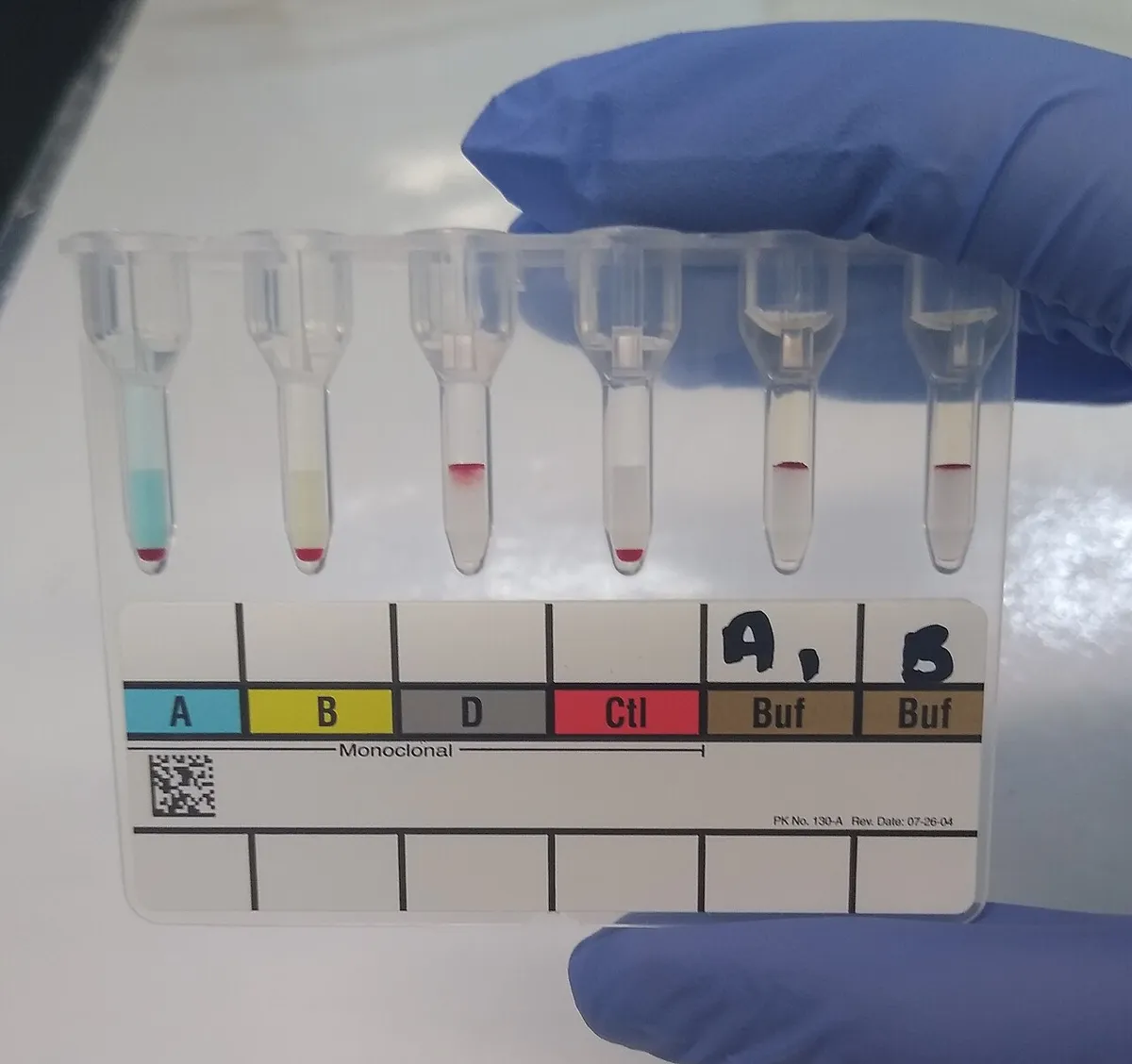
Blood groups are inherited antigens on the red cell membrane – carbohydrates such as ABO and proteins such as RhD, Kell, Duffy and Kidd. By June 2024 the ISBT recognised 47 blood group systems. People lacking A or B antigens form naturally occurring IgM anti-A or anti-B in infancy, so an ABO-incompatible red cell transfusion causes immediate intravascular haemolysis and can kill. Antibodies to other antigens (for example anti-D, anti-K, anti-Jka) are usually IgG and appear only after exposure through transfusion or pregnancy; they cause delayed haemolysis and haemolytic disease of the fetus and newborn. Pre-transfusion testing therefore has three parts: secure patient identification and sample labelling; ABO and RhD grouping with a screen for clinically significant alloantibodies by the indirect antiglobulin test; and selection of compatible units by electronic issue or serological crossmatch. Most serious incidents arise from identification errors, not laboratory failures. Group O RhD-negative red cells and group AB plasma are the emergency choices until the patient's group is known.
Patient case, mechanism, investigations, management, flashcards and exam-style questions.Open the lesson →
Key facts
- ABO antibodies are naturally occurring IgM, form from about 3–6 months of age and fix complement: ABO-incompatible red cells cause immediate intravascular haemolysis
- Red cell compatibility: group O is the universal red cell donor and AB the universal recipient; for plasma the reverse applies (AB plasma is universal)
- RhD is the most immunogenic antigen after ABO; RhD-negative girls and women of childbearing potential must receive RhD-negative (and K-negative) red cells
- Group and screen = ABO and RhD group plus an indirect antiglobulin test (IAT) screen of the patient's plasma against group O reagent cells
- Electronic issue is allowed only with a validated system, two concordant ABO/RhD groups, a negative antibody screen and no history of clinically significant antibodies
- If the patient has been transfused or pregnant within 3 months, the sample must be taken no more than 72 hours before the transfusion
- Daratumumab (anti-CD38) makes the antibody screen panreactive; labs use DTT-treated cells and give K-negative, ideally phenotype-matched units
- Wrong blood in tube and bedside identification errors cause most ABO-incompatible transfusions; two independent samples are required to confirm a first group
Differential diagnosis
| Condition | Clues | Key test |
|---|---|---|
| ABO grouping discrepancy from weak or missing antibodies | Infant under 6 months, older adult, hypogammaglobulinaemia or after HSCT | Repeat with extended incubation; review history and immunoglobulins |
| Rouleaux or cold autoagglutinins | Myeloma (rouleaux) or cold agglutinin disease; reverse group reacts unexpectedly | Saline replacement; test at 37 °C with prewarmed samples |
| Mixed-field reactions | Recent group O transfusion or ABO-mismatched HSCT | Transfusion and transplant history; repeat after 3 months |
| Weak D or partial D | Weak or discrepant RhD typing, often in pregnancy | RHD genotyping |
| Alloantibody after transfusion or pregnancy | Positive antibody screen with a pattern on the panel | Antibody identification panel; antigen-negative units |
| Warm autoantibody (AIHA) | Panreactive screen with positive DAT and haemolysis | DAT, eluate, adsorption studies |
| Daratumumab interference | Panreactive IAT, DAT often negative, patient on anti-CD38 therapy | DTT-treated reagent cells; baseline phenotype or genotype |
| Wrong blood in tube | Group differs from historical record | Repeat sample from the patient; incident report |
Exam pearls
Guideline
BSH Guidelines for pre-transfusion compatibility procedures in blood transfusion laboratories (2012, with addendum), BSH Administration of blood components (2018), NICE NG24 Blood transfusion (2015), BSH Investigation and management of red cell antibodies in pregnancy (2025) and Annual SHOT Report 2025 (published 2026)
References
- Milkins C, Berryman J, Cantwell C, et al.. Guidelines for pre-transfusion compatibility procedures in blood transfusion laboratories. Transfus Med 2013.
- Robinson S, Harris A, Atkinson S, et al.. The administration of blood components: a British Society for Haematology Guideline. Transfus Med 2018.
- National Institute for Health and Care Excellence. Blood transfusion (NG24). NICE 2015.
- Regan F, Veale K, Robinson F, et al.. Guideline for the investigation and management of red cell antibodies in pregnancy: A British Society for Haematology guideline. Transfus Med 2025.
- Serious Hazards of Transfusion (SHOT). Annual SHOT Report 2025. SHOT, Manchester 2026.
- Hyland CA, et al.. International Society of Blood Transfusion Working Party on Red Cell Immunogenetics and Blood Group Terminology Report of Gothenburg, Barcelona and four virtual business meetings: update on blood group systems. Vox Sang 2026.
Related topics
By Dr Khalid Seidi (B.Sc., M.D.) · MedEd World Clinical Knowledge library. Original teaching content checked against current guidelines (November 2026); confirm the latest local guidance before clinical use. Not a substitute for clinical judgement.