Clinical Knowledge › Internal medicine › Haematology and oncology › Transfusion and cellular therapy
TRALI and TACO
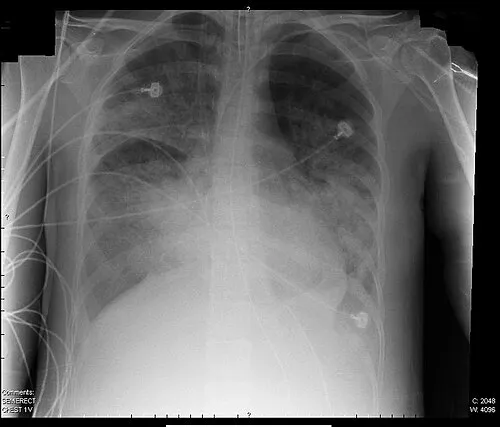
Transfusion-related acute lung injury (TRALI) and transfusion-associated circulatory overload (TACO) are the two main causes of acute pulmonary oedema after transfusion and leading causes of transfusion-related death. TACO is hydrostatic pulmonary oedema: volume given faster or in greater amounts than the heart and kidneys can handle, typically in older, small or hypoalbuminaemic patients with heart or kidney disease. It presents within 12 hours with breathlessness, hypertension, raised jugular venous pressure, a positive fluid balance and a raised natriuretic peptide, and responds to stopping the transfusion and giving diuretics. TRALI is permeability oedema within 6 hours, caused mainly by donor anti-HLA or anti-HNA antibodies (or bioactive lipids) activating primed neutrophils in the recipient's lung capillaries. It brings hypoxaemia, bilateral infiltrates, fever and often hypotension with normal filling pressures, and is treated supportively, as for ARDS. Prevention relies on TACO risk assessment, single-unit and weight-based dosing, and male-donor plasma with HLA-antibody screening of donors.
Patient case, mechanism, investigations, management, flashcards and exam-style questions.Open the lesson →
Key facts
- TACO = hydrostatic (cardiogenic) pulmonary oedema; TRALI = non-cardiogenic permeability oedema
- ISBT TACO definition: onset within 12 hours, respiratory compromise and/or pulmonary oedema plus a total of 3 or more criteria (cardiovascular changes, fluid overload, raised natriuretic peptide)
- 2019 TRALI definition: onset within 6 hours, hypoxaemia (PaO₂/FiO₂ 300 mmHg or less or SpO₂ below 90% on air) and bilateral infiltrates without dominant left atrial hypertension; type I (no ARDS risk factor) or type II (risk factor or mild ARDS)
- TACO: hypertension, raised JVP, positive fluid balance, raised NT-proBNP, response to diuretics
- TRALI: fever, hypotension, transient leucopenia, normal JVP; diuretics can worsen it
- Plasma-rich components (FFP, platelets) from multiparous women carry most TRALI risk; male-donor plasma cut cases sharply
- Risk factors for TACO: age over 70, heart failure, kidney impairment, hypoalbuminaemia, positive fluid balance, low body weight
- Both must be reported to haemovigilance; in TRALI the blood service tests implicated donors for HLA and HNA antibodies
Differential diagnosis
| Condition | Clues | Key test |
|---|---|---|
| Transfusion-associated circulatory overload | Hypertension, raised JVP, positive fluid balance, cardiac or kidney disease | NT-proBNP rise; response to diuretics |
| Transfusion-related acute lung injury | Hypoxaemia within 6 hours, fever, hypotension, normal JVP | Chest X-ray bilateral infiltrates; donor HLA/HNA antibodies |
| Anaphylaxis | Stridor, wheeze, urticaria, angioedema, hypotension within minutes | Mast cell tryptase |
| Acute haemolytic reaction | Fever, loin pain, haemoglobinuria, shock | Identity check; DAT; haemolysis screen |
| Bacterial contamination (sepsis) | High fever, rigors, hypotension, often platelets | Blood cultures from patient and pack |
| Transfusion-associated dyspnoea | Respiratory distress within 24 hours not meeting TACO, TRALI or allergy criteria | Diagnosis of exclusion |
| Pre-existing ARDS or cardiac event | Sepsis, aspiration, myocardial infarction, arrhythmia coinciding with transfusion | Troponin, ECG, echocardiography; timeline |
Exam pearls
Guideline
ISBT/IHN revised TACO surveillance definition (2018, published 2019), international consensus redefinition of TRALI (2019), BSH guideline on investigation and management of acute transfusion reactions (2023), NICE NG24 Blood transfusion (2015) and Annual SHOT Report 2025 (2026)
References
- Vlaar APJ, Toy P, Fung M, et al.. A consensus redefinition of transfusion-related acute lung injury. Transfusion 2019.
- Wiersum-Osselton JC, Whitaker B, Grey S, et al.. Revised international surveillance case definition of transfusion-associated circulatory overload: a classification agreement validation study. Lancet Haematol 2019.
- Soutar R, McSporran W, Tomlinson T, Booth C, Grey S. Guideline on the investigation and management of acute transfusion reactions. Br J Haematol 2023.
- Serious Hazards of Transfusion (SHOT). Annual SHOT Report 2025. SHOT, Manchester 2026.
- Semple JW, Rebetz J, Kapur R. Transfusion-associated circulatory overload and transfusion-related acute lung injury. Blood 2019.
- National Institute for Health and Care Excellence. Blood transfusion (NG24). NICE 2015.
Related topics
By Dr Khalid Seidi (B.Sc., M.D.) · MedEd World Clinical Knowledge library. Original teaching content checked against current guidelines (November 2026); confirm the latest local guidance before clinical use. Not a substitute for clinical judgement.