Clinical Knowledge › Internal medicine › Haematology and oncology › Transfusion and cellular therapy
Blood products and indications for transfusion
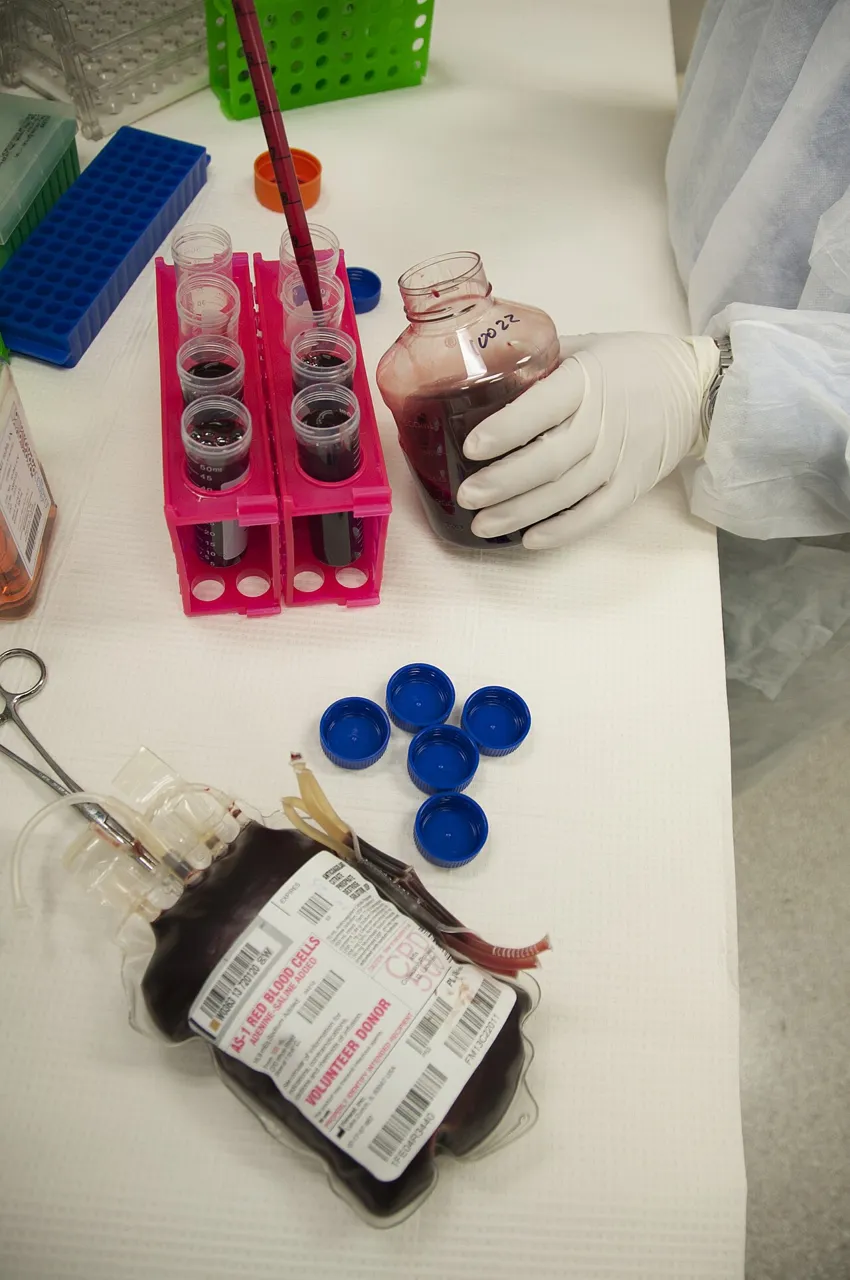
Blood components – red cells, platelets, fresh frozen plasma (FFP) and cryoprecipitate – are prepared from donated whole blood or apheresis, leucodepleted and stored in different ways. Transfusion is a common, life-saving but finite resource with real risks, most of which come from human error at the bedside, circulatory overload and immune reactions rather than infection. Good practice follows patient blood management: correct anaemia (especially iron deficiency) before surgery, minimise blood loss, and use evidence-based thresholds. For stable adults a restrictive red cell threshold of 70 g/L (7 g/dL) is standard, with higher thresholds (about 75–80 g/L) after cardiac surgery or with cardiovascular disease, and single-unit transfusion followed by reassessment. Prophylactic platelets are given below 10 ×10⁹/L in reversible marrow failure, with procedure-specific thresholds; FFP is for bleeding with coagulopathy, not for correcting an INR; cryoprecipitate replaces fibrinogen. Special requirements protect vulnerable groups.
Patient case, mechanism, investigations, management, flashcards and exam-style questions.Open the lesson →
Key facts
- Red cells: stored at 2–6 °C for up to about 35 days; one adult unit raises Hb by about 10 g/L (1 g/dL); must finish within 4 hours of leaving controlled storage
- Restrictive red cell threshold for most stable inpatients: Hb 70 g/L; about 80 g/L with acute coronary syndrome or cardiovascular disease; transfuse single units and recheck
- Platelets: stored at 20–24 °C with agitation for up to 7 days (higher bacterial risk); prophylactic threshold below 10 ×10⁹/L in reversible marrow failure
- Avoid routine platelet transfusion in ITP, TTP and HIT (except life-threatening bleeding)
- FFP 15–20 mL/kg for bleeding with clotting factor deficiency; not for reversal of warfarin (use prothrombin complex concentrate and vitamin K) or a raised INR without bleeding
- Cryoprecipitate replaces fibrinogen (also factor VIII, VWF, factor XIII); give when fibrinogen is below 1.5 g/L with bleeding (2 g/L in obstetric haemorrhage)
- Universal donors: group O RhD-negative red cells (O-positive acceptable for men in emergencies); group AB plasma (or group A with low anti-B titres)
- Irradiated components prevent transfusion-associated graft-versus-host disease in Hodgkin lymphoma, purine-analogue therapy, stem cell transplant, congenital T-cell immunodeficiency and directed donations from relatives
Differential diagnosis
| Condition | Clues | Key test |
|---|---|---|
| Iron deficiency anaemia in a stable patient | Microcytic anaemia, low ferritin, no instability | Ferritin and transferrin saturation; treat with iron rather than transfusion |
| B12 or folate deficiency | Macrocytic anaemia, neurological signs (B12) | B12 and folate levels; replace vitamins; avoid transfusion overload |
| Immune thrombocytopenia | Isolated thrombocytopenia, large platelets, little bleeding | Film; platelets reserved for severe bleeding |
| Thrombotic thrombocytopenic purpura | Thrombocytopenia, schistocytes, neurological signs | ADAMTS13; platelets relatively contraindicated |
| Warfarin-associated bleeding | Raised INR on warfarin | Prothrombin complex concentrate plus IV vitamin K rather than FFP |
| Dilutional or consumptive coagulopathy (DIC) | Bleeding with low fibrinogen and platelets, raised D-dimer | PT, APTT, fibrinogen, platelets, viscoelastic testing |
Exam pearls
Guideline
NICE NG24 Blood transfusion (2015), AABB International Guidelines for red blood cell transfusion (2023), BSH platelet transfusion guideline (2017), BSH guidelines on FFP and cryoprecipitate (2018 and 2023), BSH irradiated blood components (2020) and BSH administration of blood components (2018)
References
- National Institute for Health and Care Excellence (NICE). Blood transfusion (NG24). NICE guideline 2015.
- Carson JL, Stanworth SJ, Guyatt G, et al.. Red blood cell transfusion: 2023 AABB international guidelines. JAMA 2023.
- Estcourt LJ, Birchall J, Allard S, et al.. Guidelines for the use of platelet transfusions. Br J Haematol 2017.
- Green L, Bolton-Maggs P, Beattie C, et al.. British Society of Haematology Guidelines on the spectrum of fresh frozen plasma and cryoprecipitate products: their handling and use in various patient groups in the absence of major bleeding. Br J Haematol 2018.
- Foukaneli T, Kerr P, Bolton-Maggs PHB, et al.. Guidelines on the use of irradiated blood components. Br J Haematol 2020.
- Robinson S, Harris A, Atkinson S, et al.. The administration of blood components: a British Society for Haematology Guideline. Transfus Med 2018.
Related topics
By Dr Khalid Seidi (B.Sc., M.D.) · MedEd World Clinical Knowledge library. Original teaching content checked against current guidelines (November 2026); confirm the latest local guidance before clinical use. Not a substitute for clinical judgement.