Clinical Knowledge › Paediatrics › Paediatric haematology and oncology
Bone tumours in children (osteosarcoma and Ewing sarcoma)
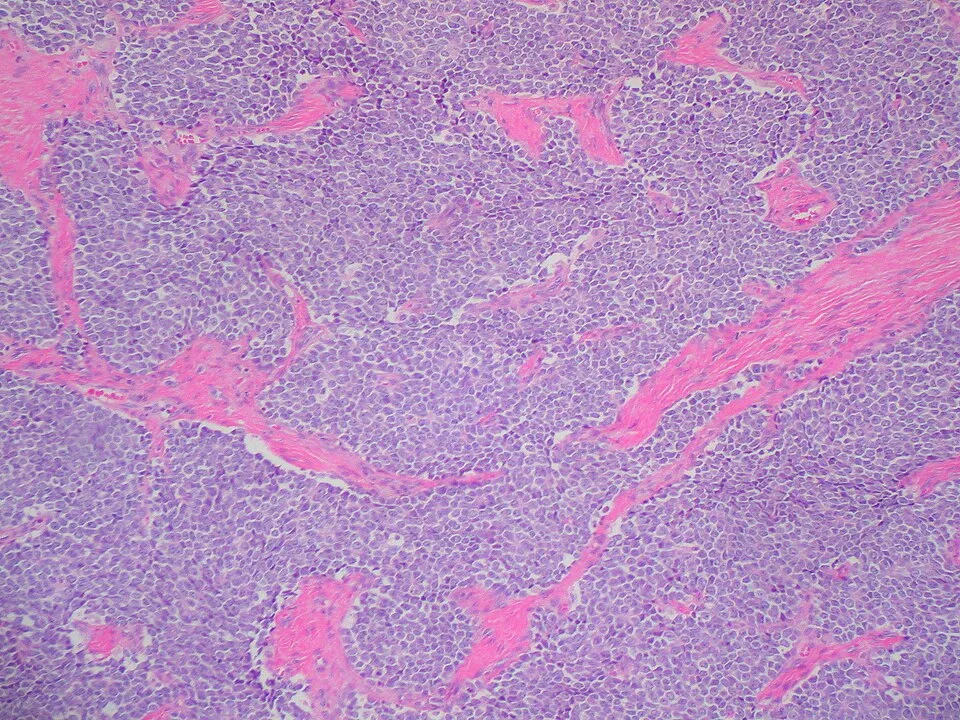
Primary malignant bone tumours make up about 5% of childhood cancers and peak in adolescence, when bone growth is fastest. Osteosarcoma, the commonest, arises from osteoid-producing mesenchymal cells in the metaphysis of long bones, especially around the knee, and is linked to hereditary retinoblastoma, Li–Fraumeni syndrome and previous radiotherapy. Ewing sarcoma, the second commonest, is a small round blue cell tumour driven by an EWSR1–ETS fusion, usually t(11;22) EWSR1–FLI1, and affects the diaphysis of long bones and flat bones such as the pelvis and ribs; it may cause fever and raised inflammatory markers that mimic osteomyelitis. Both present with persistent, often nocturnal bone pain and swelling that teenagers and clinicians attribute to sport or growing pains, so diagnosis is often delayed. An urgent X-ray is the key first test; suspicious lesions are referred to a bone sarcoma centre for MRI, staging and biopsy by the treating team. Treatment combines neoadjuvant chemotherapy, limb-sparing surgery and adjuvant chemotherapy, with radiotherapy for Ewing sarcoma. About two-thirds of children with localised disease are cured; metastatic disease does much worse.
Patient case, mechanism, investigations, management, flashcards and exam-style questions.Open the lesson →
Key facts
- Bone sarcomas peak in adolescence (osteosarcoma 13–16 years, Ewing sarcoma 10–20 years); about 5% of childhood cancers
- Osteosarcoma: metaphysis of long bones, about half around the knee (distal femur, proximal tibia), then proximal humerus
- Ewing sarcoma: diaphysis of long bones and flat bones (pelvis, ribs, scapula, spine); fever and raised ESR can mimic osteomyelitis
- X-ray: osteosarcoma shows mixed lytic–sclerotic lesion with sunburst periosteal reaction and Codman triangle; Ewing shows permeative lysis with onion-skin periosteal reaction and a soft-tissue mass
- Ewing sarcoma genetics: EWSR1–FLI1 fusion from t(11;22)(q24;q12) in about 85%; CD99 strongly positive
- Osteosarcoma predisposition: hereditary retinoblastoma (RB1), Li–Fraumeni (TP53), Rothmund–Thomson syndrome, prior radiotherapy
- Lungs are the commonest metastatic site for both; stage with chest CT and whole-body imaging; biopsy only at a sarcoma centre
- Treatment: osteosarcoma MAP chemotherapy (methotrexate, doxorubicin, cisplatin) plus surgery; Ewing VDC/IE chemotherapy plus surgery and/or radiotherapy
Differential diagnosis
| Condition | Clues | Key test |
|---|---|---|
| Acute or subacute osteomyelitis | Fever, localised tenderness, younger child, raised CRP; Brodie abscess metaphyseal | MRI with contrast; blood cultures; biopsy and culture if doubt |
| Growing pains | Bilateral, evening or night leg pain in 3–12-year-olds, normal examination, no limp, relieved by rubbing | Clinical; X-ray and bloods only if atypical features |
| Osgood–Schlatter disease | Active adolescent, tender tibial tuberosity, pain with activity | Clinical; X-ray if unilateral, night pain or swelling |
| Osteoid osteoma | Night pain relieved by NSAIDs in adolescent, small lucent nidus with sclerosis | CT shows nidus; radiofrequency ablation |
| Acute leukaemia | Bone pain, pallor, bruising, hepatosplenomegaly, cytopenias | Blood film and marrow |
| Langerhans cell histiocytosis | Punched-out lytic lesions, especially skull, in young children | Biopsy: CD1a and langerin-positive cells |
| Metastatic neuroblastoma | Child under 5 with bone pain and abdominal mass | Urinary catecholamines; MIBG |
| Benign cysts (unicameral or aneurysmal) | Pathological fracture; proximal humerus or femur; fluid levels in ABC | X-ray (fallen fragment sign) and MRI |
Exam pearls
Guideline
UK guidelines for the management of bone sarcomas (British Sarcoma Group 2024 consensus, published 2025), ESMO-EURACAN-GENTURIS-ERN PaedCan bone sarcoma Clinical Practice Guideline (2021), and NICE NG12 suspected cancer (2015, updated)
References
- Gerrand C, Amary F, Anwar HA, et al.. UK guidelines for the management of bone sarcomas. Br J Cancer 2025.
- Strauss SJ, Frezza AM, Abecassis N, et al.. Bone sarcomas: ESMO-EURACAN-GENTURIS-ERN PaedCan Clinical Practice Guideline for diagnosis, treatment and follow-up. Ann Oncol 2021.
- Marina NM, Smeland S, Bielack SS, et al.. Comparison of MAPIE versus MAP in patients with a poor response to preoperative chemotherapy for newly diagnosed high-grade osteosarcoma (EURAMOS-1): an open-label, international, randomised controlled trial. Lancet Oncol 2016.
- Brennan B, Kirton L, Marec-Bérard P, et al.. Comparison of two chemotherapy regimens in patients with newly diagnosed Ewing sarcoma (EE2012): an open-label, randomised, phase 3 trial. Lancet 2022.
- National Institute for Health and Care Excellence. Suspected cancer: recognition and referral (NG12). NICE guideline 2015.
- Womer RB, West DC, Krailo MD, et al.. Randomized controlled trial of interval-compressed chemotherapy for the treatment of localized Ewing sarcoma: a report from the Children's Oncology Group. J Clin Oncol 2012.
Related topics
By Dr Khalid Seidi (B.Sc., M.D.) · MedEd World Clinical Knowledge library. Original teaching content checked against current guidelines (November 2026); confirm the latest local guidance before clinical use. Not a substitute for clinical judgement.