Clinical Knowledge › Paediatrics › Paediatric haematology and oncology
Lymphoma in children
Lymphomas are the third most common childhood cancer and the most common in adolescents aged 15–19. Hodgkin lymphoma mainly affects adolescents and presents with painless, rubbery cervical or supraclavicular nodes, often with a mediastinal mass and B symptoms. Childhood non-Hodgkin lymphoma differs from adult disease: almost all cases are aggressive, fast-growing and extranodal, mainly Burkitt lymphoma (abdominal mass, jaw in endemic Africa), diffuse large B-cell and primary mediastinal B-cell lymphoma, lymphoblastic lymphoma (anterior mediastinal mass) and anaplastic large cell lymphoma. Emergencies include airway or superior vena cava compression from a mediastinal mass, which makes sedation dangerous, and tumour lysis syndrome. Diagnosis needs a chest X-ray, excision biopsy with immunohistochemistry, PET-CT staging and bone marrow and CSF assessment for NHL. With response-adapted chemotherapy, survival exceeds 95% for Hodgkin and is about 85–90% for NHL, so late effects of treatment now dominate survivorship care.
Patient case, mechanism, investigations, management, flashcards and exam-style questions.Open the lesson →
Key facts
- Lymphoma is about 10–15% of childhood cancers; Hodgkin lymphoma peaks in adolescence, NHL occurs throughout childhood with male predominance
- Hodgkin: painless rubbery cervical or supraclavicular nodes, mediastinal mass, B symptoms (fever over 38 °C, drenching night sweats, weight loss over 10% in 6 months)
- Paediatric NHL is high grade: Burkitt (about 40%), lymphoblastic (about 20–30%), DLBCL/PMBCL (10–20%), anaplastic large cell (about 10–15%)
- Burkitt lymphoma has one of the fastest doubling times of any tumour (about 24–48 hours): high risk of tumour lysis syndrome
- Anterior mediastinal mass: chest X-ray before any sedation; general anaesthesia can cause fatal airway or cardiovascular collapse
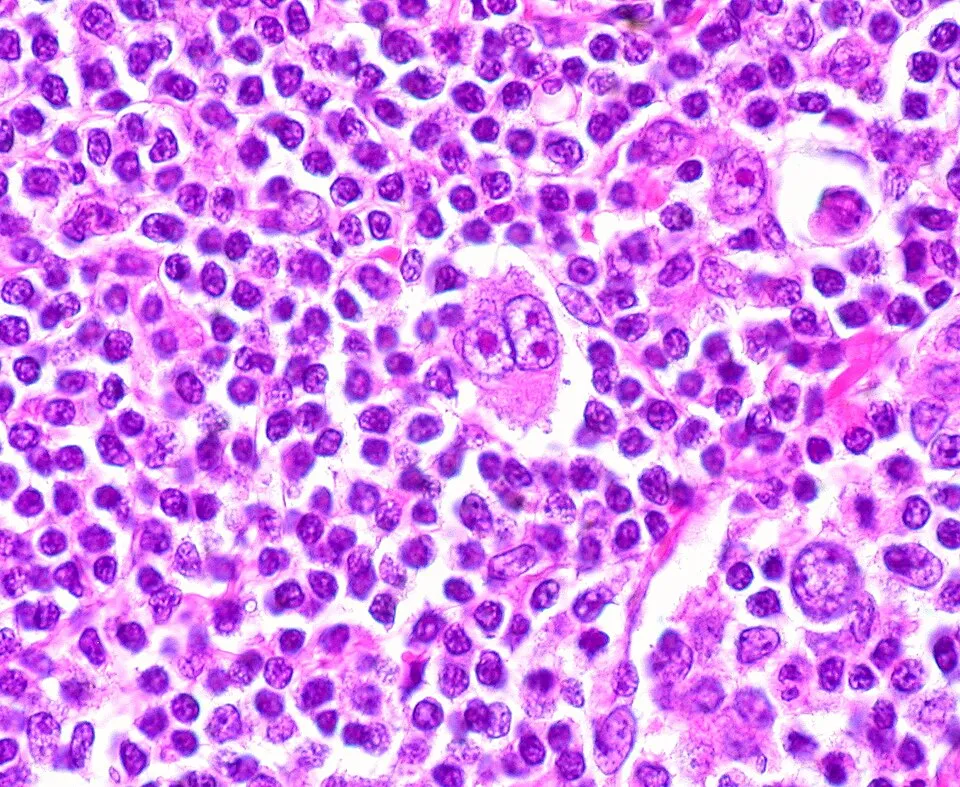
- Diagnosis by excision biopsy (not fine-needle aspiration); HL shows Hodgkin Reed–Sternberg cells (CD15+, CD30+)
- Risk factors: EBV, inherited or acquired immunodeficiency (HIV, post-transplant, ataxia telangiectasia, Wiskott–Aldrich)
- Survival above 95% for HL and about 85–90% for NHL; lifelong follow-up for cardiac, endocrine, fertility and second-cancer risks
Differential diagnosis
| Condition | Clues | Key test |
|---|---|---|
| Reactive lymphadenopathy | Small (under 2 cm), mobile, tender nodes with recent infection; resolve in 2–6 weeks | Clinical review; FBC if persistent |
| Infectious mononucleosis | Fever, exudative tonsillitis, posterior cervical nodes, splenomegaly, atypical lymphocytes | Monospot or EBV serology |
| Tuberculous lymphadenitis | Matted nodes, fluctuance, sinus, TB contact, weight loss | Biopsy with culture/PCR; IGRA |
| Atypical mycobacterial or cat-scratch adenitis | Unilateral node in a young child, violaceous skin; cat contact | Excision; Bartonella serology |
| Acute lymphoblastic leukaemia | Pallor, bruising, bone pain, cytopenias, blasts | Blood film; bone marrow (over 25% blasts = leukaemia) |
| Thymic or germ cell mediastinal tumour | Anterior mediastinal mass | AFP, beta-hCG; biopsy |
| Intussusception / other abdominal masses | Abdominal mass in a child over 3 with intussusception should raise Burkitt | Ultrasound; surgical histology |
| Kikuchi disease, Rosai–Dorfman, Castleman | Rare benign causes of lymphadenopathy | Excision biopsy |
Exam pearls
Guideline
Paediatric lymphoma practice based on EuroNet-PHL and COG trials, Inter-B-NHL ritux 2010, the revised International Pediatric NHL Staging System (2015), NICE NG12 suspected cancer referral and COG long-term follow-up guidelines (version 6, 2023)
References
- Mauz-Körholz C, Landman-Parker J, Balwierz W, et al.. Response-adapted omission of radiotherapy and comparison of consolidation chemotherapy in children and adolescents with intermediate-stage and advanced-stage classical Hodgkin lymphoma (EuroNet-PHL-C1). Lancet Oncol 2022.
- Castellino SM, Pei Q, Parsons SK, et al.. Brentuximab vedotin with chemotherapy in pediatric high-risk Hodgkin's lymphoma. N Engl J Med 2022.
- Herrera AF, LeBlanc M, Castellino SM, et al.. Nivolumab+AVD in advanced-stage classic Hodgkin's lymphoma. N Engl J Med 2024.
- Minard-Colin V, Aupérin A, Pillon M, et al.. Rituximab for high-risk, mature B-cell non-Hodgkin's lymphoma in children. N Engl J Med 2020.
- Rosolen A, Perkins SL, Pinkerton CR, et al.. Revised International Pediatric Non-Hodgkin Lymphoma Staging System. J Clin Oncol 2015.
- Steliarova-Foucher E, Colombet M, Ries LAG, et al.. International incidence of childhood cancer, 2001-10: a population-based registry study. Lancet Oncol 2017.
Related topics
By Dr Khalid Seidi (B.Sc., M.D.) · MedEd World Clinical Knowledge library. Original teaching content checked against current guidelines (November 2026); confirm the latest local guidance before clinical use. Not a substitute for clinical judgement.