Clinical Knowledge › Paediatrics › Paediatric haematology and oncology
Brain tumours in children
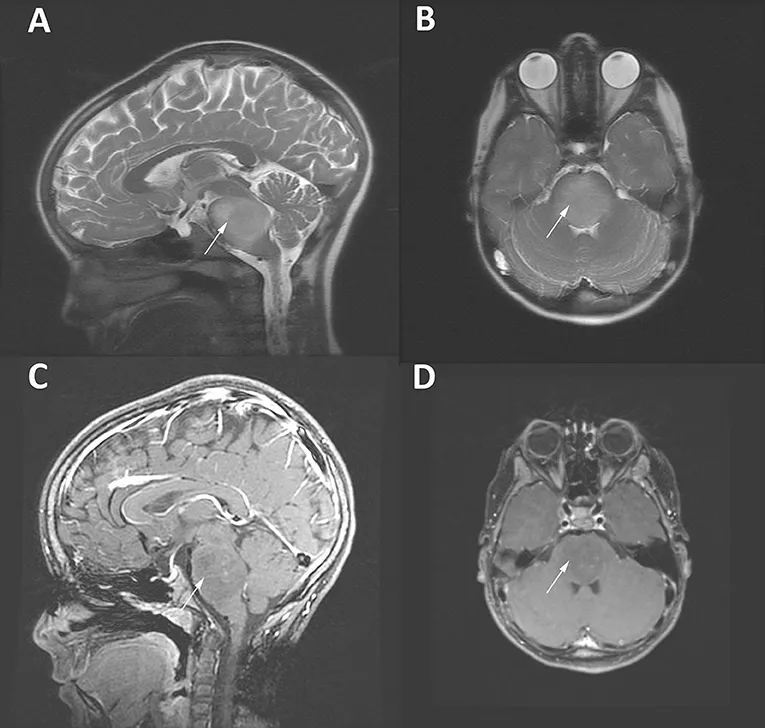
Brain and other central nervous system tumours are the commonest solid tumours of childhood, second only to leukaemia in frequency, and the leading cause of cancer death in children. Unlike adults, in whom metastases and high-grade gliomas dominate, about half of childhood tumours arise in the posterior fossa: pilocytic astrocytoma, medulloblastoma, ependymoma and diffuse midline glioma of the pons. Symptoms are often non-specific and diagnosis is frequently delayed: persistent or morning headache with vomiting, ataxia, squint, visual loss, head tilt, growth failure, early or delayed puberty, diabetes insipidus, seizures and behaviour change; infants show increasing head circumference and developmental regression. The HeadSmart guideline and NICE NG12 urge rapid MRI. Diagnosis integrates histology and molecular markers (WHO CNS5, 2021). Treatment combines surgery, focal or craniospinal radiotherapy and chemotherapy, with molecular targeted drugs increasingly used. About three-quarters survive, but many face neurocognitive, endocrine and psychosocial late effects.
Patient case, mechanism, investigations, management, flashcards and exam-style questions.Open the lesson →
Key facts
- CNS tumours are about a quarter of childhood cancers and the most common solid tumour in children
- About half are infratentorial in children aged 1–10 years; supratentorial tumours predominate in infants and adolescents
- Commonest: low-grade glioma (pilocytic astrocytoma); commonest malignant: medulloblastoma
- Red flags: headache waking the child or on waking with vomiting, persistent vomiting, ataxia, abnormal eye movements or squint, papilloedema, visual loss, head tilt, growth or pubertal disturbance, polyuria, rising head circumference
- HeadSmart awareness and guideline roughly halved the time to diagnosis in the UK (from about 14 weeks to under 7 weeks)
- MRI brain (with whole spine for embryonal tumours, ependymoma and germ cell tumours) is the imaging of choice; avoid lumbar puncture with raised intracranial pressure
- WHO CNS5 (2021) uses integrated histological and molecular diagnosis: medulloblastoma groups WNT, SHH, group 3, group 4; diffuse midline glioma H3 K27-altered
- Craniospinal radiotherapy is avoided or deferred under about 3 years because of severe neurocognitive damage
Differential diagnosis
| Condition | Clues | Key test |
|---|---|---|
| Migraine | Episodic headache with full recovery, family history, normal examination | Clinical; imaging only with red flags |
| Idiopathic intracranial hypertension | Obese adolescent girl, papilloedema, normal MRI | MRI/MRV then LP opening pressure |
| Brain abscess | Fever, congenital heart disease, sinusitis or otitis, ring-enhancing lesion | MRI with diffusion; blood cultures |
| Hydrocephalus from aqueduct stenosis | Raised head circumference without mass | MRI |
| Gastro-oesophageal reflux or gastroenteritis | Vomiting without neurology; resolves | Clinical; reassess if persistent or morning vomiting |
| Cerebellar ataxia after varicella | Acute ataxia after viral illness, improving | MRI normal |
| Functional visual loss or amblyopia | Isolated visual symptoms without other signs | Ophthalmology, visual fields, MRI if doubt |
| Non-accidental head injury (infants) | Rising head circumference, subdural collections, retinal haemorrhages | CT/MRI, skeletal survey, ophthalmology |
Exam pearls
Guideline
WHO Classification of CNS Tumours, 5th edition (2021), RCPCH HeadSmart diagnostic guideline and NICE NG12 suspected cancer recognition and referral, with SIOP Europe and COG protocol-based treatment
References
- Louis DN, Perry A, Wesseling P, et al.. The 2021 WHO Classification of Tumors of the Central Nervous System: a summary. Neuro Oncol 2021.
- HeadSmart Be Brain Tumour Aware. A new clinical guideline from the Royal College of Paediatrics and Child Health with a national awareness campaign accelerates brain tumor diagnosis in UK children - 'HeadSmart: Be Brain Tumour Aware'. Neuro Oncol 2016.
- National Institute for Health and Care Excellence. Suspected cancer: recognition and referral (NG12). NICE guideline 2015.
- Ramaswamy V, Remke M, Bouffet E, et al.. Risk stratification of childhood medulloblastoma in the molecular era: the current consensus. Acta Neuropathol 2016.
- Bouffet E, Hansford JR, Garrè ML, et al.. Dabrafenib plus trametinib in pediatric glioma with BRAF V600 mutations. N Engl J Med 2023.
- Kilburn LB, Khuong-Quang DA, Hansford JR, et al.. The type II RAF inhibitor tovorafenib in relapsed/refractory pediatric low-grade glioma: the phase 2 FIREFLY-1 trial. Nat Med 2024.
Related topics
By Dr Khalid Seidi (B.Sc., M.D.) · MedEd World Clinical Knowledge library. Original teaching content checked against current guidelines (November 2026); confirm the latest local guidance before clinical use. Not a substitute for clinical judgement.