Clinical Knowledge › Paediatrics › Paediatric haematology and oncology
Sickle cell disease in children
Sickle cell disease (SCD) is an autosomal recessive haemoglobinopathy in which HbS polymerises when deoxygenated, causing haemolysis, vaso-occlusion and progressive organ damage. Most of the 300,000 or more affected babies born each year are in sub-Saharan Africa, where without care many die before age 5. Newborn screening allows care to start before symptoms, which appear from 3–6 months as fetal haemoglobin falls: dactylitis is often the first sign, followed by acute splenic sequestration, overwhelming pneumococcal sepsis from functional asplenia, painful crises, acute chest syndrome, stroke and aplastic crises. Childhood care rests on penicillin prophylaxis and immunisation, fever treated as an emergency, parent teaching to palpate the spleen, annual transcranial Doppler screening from age 2, and hydroxycarbamide offered from 9 months to all children with HbSS or HbSβ0. Chronic transfusion prevents stroke in high-risk children. Haematopoietic stem cell transplant and gene therapy can cure selected patients.
Patient case, mechanism, investigations, management, flashcards and exam-style questions.Open the lesson →
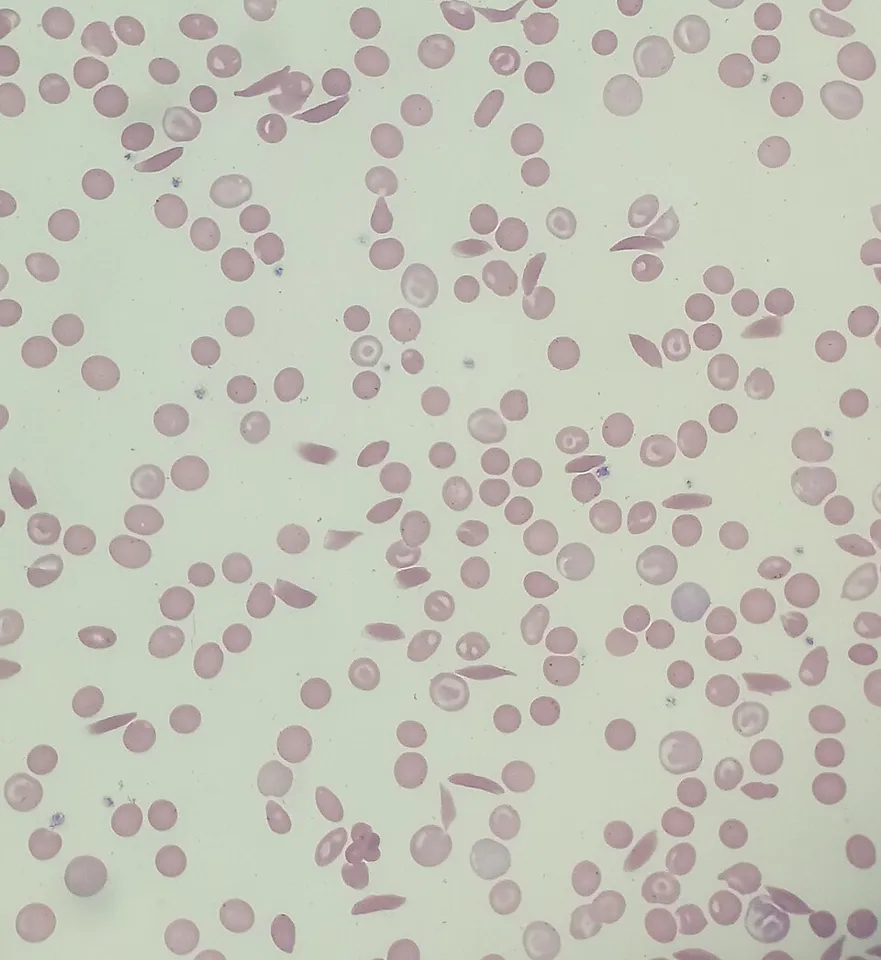
Key facts
- Autosomal recessive; point mutation in HBB (glutamic acid to valine at position 6); two carrier parents have a 1 in 4 risk per pregnancy
- Symptoms begin from 3–6 months as HbF falls; dactylitis is often the first presentation
- Functional asplenia by about age 1: fever of 38.5 °C or more needs blood culture and parenteral antibiotics (for example ceftriaxone) within 1 hour
- Penicillin V prophylaxis from about 2–3 months to at least 5 years (lifelong in many UK centres) plus full pneumococcal immunisation
- Acute splenic sequestration: sudden pallor, enlarging spleen, Hb fall of 20 g/L or more, high reticulocytes; treat with cautious transfusion
- Transcranial Doppler annually from 2 to 16 years: time-averaged mean maximum velocity 200 cm/s or more = high stroke risk, start regular transfusion (STOP trial)
- Hydroxycarbamide offered from 9 months for HbSS and HbSβ0 regardless of severity; reduces pain, dactylitis, acute chest syndrome and transfusion
- Painful crisis: analgesia within 30 minutes of arrival; acute chest syndrome = new infiltrate plus fever or respiratory symptoms
Differential diagnosis
| Condition | Clues | Key test |
|---|---|---|
| Osteomyelitis or septic arthritis | Fever, single bone or joint, persistent pain; Salmonella risk in SCD | MRI, blood culture, aspiration |
| Beta-thalassaemia major | Severe anaemia from 6 months, hepatosplenomegaly, no HbS | HPLC: absent or reduced HbA, raised HbF |
| Juvenile idiopathic arthritis | Persistent joint swelling without anaemia or HbS | Clinical; HPLC normal |
| Leukaemia | Bone pain, pallor, bruising, lymphadenopathy | Blood film; bone marrow |
| Community-acquired pneumonia | Fever and cough; acute chest syndrome may look identical | Chest X-ray; treat as acute chest syndrome in SCD |
| Appendicitis or cholecystitis | Abdominal pain in a crisis; gallstones common in SCD | Ultrasound; surgical review |
| Hereditary spherocytosis | Haemolysis, splenomegaly, positive family history | Film spherocytes; EMA binding test |
Exam pearls
Guideline
NHLBI expert panel report (2014), ASH 2020 cerebrovascular guideline, NHS Sickle Cell and Thalassaemia Screening Programme childhood standards (3rd edition, 2019) and NICE CG143 acute painful episodes (2012)
References
- Yawn BP, Buchanan GR, Afenyi-Annan AN, et al.. Management of sickle cell disease: summary of the 2014 evidence-based report by expert panel members. JAMA 2014.
- DeBaun MR, Jordan LC, King AA, et al.. American Society of Hematology 2020 guidelines for sickle cell disease: prevention, diagnosis, and treatment of cerebrovascular disease in children and adults. Blood Adv 2020.
- NHS Sickle Cell and Thalassaemia Screening Programme. Sickle cell disease in childhood: standards and guidelines for clinical care. Public Health England 2019.
- National Institute for Health and Care Excellence. Sickle cell disease: managing acute painful episodes in hospital (CG143). NICE clinical guideline 2012.
- Adams RJ, McKie VC, Hsu L, et al.. Prevention of a first stroke by transfusions in children with sickle cell anemia and abnormal results on transcranial Doppler ultrasonography. N Engl J Med 1998.
- Ware RE, Davis BR, Schultz WH, et al.. Hydroxycarbamide versus chronic transfusion for maintenance of transcranial doppler flow velocities in children with sickle cell anaemia (TWiTCH). Lancet 2016.
Related topics
By Dr Khalid Seidi (B.Sc., M.D.) · MedEd World Clinical Knowledge library. Original teaching content checked against current guidelines (November 2026); confirm the latest local guidance before clinical use. Not a substitute for clinical judgement.