Clinical Knowledge › Internal medicine › Cardiology and angiology › Diseases of the veins and lymphatics
Chronic venous insufficiency
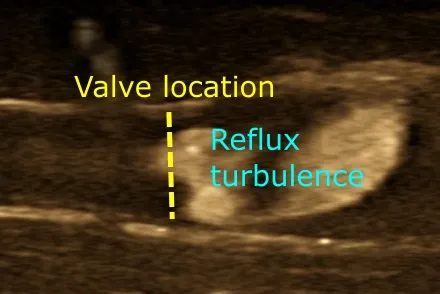
Chronic venous insufficiency (CVI) is the advanced stage of chronic venous disease of the legs, defined by oedema, skin changes or ulceration (CEAP clinical classes C3–C6). It results from sustained ambulatory venous hypertension caused by valve incompetence (reflux), venous obstruction or calf muscle pump failure. Primary valve degeneration and post-thrombotic damage after deep vein thrombosis are the main causes. Patients describe aching, heaviness and swelling that worsen through the day and improve with elevation. Signs progress from varicose veins and ankle oedema to pigmentation, eczema, lipodermatosclerosis, atrophie blanche and venous ulcers in the gaiter area. Duplex ultrasound confirms reflux or obstruction, and the ankle-brachial index must be checked before compression. Management combines compression, exercise, elevation and weight loss with skin care, and treatment of superficial reflux by endovenous ablation, which speeds ulcer healing and reduces recurrence. Deep venous obstruction may need stenting in specialist centres.
Patient case, mechanism, investigations, management, flashcards and exam-style questions.Open the lesson →
Key facts
- CVI means CEAP clinical class C3–C6: oedema, skin changes, healed or active ulcer
- The common pathway is ambulatory venous hypertension from reflux, obstruction or calf pump failure
- Primary valve incompetence (varicose veins) and post-thrombotic syndrome are the main causes
- Symptoms worsen with standing and through the day and improve with elevation
- Venous ulcers lie in the gaiter area, usually above the medial malleolus, and are shallow and exudative
- Duplex ultrasound defines reflux (over 0.5 s in superficial veins, over 1 s in femoral and popliteal veins) and obstruction
- Check the ABI before compression: avoid strong compression if ABI is below about 0.6–0.8 or arterial disease is significant
- Endovenous ablation of superficial reflux plus compression speeds healing and reduces ulcer recurrence (EVRA)
Differential diagnosis
| Condition | Clues | Key test |
|---|---|---|
| Peripheral arterial disease or mixed ulcer | Painful punched-out ulcer on the foot, absent pulses, pain worse on elevation | ABI and arterial duplex |
| Lymphoedema | Non-pitting swelling involving the foot and toes, positive Stemmer sign | Clinical; lymphoscintigraphy |
| Lipoedema | Symmetrical fat deposition sparing the feet in women, tender, no pitting | Clinical assessment |
| Heart failure, renal or hepatic oedema | Bilateral pitting oedema with breathlessness, proteinuria or liver disease | NT-proBNP, urine protein, albumin, liver tests |
| Drug-induced oedema | Ankle swelling after starting amlodipine or other calcium channel blockers | Drug review |
| Stasis dermatitis versus cellulitis | Bilateral, itchy, chronic red skin versus acute unilateral painful spreading erythema with fever | Clinical; inflammatory markers |
| Marjolin ulcer (squamous cell carcinoma) | Long-standing non-healing ulcer with rolled or heaped edges | Biopsy |
Exam pearls
Guideline
ESVS 2022 clinical practice guidelines on chronic venous disease of the lower limbs, SVS/AVF/AVLS 2022 varicose vein guidelines (published 2023) and SVS/AVF venous leg ulcer guideline (2014)
References
- De Maeseneer MG, Kakkos SK, Aherne T, et al.. European Society for Vascular Surgery (ESVS) 2022 Clinical Practice Guidelines on the Management of Chronic Venous Disease of the Lower Limbs. Eur J Vasc Endovasc Surg 2022.
- Gloviczki P, Lawrence PF, Wasan SM, et al.. The 2022 Society for Vascular Surgery, American Venous Forum, and American Vein and Lymphatic Society clinical practice guidelines for the management of varicose veins of the lower extremities. Part I. Duplex scanning and treatment of superficial truncal reflux. J Vasc Surg Venous Lymphat Disord 2023.
- O'Donnell TF Jr, Passman MA, Marston WA, et al.. Management of venous leg ulcers: clinical practice guidelines of the Society for Vascular Surgery and the American Venous Forum. J Vasc Surg 2014.
- Lurie F, Passman M, Meisner M, et al.. The 2020 update of the CEAP classification system and reporting standards. J Vasc Surg Venous Lymphat Disord 2020.
- Gohel MS, Heatley F, Liu X, et al.. A randomized trial of early endovenous ablation in venous ulceration. N Engl J Med 2018.
- Kahn SR, Shapiro S, Wells PS, et al.. Compression stockings to prevent post-thrombotic syndrome: a randomised placebo-controlled trial. Lancet 2014.
Related topics
By Dr Khalid Seidi (B.Sc., M.D.) · MedEd World Clinical Knowledge library. Original teaching content checked against current guidelines (November 2026); confirm the latest local guidance before clinical use. Not a substitute for clinical judgement.