Clinical Knowledge › Internal medicine › Cardiology and angiology › Diseases of the veins and lymphatics
Venous leg ulcers
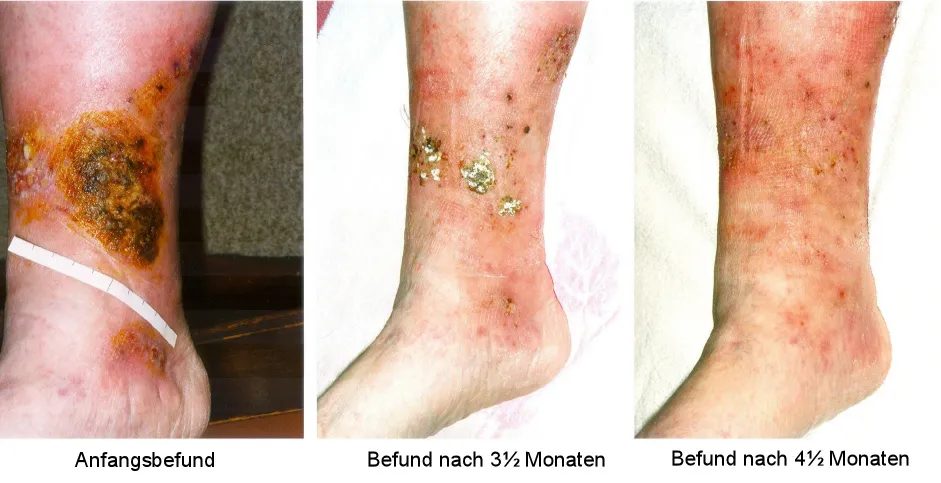
A venous leg ulcer is an open wound of the lower leg, usually in the gaiter area above the medial malleolus, caused by sustained venous hypertension and not healing within 2 weeks. It is the commonest type of leg ulcer, affecting about 1% of adults and more of the elderly, and often recurs. The underlying cause is superficial reflux, deep venous reflux or obstruction after DVT, or calf pump failure. The ulcer is shallow with irregular sloping edges and a granulating, exuding base, surrounded by oedema, haemosiderin pigmentation, venous eczema, lipodermatosclerosis and atrophie blanche; pain is usually moderate and eased by elevation. Every patient needs an ankle–brachial pressure index before compression, because mixed arterial disease changes treatment, and a venous duplex scan to find treatable reflux. Strong multilayer compression (about 40 mmHg at the ankle) is the cornerstone. Early endovenous ablation of superficial reflux speeds healing and reduces recurrence (EVRA). Antibiotics are for clinical infection only, and compression stockings continue after healing.
Patient case, mechanism, investigations, management, flashcards and exam-style questions.Open the lesson →
Key facts
- Venous ulcers make up about 70% of leg ulcers; typical site is the medial gaiter area above the malleolus
- Shallow, irregular, exuding ulcer with surrounding pigmentation, eczema, lipodermatosclerosis and oedema
- Measure the ABPI in every leg ulcer before compression; ABPI < 0.8 suggests arterial disease
- Venous duplex in all patients to identify superficial reflux and deep vein disease
- Strong multilayer compression (≈ 40 mmHg at the ankle) is the mainstay if ABPI ≥ 0.8
- Early endovenous ablation of superficial reflux with compression speeds healing (EVRA)
- Antibiotics only for clinical infection; do not treat colonisation from routine swabs
- After healing, lifelong compression stockings and treatment of reflux prevent recurrence
Differential diagnosis
| Condition | Clues | Key test |
|---|---|---|
| Arterial (ischaemic) ulcer | Punched-out, painful, on toes or pressure points, absent pulses, worse on elevation | ABPI, toe pressures, duplex |
| Mixed arterial–venous ulcer | Venous features plus reduced pulses | ABPI 0.5–0.8 |
| Neuropathic (diabetic) ulcer | Plantar or pressure sites, painless, callus, sensory loss | Monofilament, glucose, X-ray for osteomyelitis |
| Marjolin ulcer (squamous cell carcinoma) | Rolled or everted edge, overgranulation, long non-healing ulcer | Biopsy |
| Pyoderma gangrenosum | Rapidly enlarging painful ulcer with violaceous undermined edge; IBD or arthritis | Clinical; biopsy to exclude other causes |
| Vasculitic ulcer | Multiple painful punched-out ulcers, palpable purpura, systemic disease | ANCA, ANA, complement, biopsy |
| Pressure ulcer | Heel or malleolus in immobile patient | Clinical |
Exam pearls
Guideline
ESVS 2022 guidelines on chronic venous disease, SVS/AVF 2014 venous leg ulcer guideline, 2025 SCAI chronic venous disease guideline and SIGN 120 (update in consultation 2026)
References
- De Maeseneer MG, Kakkos SK, Aherne T, et al.. European Society for Vascular Surgery (ESVS) 2022 Clinical Practice Guidelines on the Management of Chronic Venous Disease of the Lower Limbs. Eur J Vasc Endovasc Surg 2022.
- O'Donnell TF Jr, Passman MA, Marston WA, et al.. Management of venous leg ulcers: clinical practice guidelines of the Society for Vascular Surgery and the American Venous Forum. J Vasc Surg 2014.
- Attaran RR, Edwards ML, Arena FJ, et al.. 2025 SCAI Clinical Practice Guidelines for the Management of Chronic Venous Disease. J Soc Cardiovasc Angiogr Interv 2025.
- Gohel MS, Heatley F, Liu X, et al.. A randomized trial of early endovenous ablation in venous ulceration. N Engl J Med 2018.
- Gohel MS, Barwell JR, Taylor M, et al.. Long term results of compression therapy alone versus compression plus surgery in chronic venous ulceration (ESCHAR): randomised controlled trial. BMJ 2007.
- O'Meara S, Cullum N, Nelson EA, Dumville JC.. Compression for venous leg ulcers. Cochrane Database Syst Rev 2012.
Related topics
By Dr Khalid Seidi (B.Sc., M.D.) · MedEd World Clinical Knowledge library. Original teaching content checked against current guidelines (November 2026); confirm the latest local guidance before clinical use. Not a substitute for clinical judgement.