Clinical Knowledge › Internal medicine › Cardiology and angiology › Diseases of the veins and lymphatics
Varicose veins
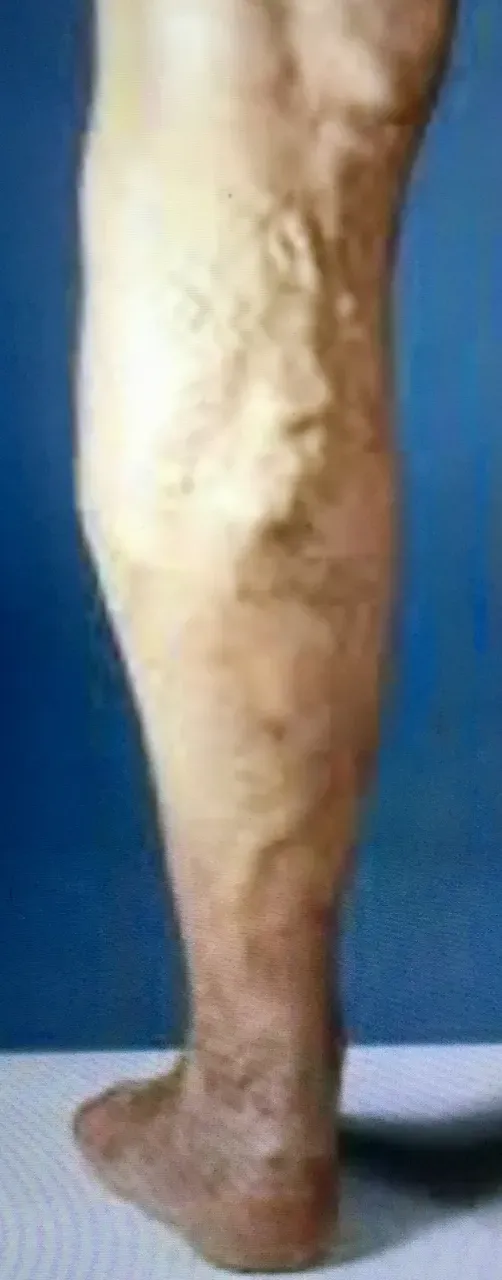
Varicose veins are dilated, tortuous subcutaneous veins of 3 mm or more in diameter measured standing (CEAP class C2). They affect about a third of adults; risk rises with age, pregnancy, family history, obesity and prolonged standing. Most are primary, caused by valve failure and vein wall weakness in the great or small saphenous veins and their tributaries; secondary varicose veins follow deep vein thrombosis. Reflux causes ambulatory venous hypertension, giving aching, heaviness, itching, swelling and night cramps that worsen through the day and ease with elevation. Progression leads to skin changes, superficial vein thrombosis, bleeding and venous ulcers. Duplex ultrasound is the standard test, defining reflux (over 0.5 seconds in superficial veins) and excluding deep vein disease; the CEAP classification grades severity. Endovenous thermal ablation (radiofrequency or laser) is first-line for symptomatic truncal reflux, followed by ultrasound-guided foam sclerotherapy or non-thermal methods, with surgery reserved for unsuitable veins. Compression stockings relieve symptoms but do not cure.
Patient case, mechanism, investigations, management, flashcards and exam-style questions.Open the lesson →
Key facts
- Varicose veins = dilated tortuous subcutaneous veins ≥ 3 mm standing (CEAP C2)
- Telangiectasia < 1 mm and reticular veins 1–3 mm are CEAP C1
- Primary varicose veins result from valve incompetence; secondary follow DVT (post-thrombotic)
- Symptoms: aching, heaviness, itching, swelling and cramps, worse after standing, better with elevation
- Duplex ultrasound confirms reflux (> 0.5 s in superficial veins) and assesses deep veins
- CEAP C0–C6: oedema C3, skin changes C4, healed ulcer C5, active ulcer C6
- Endothermal ablation (RFA or EVLA) is first-line for symptomatic truncal reflux; foam or surgery if unsuitable
- Bleeding varicose vein: elevate and apply direct pressure; refer urgently
Differential diagnosis
| Condition | Clues | Key test |
|---|---|---|
| Post-thrombotic syndrome | Previous DVT, swelling, skin changes; deep vein reflux or obstruction | Duplex of deep veins |
| Lymphoedema | Non-pitting swelling involving the foot and toes, Stemmer sign | Clinical; lymphoscintigraphy |
| Arteriovenous malformation (Klippel–Trenaunay) | Congenital varicosities, port-wine stain, limb overgrowth | Duplex, MRI |
| Peripheral arterial disease | Calf claudication, absent pulses | Ankle–brachial index |
| Cardiac or renal oedema | Bilateral pitting oedema, breathlessness or proteinuria | BNP, echocardiogram, urine protein |
| Lipoedema | Symmetrical fat deposition in legs sparing feet, women | Clinical |
Exam pearls
Guideline
ESVS 2022 guidelines on chronic venous disease, SVS/AVF/AVLS 2022 varicose vein guideline (published 2023), 2025 SCAI chronic venous disease guideline and NICE CG168 (2013)
References
- De Maeseneer MG, Kakkos SK, Aherne T, et al.. European Society for Vascular Surgery (ESVS) 2022 Clinical Practice Guidelines on the Management of Chronic Venous Disease of the Lower Limbs. Eur J Vasc Endovasc Surg 2022.
- Gloviczki P, Lawrence PF, Wasan SM, et al.. The 2022 Society for Vascular Surgery, American Venous Forum, and American Vein and Lymphatic Society clinical practice guidelines for the management of varicose veins of the lower extremities. Part I. Duplex scanning and treatment of superficial truncal reflux. J Vasc Surg Venous Lymphat Disord 2023.
- Attaran RR, Edwards ML, Arena FJ, et al.. 2025 SCAI Clinical Practice Guidelines for the Management of Chronic Venous Disease. J Soc Cardiovasc Angiogr Interv 2025.
- National Institute for Health and Care Excellence (NICE). Varicose veins: diagnosis and management (clinical guideline CG168). NICE 2013.
- Lurie F, Passman M, Meisner M, et al.. The 2020 update of the CEAP classification system and reporting standards. J Vasc Surg Venous Lymphat Disord 2020.
- Brittenden J, Cotton SC, Elders A, et al.. A randomized trial comparing treatments for varicose veins. N Engl J Med 2014.
Related topics
By Dr Khalid Seidi (B.Sc., M.D.) · MedEd World Clinical Knowledge library. Original teaching content checked against current guidelines (November 2026); confirm the latest local guidance before clinical use. Not a substitute for clinical judgement.