Clinical Knowledge › Internal medicine › Cardiology and angiology › Diseases of the veins and lymphatics
Lymphoedema
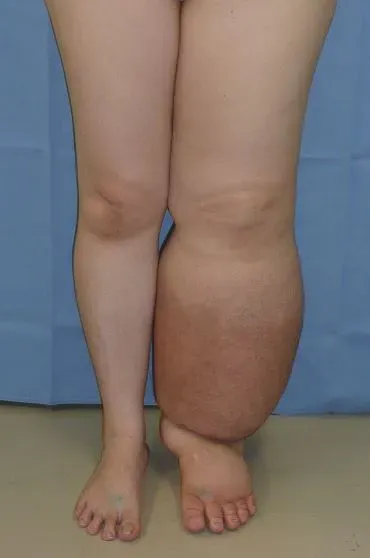
Lymphoedema is chronic swelling caused by failure of lymphatic transport, so protein-rich fluid accumulates in the interstitium and, over time, triggers inflammation, adipose deposition and fibrosis. Primary lymphoedema results from inherited or developmental lymphatic abnormalities (congenital Milroy disease, lymphoedema praecox around puberty, lymphoedema tarda after 35). Secondary lymphoedema is far commoner: worldwide the leading cause is lymphatic filariasis, while in high-income countries it follows cancer surgery and radiotherapy (about 1 in 5 women after axillary dissection), obesity, chronic venous disease and recurrent cellulitis. Swelling starts distally, involves the dorsum of the foot or hand and the toes, and becomes non-pitting with a positive Stemmer sign. Diagnosis is clinical, supported by volume measurement and lymphoscintigraphy. Treatment is lifelong complete decongestive therapy (manual lymphatic drainage, bandaging, skin care, exercise, then garments), weight control, cellulitis prevention and, for selected patients, surgery. Diuretics do not help.
Patient case, mechanism, investigations, management, flashcards and exam-style questions.Open the lesson →
Key facts
- Lymphoedema is a high-protein oedema from impaired lymph transport; chronic stasis causes fat deposition and fibrosis, so it becomes non-pitting
- Worldwide the commonest cause is lymphatic filariasis (Wuchereria bancrofti, Brugia spp.); in high-income countries it is cancer treatment and obesity
- About 1 in 5 women develop arm lymphoedema after axillary node dissection; the risk is much lower after sentinel node biopsy alone
- Stemmer sign (cannot pinch the skin at the base of the second toe) and involvement of the dorsum of the foot point to lymphoedema; lipoedema spares the feet
- ISL stages: 0 latent; I pitting, reduces with elevation; II no reduction with elevation, fibrosis; III elephantiasis with skin changes
- Lymphoscintigraphy is the reference test; ICG lymphography maps lymphatics before microsurgery
- Complete decongestive therapy (MLD, multilayer bandaging, skin care, exercise, then garments) is first-line; diuretics are ineffective
- Cellulitis is the commonest complication; prophylactic penicillin after recurrent episodes reduces recurrence (PATCH I)
Differential diagnosis
| Condition | Clues | Key test |
|---|---|---|
| Chronic venous insufficiency / post-thrombotic syndrome | Pitting oedema sparing the toes, pigmentation, varicose veins, ulcer at medial malleolus | Venous duplex |
| Lipoedema | Bilateral symmetrical fat in women, feet spared (cuff sign), painful easy bruising, Stemmer negative | Clinical |
| Deep vein thrombosis | Acute unilateral swelling and calf pain | Compression duplex, D-dimer |
| Heart failure, nephrotic syndrome, cirrhosis | Bilateral pitting oedema, systemic signs | NT-proBNP, urine protein, albumin, liver tests |
| Hypothyroid myxoedema | Non-pitting pretibial swelling, fatigue, cold intolerance | TSH, free T4 |
| Malignant obstruction | New-onset progressive lymphoedema in an older adult, proximal onset | Pelvic or axillary imaging (CT/MRI) |
| Drug-induced oedema | Calcium channel blockers, pioglitazone, steroids; bilateral | Drug review and withdrawal |
Exam pearls
Guideline
International Society of Lymphology 2023 Consensus Document on peripheral lymphoedema, WHO lymphatic filariasis morbidity management guidance (2nd edition, 2021) and ACS/LANA 2024 breast cancer-related lymphoedema risk-reduction consensus
References
- Executive Committee of the International Society of Lymphology. The Diagnosis and Treatment of Peripheral Lymphedema: 2023 Consensus Document of The International Society of Lymphology. Lymphology 2023.
- World Health Organization (WHO). Lymphatic filariasis: managing morbidity and preventing disability: an aide-mémoire for national programme managers, 2nd edition. Geneva: World Health Organization 2021.
- Brunelle CL, Jackson K, Shallwani SM, et al.. Evidence-based recommendations regarding risk reduction practices for people at risk of or with breast cancer-related lymphedema: consensus from an expert panel. Med Oncol 2024.
- DiSipio T, Rye S, Newman B, Hayes S. Incidence of unilateral arm lymphoedema after breast cancer: a systematic review and meta-analysis. Lancet Oncol 2013.
- Schmitz KH, Ahmed RL, Troxel A, et al.. Weight lifting in women with breast-cancer-related lymphedema. N Engl J Med 2009.
- Thomas KS, Crook AM, Nunn AJ, et al.. Penicillin to prevent recurrent leg cellulitis. N Engl J Med 2013.
Related topics
By Dr Khalid Seidi (B.Sc., M.D.) · MedEd World Clinical Knowledge library. Original teaching content checked against current guidelines (November 2026); confirm the latest local guidance before clinical use. Not a substitute for clinical judgement.