Clinical Knowledge › Paediatrics › Endocrine and metabolic disorders
Congenital hypothyroidism
Congenital hypothyroidism (CH) is thyroid hormone deficiency present at birth and the commonest preventable cause of intellectual disability worldwide. It affects about 1 in 2000–3000 newborns where screening is in place. Most permanent primary cases are due to thyroid dysgenesis (an ectopic, hypoplastic or absent gland); the rest are due to dyshormonogenesis, usually autosomal recessive. Because maternal thyroxine crosses the placenta, most babies look normal at birth, which is why newborn blood-spot screening of thyroid-stimulating hormone (TSH) is essential. Untreated infants develop prolonged jaundice, poor feeding, constipation, a large tongue, umbilical hernia, a wide posterior fontanelle, hypotonia and, later, developmental delay and short stature. Diagnosis is confirmed with venous TSH and free T4; levothyroxine 10–15 micrograms/kg/day should start within the first 2 weeks of life without waiting for imaging. Targets are a normal TSH with free T4 in the upper half of the reference range. With early, adequate treatment, intellectual outcome is close to normal.
Patient case, mechanism, investigations, management, flashcards and exam-style questions.Open the lesson →
Key facts
- Incidence about 1 in 2000–3000 live births where screening is used; about twice as common in girls for dysgenesis; more common in Down syndrome and preterm infants
- Thyroid dysgenesis (ectopic gland most common, then agenesis and hypoplasia) causes most permanent primary CH; dyshormonogenesis is usually autosomal recessive (25% recurrence)
- Most affected newborns look normal because maternal T4 crosses the placenta; screening finds them before signs appear
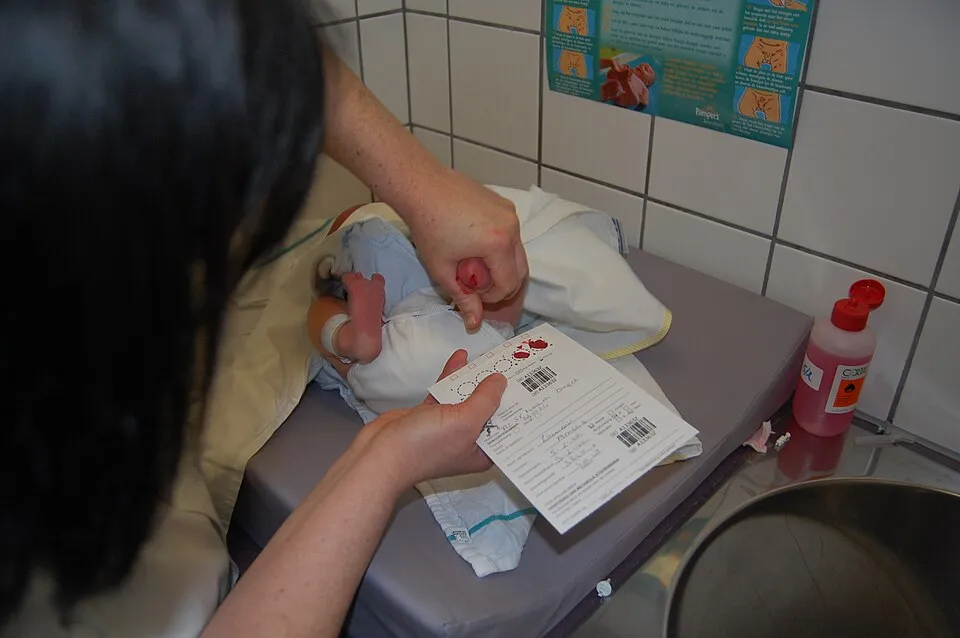
- Newborn blood-spot TSH screening on day 5 (UK days 5–8; earlier in some countries); preterm and sick infants need a repeat screen because the TSH rise may be delayed
- Confirm with venous TSH and free T4; start levothyroxine 10–15 micrograms/kg/day orally as soon as the confirmatory sample is taken, ideally before day 14
- Treatment targets: TSH in the age-specific reference range and free T4 in the upper half; frequent checks in the first 3 years when the brain depends on thyroid hormone
- Central (secondary) CH is missed by TSH-only screening and is often part of multiple pituitary hormone deficiency; check cortisol before thyroxine
- Transient CH follows maternal antithyroid drugs or TSH receptor-blocking antibodies, iodine excess or deficiency, and prematurity; re-evaluate at about age 3 if no permanent cause
Differential diagnosis
| Condition | Clues | Key test |
|---|---|---|
| Transient hyperthyrotropinaemia | Mildly raised TSH with normal free T4 that settles on repeat | Repeat venous TSH and free T4 in 1–2 weeks |
| Central (secondary) hypothyroidism | Low free T4 with low or normal TSH; hypoglycaemia, micropenis, midline defects | Free T4, cortisol, MRI pituitary |
| Non-thyroidal illness in sick or preterm neonate | Low T4 with low or normal TSH during critical illness | Repeat tests after recovery |
| Breast milk or physiological jaundice | Well, thriving baby; normal thyroid results | Split bilirubin; thyroid function if prolonged jaundice |
| Biliary atresia | Pale stools, dark urine, conjugated hyperbilirubinaemia | Conjugated bilirubin, liver ultrasound |
| Down syndrome (trisomy 21) | Hypotonia, macroglossia and umbilical hernia also occur; CH may coexist | Karyotype; thyroid function at birth and yearly |
| Beckwith–Wiedemann syndrome | Macroglossia and umbilical hernia with overgrowth and hypoglycaemia | Clinical features, methylation testing |
| Thyroid hormone resistance or binding protein disorders | Abnormal T4 with unexpected TSH pattern | Free T4 by different methods, specialist assessment |
Exam pearls
Guideline
ENDO-ERN/ESPE/ESE Congenital hypothyroidism consensus guidelines update (2020–2021) and AAP clinical report Congenital hypothyroidism: screening and management (2023)
References
- van Trotsenburg P, Stoupa A, Léger J, et al.. Congenital hypothyroidism: a 2020–2021 consensus guidelines update – an ENDO-European Reference Network initiative endorsed by the European Society for Pediatric Endocrinology and the European Society for Endocrinology. Thyroid 2021.
- Rose SR, Wassner AJ, Wintergerst KA, et al.. Congenital hypothyroidism: screening and management. Pediatrics 2023.
- Sperling MA, ed.. Sperling Pediatric Endocrinology. 2021.
- Dattani MT, Brook CGD, eds.. Brook's Clinical Pediatric Endocrinology. 2019.
- World Health Organization. Guideline: fortification of food-grade salt with iodine for the prevention and control of iodine deficiency disorders. WHO 2014.
- Clinical and Laboratory Standards Institute. Newborn screening for preterm, low birth weight, and sick newborns (NBS03). CLSI 2019.
Related topics
By Dr Khalid Seidi (B.Sc., M.D.) · MedEd World Clinical Knowledge library. Original teaching content checked against current guidelines (November 2026); confirm the latest local guidance before clinical use. Not a substitute for clinical judgement.