Clinical Knowledge › Paediatrics › Endocrine and metabolic disorders
Growth hormone deficiency
Growth hormone deficiency (GHD) in childhood is inadequate pituitary secretion of growth hormone (GH), causing low insulin-like growth factor 1 (IGF-1) and poor linear growth. It affects about 1 in 3500–10,000 children. It may be isolated or part of multiple pituitary hormone deficiency, and congenital (septo-optic dysplasia, midline defects, GH1, POU1F1 or PROP1 variants) or acquired (craniopharyngioma and other tumours, cranial irradiation, head injury, infiltration). Neonates may present with hypoglycaemia, prolonged jaundice and micropenis; older children with slow height velocity, proportionate short stature, increased fat around the trunk, a young-looking face and delayed bone age. Diagnosis rests on careful auxology and exclusion of commoner causes of poor growth, followed by low IGF-1, two failed GH stimulation tests (one if pituitary anatomy is clearly abnormal) and pituitary MRI. Daily subcutaneous somatropin, or a weekly long-acting preparation, restores growth; early treatment usually brings adult height close to the family target.
Patient case, mechanism, investigations, management, flashcards and exam-style questions.Open the lesson →
Key facts
- Incidence about 1 in 3500–10,000 children; most cases are isolated and idiopathic, but organic causes must be excluded
- Neonatal clues: hypoglycaemia, prolonged jaundice and micropenis (with gonadotrophin deficiency); midline defects or nystagmus suggest septo-optic dysplasia
- Childhood: falling height velocity crossing centiles, proportionate short stature, increased weight-for-height, immature facies, delayed dentition and delayed bone age
- First exclude hypothyroidism, coeliac disease, chronic illness, psychosocial deprivation, Turner syndrome in girls and skeletal dysplasia
- Low IGF-1 and IGFBP-3 support GHD but are also low in malnutrition, hypothyroidism and chronic illness
- GH stimulation tests (glucagon, arginine, clonidine, insulin tolerance) are needed; two subnormal peaks are usually required, with sex-steroid priming near puberty
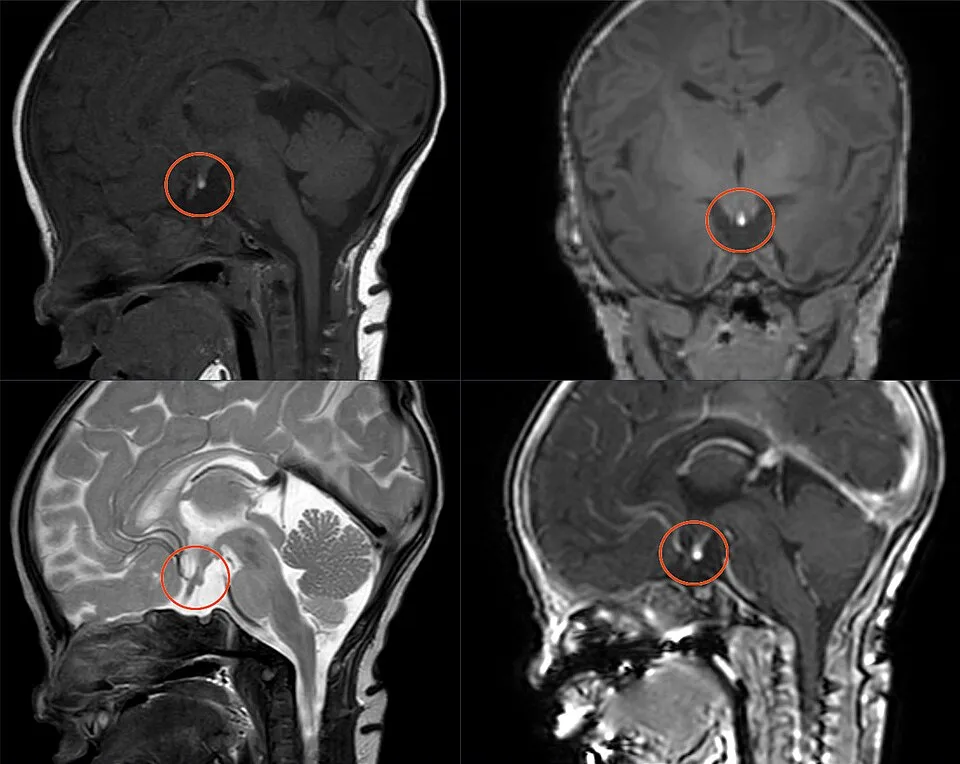
- MRI pituitary looks for a hypoplastic anterior pituitary, ectopic posterior pituitary, absent stalk or tumour such as craniopharyngioma
- Somatropin about 25–35 micrograms/kg/day subcutaneously (teaching dose); watch for raised intracranial pressure, slipped capital femoral epiphysis and scoliosis
Differential diagnosis
| Condition | Clues | Key test |
|---|---|---|
| Familial short stature | Normal height velocity, height within mid-parental target range, normal bone age | Mid-parental height, bone age |
| Constitutional delay of growth and puberty | Slow growth and late puberty with delayed bone age, family history of late bloomers, normal velocity for bone age | Bone age; observe pubertal progress |
| Turner syndrome | Short girl, possible webbed neck, wide carrying angle, ovarian failure | Karyotype |
| Hypothyroidism | Growth failure with weight gain, delayed bone age, constipation, fatigue | TSH and free T4 |
| Coeliac disease or inflammatory bowel disease | Faltering growth, abdominal symptoms, anaemia; weight falls before height | tTG-IgA with total IgA, faecal calprotectin, CRP |
| Psychosocial deprivation | Growth failure with neglect; GH secretion recovers in a safe environment | Social history; catch-up growth after removal |
| Skeletal dysplasia (for example SHOX deficiency, achondroplasia) | Disproportionate short stature, abnormal sitting height ratio, Madelung deformity | Sitting height, skeletal survey, genetic testing |
| Glucocorticoid excess (Cushing syndrome) | Short and obese with slowing growth, striae, hypertension | Overnight dexamethasone suppression or late-night salivary cortisol |
Exam pearls
Guideline
Pediatric Endocrine Society guidelines for growth hormone and IGF-I treatment in children (2016), Growth Hormone Research Society international perspective on short stature (2019) and NICE TA188 somatropin for growth failure in children (2010)
References
- Grimberg A, DiVall SA, Polychronakos C, et al.. Guidelines for growth hormone and insulin-like growth factor-I treatment in children and adolescents: growth hormone deficiency, idiopathic short stature, and primary insulin-like growth factor-I deficiency. Horm Res Paediatr 2016.
- Collett-Solberg PF, Ambler G, Backeljauw PF, et al.. Diagnosis, genetics, and therapy of short stature in children: a Growth Hormone Research Society international perspective. Horm Res Paediatr 2019.
- National Institute for Health and Care Excellence. Human growth hormone (somatropin) for the treatment of growth failure in children (TA188). NICE technology appraisal guidance 2010.
- Miller BS, Velazquez E, Yuen KCJ.. Long-acting growth hormone preparations – current status and future considerations. J Clin Endocrinol Metab 2020.
- Sperling MA, ed.. Sperling Pediatric Endocrinology. 2021.
- Dattani MT, Brook CGD, eds.. Brook's Clinical Pediatric Endocrinology. 2019.
Related topics
By Dr Khalid Seidi (B.Sc., M.D.) · MedEd World Clinical Knowledge library. Original teaching content checked against current guidelines (November 2026); confirm the latest local guidance before clinical use. Not a substitute for clinical judgement.