Clinical Knowledge › Paediatrics › Endocrine and metabolic disorders
Inborn errors of metabolism: overview
Inborn errors of metabolism (IEMs) are inherited defects of enzymes, transporters or cofactors that block a metabolic pathway, so that a toxic substrate builds up, a product is missing, or energy production fails. Individually rare but collectively about 1 in 800–2500 births, most are autosomal recessive, so consanguinity and a previous unexplained neonatal death are key clues. A practical clinical grouping is: intoxication disorders (urea cycle defects, organic acidaemias, maple syrup urine disease, galactosaemia) that present after a symptom-free interval once feeds start; energy-deficiency disorders (fatty acid oxidation, glycogen storage, mitochondrial) that present with hypoglycaemia, cardiomyopathy or hypotonia; and complex-molecule disorders (lysosomal, peroxisomal) with slowly progressive organ or neurological disease. The sick neonate who looks septic but has hypoglycaemia, metabolic acidosis with a high anion gap, or a raised ammonia must have first-line metabolic tests taken at presentation. Emergency treatment is to stop protein, give high-energy intravenous glucose, start ammonia scavengers and consider dialysis while specialist advice is sought. Newborn screening detects a growing list of treatable IEMs before symptoms.
Patient case, mechanism, investigations, management, flashcards and exam-style questions.Open the lesson →
Key facts
- Collectively common (about 1 in 800–2500 births); mostly autosomal recessive; ask about consanguinity, sibling deaths and a symptom-free interval after birth
- Three practical groups: intoxication (urea cycle, organic acidaemias, MSUD, galactosaemia), energy deficiency (fatty acid oxidation, glycogen storage, mitochondrial) and complex molecules (lysosomal, peroxisomal)
- Measure plasma ammonia in every neonate with unexplained encephalopathy, vomiting or 'sepsis' – a free-flowing sample on ice, analysed within 30 minutes
- Hyperammonaemia with respiratory alkalosis and no acidosis suggests a urea cycle defect; with high anion gap metabolic acidosis and ketosis suggests an organic acidaemia
- Hypoketotic hypoglycaemia (low ketones despite low glucose) points to a fatty acid oxidation defect such as MCAD deficiency or hyperinsulinism
- Emergency care: stop protein, give 10% glucose at about 1.5 times maintenance, correct acidosis cautiously, start scavengers (sodium benzoate, phenylbutyrate, arginine) and plan haemodialysis if ammonia is very high or rising
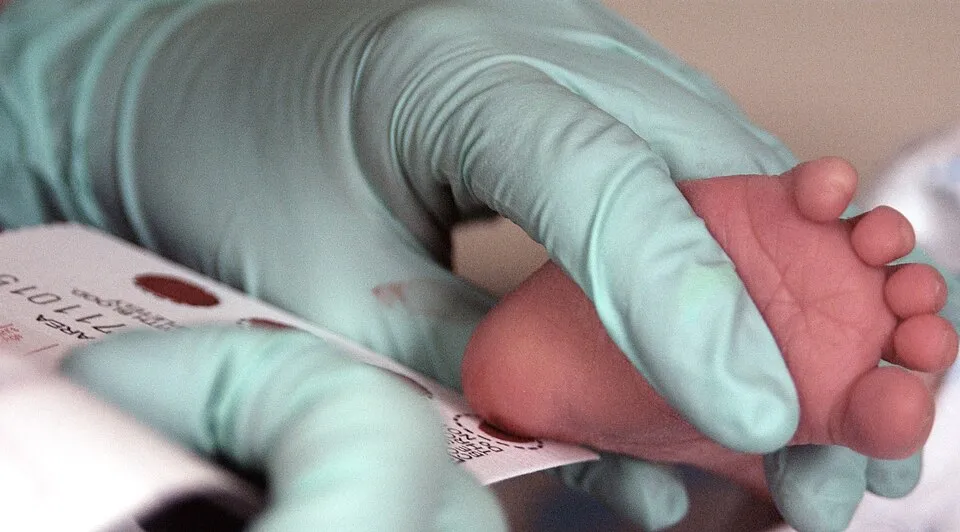
- England's blood spot screens 9 conditions including PKU, MCADD, MSUD, isovaleric acidaemia, glutaric aciduria type 1 and homocystinuria; SMA in-service evaluation began rolling out in October 2026
- Always save 'golden samples' (plasma, urine, dried blood spot) during the acute illness; they may be the only chance of diagnosis if the child dies
Differential diagnosis
| Condition | Clues | Key test |
|---|---|---|
| Neonatal sepsis | Fever or hypothermia, raised CRP; ammonia only mildly raised | Blood culture, CRP; ammonia, gas and glucose in parallel |
| Hypoxic-ischaemic encephalopathy | Perinatal asphyxia, encephalopathy from birth without a well interval | Cord gases, Apgar scores, MRI brain |
| Congenital heart disease (duct-dependent) | Shock or cyanosis at days 2–7 with weak femoral pulses | Pre- and post-ductal saturations, echocardiogram |
| Congenital adrenal hyperplasia (salt-wasting) | Vomiting and shock at 1–3 weeks with hyponatraemia, hyperkalaemia | 17-hydroxyprogesterone, electrolytes |
| Hyperinsulinism | Hypoglycaemia with inappropriately low ketones and free fatty acids, high glucose requirement | Insulin, C-peptide at the time of hypoglycaemia |
| Non-accidental head injury | Encephalopathy or seizures with retinal haemorrhages or bruising | CT/MRI brain, skeletal survey, ophthalmology |
| Neonatal liver failure (e.g. herpes simplex, neonatal haemochromatosis) | Coagulopathy, jaundice, raised transaminases | HSV PCR, ferritin, galactosaemia screen |
| Pyloric stenosis | Projectile non-bilious vomiting at 2–8 weeks with hypochloraemic alkalosis | Ultrasound pylorus, gas |
Exam pearls
Guideline
European urea cycle disorder guidelines (first revision 2019), MMA/PA guidelines (first revision 2021), GalNet classical galactosaemia guideline (2017), NHS newborn blood spot screening programme (2026) and the US Recommended Uniform Screening Panel
References
- Saudubray JM, Garcia-Cazorla À.. Inborn errors of metabolism overview: pathophysiology, manifestations, evaluation, and management. Pediatr Clin North Am 2018.
- Häberle J, Burlina A, Chakrapani A, et al.. Suggested guidelines for the diagnosis and management of urea cycle disorders: first revision. J Inherit Metab Dis 2019.
- Forny P, Hörster F, Ballhausen D, et al.. Guidelines for the diagnosis and management of methylmalonic acidaemia and propionic acidaemia: first revision. J Inherit Metab Dis 2021.
- Welling L, Bernstein LE, Berry GT, et al.. International clinical guideline for the management of classical galactosemia: diagnosis, treatment, and follow-up. J Inherit Metab Dis 2017.
- UK Health Security Agency / NHS England. NHS newborn blood spot screening programme: conditions screened and in-service evaluations (SMA evaluation rollout from October 2026). GOV.UK screening programme guidance 2026.
- US Health Resources and Services Administration Advisory Committee on Heritable Disorders in Newborns and Children. Recommended Uniform Screening Panel (RUSP). HRSA 2024.
Related topics
By Dr Khalid Seidi (B.Sc., M.D.) · MedEd World Clinical Knowledge library. Original teaching content checked against current guidelines (November 2026); confirm the latest local guidance before clinical use. Not a substitute for clinical judgement.