Clinical Knowledge › Paediatrics › Endocrine and metabolic disorders
Disorders of sex development
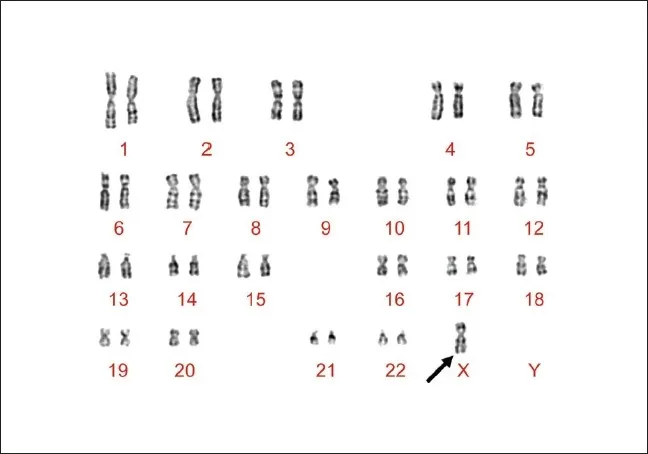
Disorders (or differences) of sex development (DSD) are congenital conditions in which chromosomal, gonadal or anatomical sex is atypical. The 2006 Chicago consensus grouped them as sex chromosome DSD (for example 45,X/46,XY mosaicism), 46,XY DSD (gonadal dysgenesis, androgen synthesis defects such as 5α-reductase deficiency, and androgen insensitivity) and 46,XX DSD (mostly congenital adrenal hyperplasia). Atypical genitalia occur in about 1 in 4500 births; more subtle forms present with proximal hypospadias and undescended testes, an inguinal hernia containing a testis in a girl, or delayed puberty and primary amenorrhoea. A newborn with atypical genitalia is a medical and psycho-social emergency: salt-wasting CAH can cause life-threatening adrenal crisis in the first two weeks. Initial tests are rapid karyotype or QF-PCR with SRY, electrolytes and glucose, 17-hydroxyprogesterone after 36 hours, pelvic ultrasound, and anti-Müllerian hormone, testosterone and gonadotrophins, guided by a specialist multidisciplinary team. Sex of rearing is decided with parents after evaluation, irreversible surgery is deferred where possible, and gonadal tumour risk is managed according to diagnosis.
Patient case, mechanism, investigations, management, flashcards and exam-style questions.Open the lesson →
Key facts
- Atypical genitalia about 1 in 4500 births; DSD in a broader sense (including proximal hypospadias and cryptorchidism) far more common
- Chicago 2006 classification: sex chromosome DSD, 46,XY DSD, 46,XX DSD – based on karyotype
- Commonest cause of atypical genitalia in a 46,XX newborn is 21-hydroxylase-deficient CAH; it is the one DSD that can kill in the first weeks (salt-wasting crisis)
- Features needing specialist assessment: bilateral impalpable testes, perineal or proximal hypospadias with undescended testis, clitoromegaly, posterior labial fusion, inguinal hernia or mass in a girl, discordance between genitalia and prenatal karyotype
- First-line tests: rapid karyotype/QF-PCR with SRY, electrolytes and glucose daily, 17-OHP (after 36 hours), pelvic ultrasound for uterus, AMH, testosterone, LH and FSH (minipuberty window)
- Gonadal tumour (germ cell) risk is highest in gonadal dysgenesis with Y material (for example 45,X/46,XY) and lowest in complete androgen insensitivity
- Sex assignment follows full evaluation and discussion with parents by an experienced multidisciplinary team; avoid guessing the sex or using 'it'
- Current consensus favours deferring irreversible, non-urgent genital surgery where possible so the person can take part in decisions
Differential diagnosis
| Condition | Clues | Key test |
|---|---|---|
| Salt-wasting 21-hydroxylase deficiency CAH (46,XX) | Virilised girl with palpable gonads absent; vomiting and collapse at 1–3 weeks | 17-OHP, electrolytes, karyotype |
| Complete androgen insensitivity (46,XY) | Female genitalia, inguinal hernia containing testes, or primary amenorrhoea with breast development | Karyotype, testosterone (male range), AMH |
| 5α-reductase type 2 deficiency (46,XY) | Atypical genitalia at birth with virilisation at puberty; normal testosterone | Testosterone/DHT ratio after hCG, urinary steroid profile, SRD5A2 testing |
| Mixed gonadal dysgenesis (45,X/46,XY) | Asymmetric genitalia, one palpable gonad, Turner features | Karyotype (several tissues), ultrasound |
| Isolated hypospadias with undescended testis | Usually 46,XY; distal hypospadias rarely DSD, proximal more often | Examination; karyotype if proximal or bilateral cryptorchidism |
| Maternal virilisation (luteoma, androgenic drugs) | 46,XX baby with virilisation and virilised mother | Maternal history, maternal androgens |
| Aromatase deficiency (46,XX) | Virilised daughter and maternal virilisation during pregnancy | CYP19A1 testing |
| Persistent Müllerian duct syndrome (46,XY) | Normal male genitalia with uterus found at hernia repair | AMH or AMH receptor genetics |
Exam pearls
Guideline
Society for Endocrinology UK guidance on initial evaluation of suspected DSD (revised 2021), Global DSD update (2016) of the 2006 Chicago consensus, COST DSDnet consensus statement (2018) and Endocrine Society CAH guideline (2018)
References
- Ahmed SF, Achermann J, Alderson J, et al.. Society for Endocrinology UK guidance on the initial evaluation of a suspected difference or disorder of sex development (revised 2021). Clin Endocrinol (Oxf) 2021.
- Lee PA, Nordenström A, Houk CP, et al.. Global disorders of sex development update since 2006: perceptions, approach and care. Horm Res Paediatr 2016.
- Houk CP, Hughes IA, Ahmed SF, Lee PA.. Summary of consensus statement on intersex disorders and their management. Pediatrics 2006.
- Cools M, Nordenström A, Robeva R, et al.. Caring for individuals with a difference of sex development (DSD): a consensus statement. Nat Rev Endocrinol 2018.
- Speiser PW, Arlt W, Auchus RJ, et al.. Congenital adrenal hyperplasia due to steroid 21-hydroxylase deficiency: an Endocrine Society clinical practice guideline. J Clin Endocrinol Metab 2018.
- Sperling MA, ed.. Sperling Pediatric Endocrinology. 2021.
Related topics
By Dr Khalid Seidi (B.Sc., M.D.) · MedEd World Clinical Knowledge library. Original teaching content checked against current guidelines (November 2026); confirm the latest local guidance before clinical use. Not a substitute for clinical judgement.