Clinical Knowledge › Anaesthesiology › Relevant pharmacology
Dantrolene
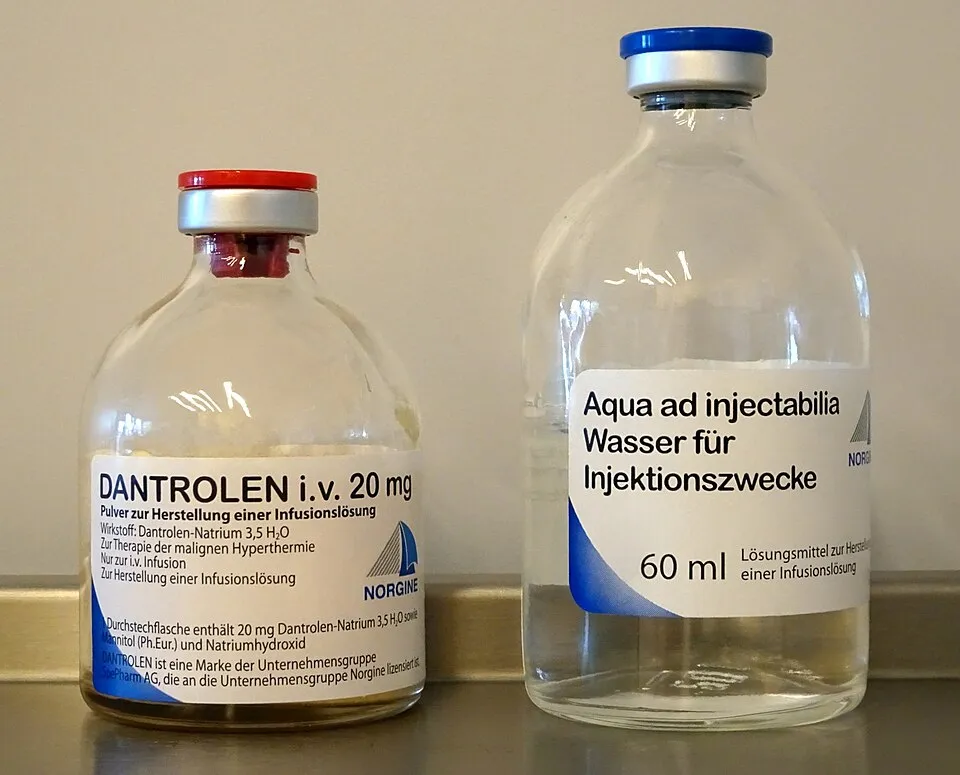
Dantrolene is the only specific treatment for malignant hyperthermia and the single drug that changed its mortality from over 70% to under 5%. It is a hydantoin derivative that binds the skeletal muscle ryanodine receptor (RYR1) and reduces calcium release from the sarcoplasmic reticulum, so excitation contraction coupling is uncoupled without blocking the neuromuscular junction. Cardiac and smooth muscle, which use RYR2 and RYR3, are largely unaffected. In a crisis the trigger is stopped, the patient is hyperventilated with high-flow oxygen on a vapour-free circuit, and dantrolene 2.5 mg/kg is given intravenously by actual body weight and repeated in 2.5 mg/kg increments until the metabolic response settles, commonly up to 10 mg/kg (teaching doses; check local protocol). The classic preparation needs 20 mg vials reconstituted with 60 mL of sterile water each; concentrated formulations needing far less water exist in some countries. European guidance recommends that 36 vials of the traditional preparation be immediately available wherever volatile agents or suxamethonium are used, with a further 24 obtainable within an hour. The main adverse effects are muscle weakness, phlebitis, nausea and, with long-term oral use for spasticity, hepatotoxicity.
Patient case, mechanism, investigations, management, flashcards and exam-style questions.Open the lesson →
Key facts
- Dantrolene binds RYR1 in skeletal muscle and reduces sarcoplasmic reticulum calcium release, uncoupling excitation from contraction
- It does not act at the neuromuscular junction, so it does not abolish the train-of-four response or replace neuromuscular blockade
- RYR2 (cardiac) and RYR3 receptors are largely unaffected, which is why cardiac contractility is preserved
- Crisis dose is 2.5 mg/kg intravenously by actual body weight, repeated in 2.5 mg/kg increments until signs settle, commonly to about 10 mg/kg (teaching dose; check local protocol)
- Each traditional 20 mg vial contains 3 g of mannitol and must be reconstituted with 60 mL of sterile water; a 70 kg adult needs about nine vials for the first dose alone
- European Malignant Hyperthermia Group guidance: dantrolene wherever volatile agents or suxamethonium are used, with 36 vials immediately available and 24 more within an hour
- Recurrence occurs in up to a quarter of cases, so monitor in critical care for at least 24 hours and repeat dantrolene as required
- Avoid calcium channel blockers with dantrolene: the combination has caused hyperkalaemia and cardiovascular collapse
Differential diagnosis
| Condition | Clues | Key test |
|---|---|---|
| Malignant hyperthermia | Unexplained rising end-tidal CO2, tachycardia, masseter or generalised rigidity, hyperthermia after volatile agent or suxamethonium | Arterial blood gas, creatine kinase, potassium, myoglobinuria |
| Inadequate anaesthesia or analgesia | Tachycardia and hypertension with movement, no rigidity, normal end-tidal CO2 trend | Clinical response to deepening anaesthesia |
| Hypoventilation or equipment failure | Rising end-tidal CO2 with low minute volume or exhausted absorber, no rigidity | Check circuit, ventilator, soda lime and capnogram shape |
| Sepsis | Fever, vasodilatation, raised lactate, slower onset | Cultures, inflammatory markers, clinical context |
| Thyroid storm | Fever, tachycardia, agitation, goitre, no rigidity | Thyroid function tests |
| Neuroleptic malignant syndrome | Lead-pipe rigidity and fever developing over days on antipsychotics | Drug history, creatine kinase, time course |
| Serotonin toxicity | Clonus, hyperreflexia, agitation after serotonergic drugs | Neuromuscular examination, drug history |
| Exertional heat stroke or rhabdomyolysis | Exercise in heat, hyperthermia, no anaesthetic trigger | Core temperature, creatine kinase; cooling is the treatment, not dantrolene |
Exam pearls
Guideline
Malignant hyperthermia 2020: guideline from the Association of Anaesthetists, with the European Malignant Hyperthermia Group guidelines on dantrolene availability (2020) and on investigation of malignant hyperthermia susceptibility (2015)
References
- Hopkins PM, Girard T, Dalay S, et al.. Malignant hyperthermia 2020: guideline from the Association of Anaesthetists. Anaesthesia 2021.
- Glahn KPE, Bendixen D, Girard T, et al.. Availability of dantrolene for the management of malignant hyperthermia crises: European Malignant Hyperthermia Group guidelines. Br J Anaesth 2020.
- Hopkins PM, Ruffert H, Snoeck MM, et al.. European Malignant Hyperthermia Group guidelines for investigation of malignant hyperthermia susceptibility. Br J Anaesth 2015.
- Riazi S, Kraeva N, Hopkins PM.. Malignant hyperthermia in the post-genomics era: new perspectives on an old concept. Anesthesiology 2018.
- Soar J, Bottiger BW, Carli P, et al.. European Resuscitation Council Guidelines 2025: Adult Advanced Life Support. Resuscitation 2025.
- World Health Organization. WHO model list of essential medicines. WHO 2025.
Related topics
By Dr Khalid Seidi (B.Sc., M.D.) · MedEd World Clinical Knowledge library. Original teaching content checked against current guidelines (November 2026); confirm the latest local guidance before clinical use. Not a substitute for clinical judgement.