Clinical Knowledge › Anaesthesiology › Relevant pharmacology
Local anaesthetic agents
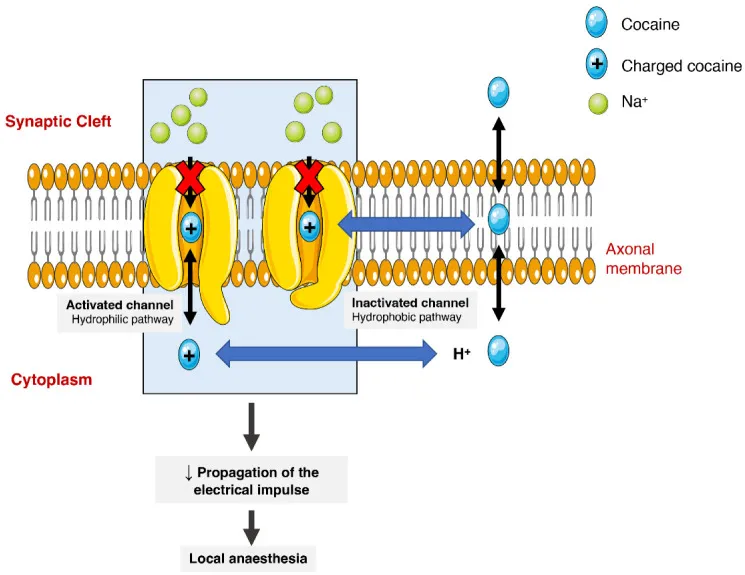
Local anaesthetics reversibly block voltage-gated sodium channels from the inner surface of the axonal membrane, preventing depolarisation and so abolishing conduction in a defined region without loss of consciousness. All consist of an aromatic ring joined to a tertiary amine by an ester or amide link, and that link determines metabolism: esters are hydrolysed by plasma esterases and amides by hepatic enzymes. pKa governs onset, lipid solubility governs potency and protein binding governs duration, while small autonomic and nociceptive fibres are blocked before large motor fibres. Adrenaline prolongs the block and limits systemic absorption. Safe use depends on calculating a weight-based maximum dose, aspirating and injecting incrementally while talking to the patient, using ultrasound where appropriate, and having lipid emulsion immediately available, because local anaesthetic systemic toxicity presents with neurological excitation followed by cardiovascular collapse that may be refractory, particularly with bupivacaine.
Patient case, mechanism, investigations, management, flashcards and exam-style questions.Open the lesson →
Key facts
- Local anaesthetics block voltage-gated sodium channels from the intracellular side in a use-dependent manner
- The unionised base crosses the membrane; the ionised form inside the axon blocks the channel
- pKa determines speed of onset, lipid solubility determines potency and protein binding determines duration
- Infected or acidic tissue reduces efficacy because more drug is ionised and cannot cross the membrane
- Esters are metabolised by plasma cholinesterase and amides by hepatic cytochrome enzymes; true allergy is rare and usually ester related
- Teaching maximum doses: lidocaine 3 mg/kg, or 7 mg/kg with adrenaline; bupivacaine and levobupivacaine 2 mg/kg; prilocaine 6 mg/kg
- A 1% solution contains 10 mg/mL, and adrenaline 1:200 000 is 5 micrograms/mL
- Bupivacaine is the most cardiotoxic agent in routine use and may cause refractory cardiac arrest
Differential diagnosis
| Condition | Clues | Key test |
|---|---|---|
| Local anaesthetic systemic toxicity | Perioral tingling, tinnitus, agitation then seizure or arrhythmia after injection | Timing and cumulative dose; give lipid emulsion |
| Intravascular injection of adrenaline | Transient tachycardia, hypertension and anxiety immediately on injection | Rapid onset and resolution; ECG monitoring |
| Vasovagal syncope during a block | Bradycardia, pallor and nausea with rapid recovery when supine | Clinical course; blood pressure and heart rate |
| Allergy to a local anaesthetic or preservative | Urticaria, bronchospasm or anaphylaxis rather than neurological excitation | Specialist allergy testing; esters and preservatives implicated |
| High or total spinal block | Ascending block with bradycardia, hypotension and respiratory failure after neuraxial injection | Sensory level, haemodynamics; supportive management |
| Methaemoglobinaemia | Cyanosis unresponsive to oxygen after prilocaine or benzocaine | Co-oximetry; methylthioninium chloride |
| Anxiety or panic during infiltration | Hyperventilation and paraesthesiae without objective signs | Reassurance; normal observations and no progression |
Exam pearls
Guideline
Association of Anaesthetists safety guideline on management of severe local anaesthetic toxicity with the American Society of Regional Anesthesia and Pain Medicine local anaesthetic systemic toxicity checklist (2020 version) and Association of Anaesthetists monitoring standards (2021)
References
- Association of Anaesthetists. Management of severe local anaesthetic toxicity: safety guideline. Association of Anaesthetists 2010.
- Neal JM, Neal EJ, Weinberg GL.. American Society of Regional Anesthesia and Pain Medicine local anesthetic systemic toxicity checklist: 2020 version. Reg Anesth Pain Med 2021.
- Klein AA, Meek T, Allcock E, et al.. Recommendations for standards of monitoring during anaesthesia and recovery 2021. Anaesthesia 2021.
- Harper NJN, Cook TM, Garcez T, et al.. Anaesthesia, surgery, and life-threatening allergic reactions: epidemiology and clinical features of perioperative anaphylaxis in the 6th National Audit Project (NAP6). Br J Anaesth 2018.
- Royal College of Anaesthetists. Guidelines for the Provision of Anaesthesia Services (GPAS). RCoA 2025.
- Joint Formulary Committee. British National Formulary. 2026.
Related topics
By Dr Khalid Seidi (B.Sc., M.D.) · MedEd World Clinical Knowledge library. Original teaching content checked against current guidelines (November 2026); confirm the latest local guidance before clinical use. Not a substitute for clinical judgement.