Clinical Knowledge › Anaesthesiology › Relevant pharmacology
Inhalational anaesthetic agents
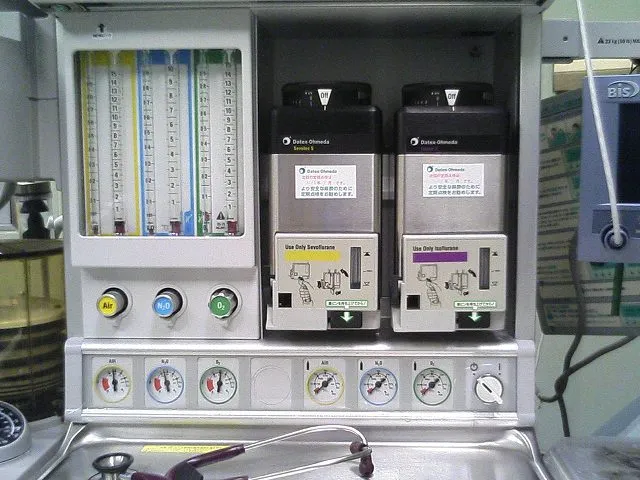
Inhalational anaesthetics are volatile liquids or gases delivered from a calibrated vaporiser through an anaesthetic breathing system and titrated against the measured end-tidal concentration. Sevoflurane, desflurane and isoflurane are the halogenated ethers in routine use, supplemented by nitrous oxide; all are given by a trained anaesthetist with agent analysis, capnography and the rest of the standard monitoring in place. Potency is expressed as minimum alveolar concentration, which falls with age, opioids and nitrous oxide and rises in infancy and hyperthermia, while speed of onset and offset depends chiefly on the blood:gas partition coefficient. All volatile agents depress myocardial contractility and ventilation, relax the uterus and bronchi, and trigger malignant hyperthermia in susceptible patients. Agent-specific issues include desflurane airway irritation, sevoflurane emergence agitation in children, nitrous oxide expansion of air-filled spaces, and the substantial greenhouse impact of desflurane and nitrous oxide.
Patient case, mechanism, investigations, management, flashcards and exam-style questions.Open the lesson →
Key facts
- Minimum alveolar concentration is the concentration at which half of patients do not move to a standard surgical stimulus
- Approximate MAC values in oxygen: sevoflurane about 2%, isoflurane about 1.15%, desflurane about 6%, nitrous oxide about 104%
- MAC falls roughly 6% per decade after the age of 40 and is reduced by opioids, benzodiazepines, nitrous oxide, hypothermia and pregnancy
- A low blood:gas partition coefficient means rapid wash-in and wash-out: desflurane is fastest, then sevoflurane, then isoflurane
- Oil:gas partition coefficient correlates with potency, the basis of the Meyer-Overton observation
- All volatile agents are triggers for malignant hyperthermia; nitrous oxide is not
- Nitrous oxide diffuses into air-filled spaces and is avoided in pneumothorax, bowel obstruction, middle ear and intraocular gas surgery
- Desflurane and nitrous oxide have a high global warming potential, and many services have restricted or withdrawn desflurane
Differential diagnosis
| Condition | Clues | Key test |
|---|---|---|
| Inadequate depth of anaesthesia | Hypertension, tachycardia, movement, lacrimation with a low end-tidal agent concentration | End-tidal agent analysis and depth of anaesthesia monitoring |
| Vaporiser or circuit failure | Falling agent concentration despite an unchanged dial setting | Check vaporiser filling, seating, circuit leak and fresh gas flow |
| Malignant hyperthermia | Unexplained rising end-tidal carbon dioxide, tachycardia, rigidity, hyperthermia | Arterial gas, potassium, creatine kinase; stop trigger and give dantrolene |
| Perioperative anaphylaxis | Rash, bronchospasm and refractory hypotension | Clinical pattern and mast cell tryptase |
| Hypercapnia from hypoventilation or absorber exhaustion | Rising end-tidal carbon dioxide with an abnormal capnograph baseline | Capnograph morphology, soda lime colour change, minute ventilation |
| Volatile overdose | Profound hypotension with a high end-tidal agent concentration | Agent analyser reading; reduce delivered concentration |
| Diffusion hypoxia after nitrous oxide | Desaturation at the end of anaesthesia when nitrous oxide is discontinued | Pulse oximetry; give high inspired oxygen on emergence |
Exam pearls
Guideline
Association of Anaesthetists recommendations for standards of monitoring during anaesthesia and recovery (2021) with RCoA Guidelines for the Provision of Anaesthesia Services (2025), NAP5 awareness findings and Association of Anaesthetists malignant hyperthermia crisis guidance
References
- Klein AA, Meek T, Allcock E, et al.. Recommendations for standards of monitoring during anaesthesia and recovery 2021. Anaesthesia 2021.
- Royal College of Anaesthetists. Guidelines for the Provision of Anaesthesia Services (GPAS). RCoA 2025.
- Pandit JJ, Andrade J, Bogod DG, et al.. 5th National Audit Project (NAP5) on accidental awareness during general anaesthesia: summary of main findings and risk factors. Br J Anaesth 2014.
- Association of Anaesthetists. Malignant hyperthermia crisis: safety guideline. Association of Anaesthetists 2020.
- Frerk C, Mitchell VS, McNarry AF, et al.. Difficult Airway Society 2015 guidelines for management of unanticipated difficult intubation in adults. Br J Anaesth 2015.
- Joint Formulary Committee. British National Formulary. 2026.
Related topics
By Dr Khalid Seidi (B.Sc., M.D.) · MedEd World Clinical Knowledge library. Original teaching content checked against current guidelines (November 2026); confirm the latest local guidance before clinical use. Not a substitute for clinical judgement.