Clinical Knowledge › Anaesthesiology › Relevant pharmacology
Reversal of neuromuscular blockade (neostigmine and sugammadex)
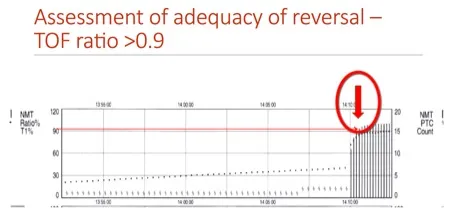
Reversal of neuromuscular blockade is the deliberate pharmacological restoration of neuromuscular function at the end of anaesthesia, judged against a quantitatively measured train-of-four ratio rather than against the clock or clinical impression. Residual blockade is common, frequently missed and associated with upper airway obstruction, impaired swallowing and postoperative pulmonary complications, because pharyngeal muscles recover later than the diaphragm. Neostigmine inhibits acetylcholinesterase and raises junctional acetylcholine, but it has a ceiling effect, cannot antagonise deep block and must be given with an antimuscarinic such as glycopyrronium to prevent bradycardia, bronchospasm and secretions. Sugammadex is a modified gamma-cyclodextrin that encapsulates rocuronium and vecuronium in a one-to-one complex excreted in urine; it reverses even profound block within minutes but is ineffective against benzylisoquinolinium agents. Choice and dose follow the class of blocker used and the measured depth of block.
Patient case, mechanism, investigations, management, flashcards and exam-style questions.Open the lesson →
Key facts
- A quantitatively measured train-of-four ratio of at least 0.9 is required before extubation
- Pharyngeal and upper airway muscles recover later than the diaphragm, so adequate breathing does not mean a protected airway
- Neostigmine teaching dose 0.05 mg/kg to a usual maximum of about 5 mg, with glycopyrronium 10 to 15 micrograms/kg
- Neostigmine has a ceiling effect: it is reserved for minimal block, classically needing at least two train-of-four twitches and by current guidance a ratio of at least 0.4
- Neostigmine does not reverse suxamethonium and may prolong it by inhibiting its metabolism
- Sugammadex 2 mg/kg reverses moderate block, 4 mg/kg deep block at a post-tetanic count of one or two, and 16 mg/kg immediate reversal
- Sugammadex encapsulates aminosteroids only and has no useful effect on atracurium or cisatracurium
- Sugammadex binds progestogens, so patients using hormonal contraception need additional precautions for seven days
Differential diagnosis
| Condition | Clues | Key test |
|---|---|---|
| Residual neuromuscular blockade | Weak head lift, poor cough, airway obstruction with fade on monitoring | Quantitative train-of-four ratio below 0.9 |
| Opioid-induced respiratory depression | Slow respiratory rate with miosis and a normal train-of-four ratio | Nerve stimulator and response to naloxone |
| Residual volatile or intravenous anaesthetic effect | Drowsiness without weakness and with normal monitoring | End-tidal agent concentration, time course |
| Suxamethonium apnoea | Prolonged paralysis after suxamethonium unresponsive to neostigmine | Butyrylcholinesterase activity and phenotyping |
| Recurarisation after inadequate reversal | Recovery then renewed weakness in the recovery area | Repeat quantitative monitoring; further antagonist |
| Myasthenic or cholinergic crisis | Known myasthenia with weakness and either dry or wet secretions | Medication history, nerve stimulator, specialist advice |
| Central cause of delayed waking | Normal train-of-four with abnormal pupils, posture or asymmetry | Neurological examination, glucose, imaging |
Exam pearls
Guideline
American Society of Anesthesiologists Practice Guidelines for Monitoring and Antagonism of Neuromuscular Blockade (2023) with Association of Anaesthetists monitoring standards (2021) and Difficult Airway Society guidance
References
- Thilen SR, Weigel WA, Todd MM, et al.. 2023 American Society of Anesthesiologists Practice Guidelines for Monitoring and Antagonism of Neuromuscular Blockade. Anesthesiology 2023.
- Klein AA, Meek T, Allcock E, et al.. Recommendations for standards of monitoring during anaesthesia and recovery 2021. Anaesthesia 2021.
- Frerk C, Mitchell VS, McNarry AF, et al.. Difficult Airway Society 2015 guidelines for management of unanticipated difficult intubation in adults. Br J Anaesth 2015.
- Harper NJN, Cook TM, Garcez T, et al.. Anaesthesia, surgery, and life-threatening allergic reactions: epidemiology and clinical features of perioperative anaphylaxis in the 6th National Audit Project (NAP6). Br J Anaesth 2018.
- Royal College of Anaesthetists. Guidelines for the Provision of Anaesthesia Services (GPAS). RCoA 2025.
- Joint Formulary Committee. British National Formulary. 2026.
Related topics
By Dr Khalid Seidi (B.Sc., M.D.) · MedEd World Clinical Knowledge library. Original teaching content checked against current guidelines (November 2026); confirm the latest local guidance before clinical use. Not a substitute for clinical judgement.