Clinical Knowledge › Internal medicine › Basics of internal medicine › Care of older adults
Delirium
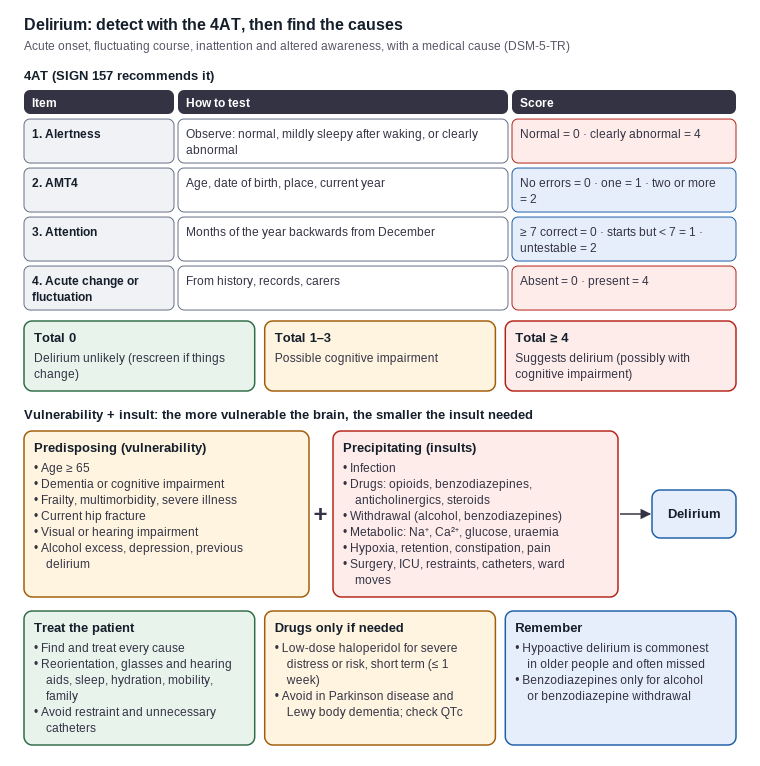
Delirium is an acute, fluctuating disturbance of attention and awareness, with additional cognitive or perceptual problems, caused directly by a medical condition, a drug, or withdrawal. It affects roughly a quarter of older medical inpatients, up to half of older people after hip fracture and most ventilated patients in intensive care, yet about half of cases, especially the quiet hypoactive form, are missed. Key risk factors are older age, dementia, frailty, severe illness and hip fracture; common precipitants are infection, drugs (opioids, sedatives, anticholinergics), electrolyte disturbance, retention, constipation, pain, hypoxia, withdrawal and surgery. The 4AT or CAM make detection quick. Management is to find and treat every contributing cause, provide multicomponent supportive care (reorientation, sensory aids, sleep, hydration, mobility, family) and avoid restraint. Antipsychotics are reserved for severe distress or danger, at the lowest dose for the shortest time. Multicomponent prevention reduces incidence by about a third or more; delirium increases mortality, institutionalisation and later dementia.
Patient case, mechanism, investigations, management, flashcards and exam-style questions.Open the lesson →
Key facts
- Delirium = acute onset (hours to days), fluctuating course, inattention and altered awareness, with a medical cause
- Affects about 20–30% of older medical inpatients, up to about 50% after hip fracture and up to 80% of ventilated ICU patients
- Hypoactive delirium (drowsy, withdrawn) is the commonest subtype in older people, is often missed and carries the worst prognosis
- 4AT: Alertness, AMT4, Attention (months backwards), Acute change or fluctuation; score ≥4 suggests delirium
- Key risk factors: age ≥65, dementia or cognitive impairment, current hip fracture, severe illness, frailty, sensory impairment
- Commonest precipitants: infection, drugs, metabolic disturbance, retention, constipation, pain, hypoxia, withdrawal
- Multicomponent non-drug prevention (e.g. Hospital Elder Life Program) reduces incident delirium by about a third or more
- Antipsychotics do not shorten delirium; use low-dose haloperidol only for severe distress or risk, and avoid in Parkinson disease and Lewy body dementia
Differential diagnosis
| Condition | Clues | Key test |
|---|---|---|
| Dementia | Insidious onset over months, attention preserved until late, no fluctuation in level of consciousness | Collateral history; cognitive testing after delirium resolves |
| Depression | Low mood, slowed thinking, 'don't know' answers; attention largely intact | GDS-15 or PHQ-9 |
| Primary psychosis | Clear consciousness, organised delusions, younger age, prior psychiatric history | Psychiatric history; normal attention |
| Non-convulsive status epilepticus | Fluctuating confusion, subtle twitching, history of seizures | EEG |
| Stroke (fluent aphasia or right hemisphere) | Sudden onset, focal deficits, aphasia mistaken for confusion | Neurological examination, CT or MRI brain |
| Wernicke encephalopathy | Alcohol use or malnutrition, ophthalmoplegia, ataxia | Clinical; give IV thiamine immediately |
| Hepatic encephalopathy | Liver disease, asterixis, constipation, GI bleed | LFTs, ammonia if uncertain, precipitant search |
| Hypoglycaemia | Sweating, confusion in a patient on insulin or sulfonylureas | Capillary glucose |
Exam pearls
Guideline
NICE CG103 Delirium: prevention, diagnosis and management in hospital and long-term care (2010, updated 2023); SIGN 157 Risk reduction and management of delirium (2019); AGS Beers Criteria (2023); DSM-5-TR (2022)
References
- National Institute for Health and Care Excellence (NICE). Delirium: prevention, diagnosis and management in hospital and long-term care (CG103). NICE clinical guideline (updated 2023) 2010.
- Scottish Intercollegiate Guidelines Network (SIGN). Risk reduction and management of delirium (SIGN 157). SIGN, Edinburgh 2019.
- Inouye SK, Westendorp RG, Saczynski JS.. Delirium in elderly people. Lancet 2014.
- Inouye SK, Bogardus ST Jr, Charpentier PA, et al.. A multicomponent intervention to prevent delirium in hospitalized older patients. N Engl J Med 1999.
- Shenkin SD, Fox C, Godfrey M, et al.. Delirium detection in older acute medical inpatients: a multicentre prospective comparative diagnostic test accuracy study of the 4AT and the confusion assessment method. BMC Med 2019.
- Tieges Z, Maclullich AMJ, Anand A, et al.. Diagnostic accuracy of the 4AT for delirium detection in older adults: systematic review and meta-analysis. Age Ageing 2021.
Related topics
By Dr Khalid Seidi (B.Sc., M.D.) · MedEd World Clinical Knowledge library. Original teaching content checked against current guidelines (November 2026); confirm the latest local guidance before clinical use. Not a substitute for clinical judgement.