Clinical Knowledge › Internal medicine › Basics of internal medicine › Care of older adults
Sarcopenia
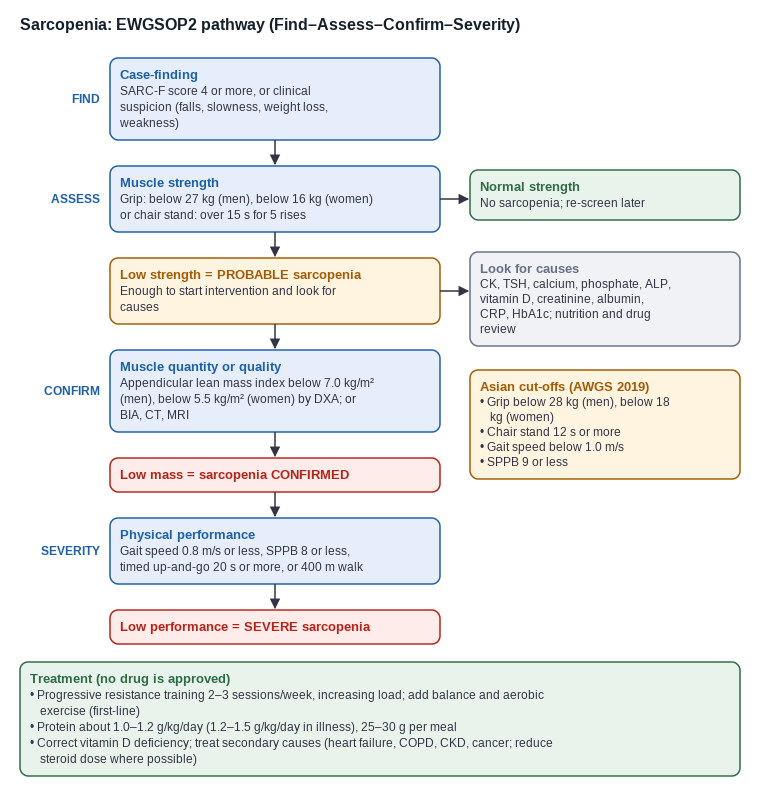
Sarcopenia is a progressive, generalised skeletal muscle disorder in which low muscle strength is accompanied by low muscle quantity or quality, increasing the risk of falls, fractures, disability, hospitalisation and death. It is primary when related to ageing and secondary when driven by inactivity, malnutrition, chronic disease (cancer, heart failure, COPD, CKD, cirrhosis) or drugs such as corticosteroids. Mechanisms include motor unit loss, anabolic resistance, inflammation and fat infiltration of muscle. The EWGSOP2 pathway is Find–Assess–Confirm–Severity: case-find with the SARC-F questionnaire or clinical suspicion, assess strength by grip or chair-stand test (probable sarcopenia), confirm low appendicular lean mass by DXA, bioimpedance or CT, and grade severity by gait speed or SPPB. Asian criteria (AWGS 2019) use different cut-offs. Progressive resistance exercise is the cornerstone of treatment, supported by adequate protein (about 1.0–1.2 g/kg/day, more in illness), correction of vitamin D deficiency and treatment of the underlying cause; no drug is approved.
Patient case, mechanism, investigations, management, flashcards and exam-style questions.Open the lesson →
Key facts
- Low muscle strength is the primary parameter in EWGSOP2: it defines probable sarcopenia
- EWGSOP2 grip strength cut-offs: below 27 kg in men and below 16 kg in women; chair stand over 15 seconds for 5 rises
- Diagnosis is confirmed by low muscle quantity or quality (for example appendicular lean mass index below 7.0 kg/m² in men and 5.5 kg/m² in women by DXA)
- Severe sarcopenia = low strength + low mass + low physical performance (gait speed 0.8 m/s or less, SPPB 8 or less)
- SARC-F score of 4 or more is a positive case-finding screen
- Asian Working Group (AWGS 2019) cut-offs: grip below 28 kg (men) and 18 kg (women), gait speed below 1.0 m/s
- Progressive resistance training is the first-line treatment; protein supplementation supports it
- Sarcopenia has an ICD-10-CM code (M62.84) and is recognised as a disease, not just a feature of ageing
Differential diagnosis
| Condition | Clues | Key test |
|---|---|---|
| Cachexia | Weight loss with anorexia and systemic inflammation in cancer, heart failure or COPD | CRP, albumin, weight trajectory; underlying disease |
| Frailty | Multidimensional vulnerability: exhaustion, slowness, weakness, weight loss, low activity | Clinical Frailty Scale or Fried phenotype |
| Inflammatory myopathy | Subacute proximal weakness, raised CK, rash in dermatomyositis | CK, myositis antibodies, EMG, MRI, biopsy |
| Statin or corticosteroid myopathy | Proximal weakness on these drugs | CK often raised with statins (may be normal); normal with steroids; drug review |
| Hypothyroid or osteomalacic myopathy | Proximal weakness, bone pain, fatigue | TSH; calcium, phosphate, ALP, 25-hydroxyvitamin D |
| Motor neurone disease | Weakness with fasciculations and mixed upper and lower motor neurone signs | EMG and neurological assessment |
| Polymyalgia rheumatica | Shoulder and hip girdle pain and stiffness rather than weakness | ESR and CRP; rapid response to steroids |
Exam pearls
Guideline
EWGSOP2 revised European consensus (2019), Asian Working Group for Sarcopenia (AWGS) 2019 update, ICFSR International Clinical Practice Guidelines for Sarcopenia (2018) and the Global Leadership Initiative in Sarcopenia (GLIS) conceptual definition (2024)
References
- Cruz-Jentoft AJ, Bahat G, Bauer J, et al.. Sarcopenia: revised European consensus on definition and diagnosis. Age Ageing 2019.
- Chen LK, Woo J, Assantachai P, et al.. Asian Working Group for Sarcopenia: 2019 consensus update on sarcopenia diagnosis and treatment. J Am Med Dir Assoc 2020.
- Dent E, Morley JE, Cruz-Jentoft AJ, et al.. International Clinical Practice Guidelines for Sarcopenia (ICFSR): screening, diagnosis and management. J Nutr Health Aging 2018.
- Kirk B, Cawthon PM, Arai H, et al.. The conceptual definition of sarcopenia: Delphi consensus from the Global Leadership Initiative in Sarcopenia (GLIS). Age Ageing 2024.
- Cruz-Jentoft AJ, Sayer AA.. Sarcopenia. Lancet 2019.
- Fried LP, Tangen CM, Walston J, et al.. Frailty in older adults: evidence for a phenotype. J Gerontol A Biol Sci Med Sci 2001.
Related topics
By Dr Khalid Seidi (B.Sc., M.D.) · MedEd World Clinical Knowledge library. Original teaching content checked against current guidelines (November 2026); confirm the latest local guidance before clinical use. Not a substitute for clinical judgement.