Clinical Knowledge › Internal medicine › Basics of internal medicine › Care of older adults
Polypharmacy and deprescribing
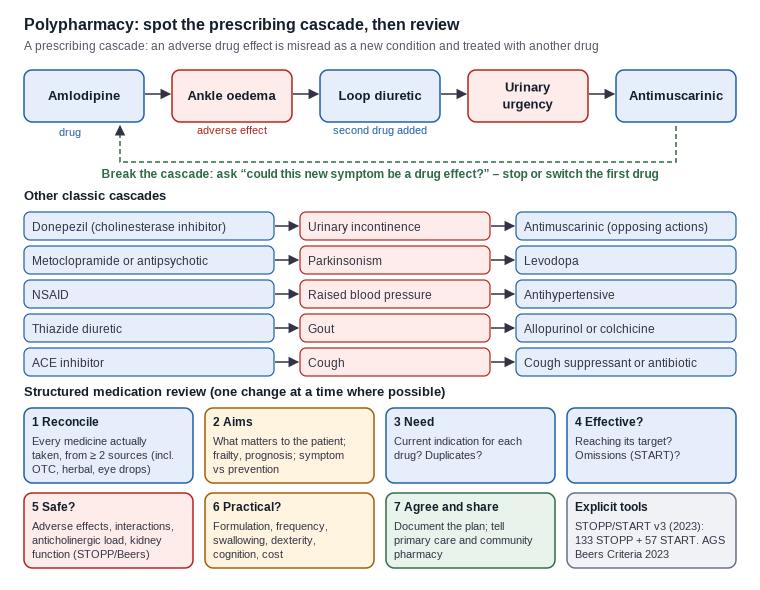
Polypharmacy is the concurrent use of multiple medicines, usually five or more, and becomes problematic when the risks of the regimen outweigh its benefits. It is driven by multimorbidity, single-disease guidelines, fragmented care and prescribing cascades, in which an adverse effect is treated as a new condition with another drug. Older adults are vulnerable because of reduced renal clearance, altered body composition, a sensitive brain and blunted baroreflex. Inappropriate polypharmacy causes falls, delirium, acute kidney injury, bleeding, hypoglycaemia and avoidable admissions. The ward doctor's task is a structured medication review: reconcile what the patient actually takes, define goals of care, check each drug for indication, benefit, harm and time to benefit, and use STOPP/START version 3 and the 2023 Beers Criteria. Deprescribing is planned, supervised withdrawal, done one change at a time with tapering, shared decisions, monitoring and clear communication at discharge.
Patient case, mechanism, investigations, management, flashcards and exam-style questions.Open the lesson →
Key facts
- Polypharmacy is most often defined as 5 or more regular medicines; 10 or more is sometimes called hyperpolypharmacy
- The number of drugs is not the problem in itself; the question is whether each drug is appropriate for this patient now
- A prescribing cascade occurs when a drug side effect is treated as a new disease with a further drug
- Anticholinergic burden is cumulative and causes confusion, constipation, urinary retention, falls and possibly long-term cognitive decline
- STOPP/START version 3 (2023) contains 133 STOPP and 57 START criteria (190 in total)
- The 2023 AGS Beers Criteria list drugs to avoid or use with caution in adults aged 65 years or more
- Benzodiazepines and Z-drugs should be tapered gradually; abrupt cessation risks withdrawal seizures and rebound insomnia
- Medicines reconciliation should be completed promptly after admission, ideally within 24 hours, and changes communicated at discharge
Differential diagnosis
| Condition | Clues | Key test |
|---|---|---|
| Adverse drug reaction presenting as delirium | New confusion after an anticholinergic, opioid, benzodiazepine or dose increase | Medication timeline; anticholinergic burden score; improvement on withdrawal |
| Prescribing cascade | New drug started soon after another to treat a symptom (for example ankle oedema after amlodipine) | Review the sequence of prescriptions and timing of symptom onset |
| Progression of underlying disease | Symptom fits the natural history and predates the drug | Disease-specific tests and history before the drug was started |
| Non-adherence or intentional dose changes | Erratic control, unused medicines at home, cost or side-effect concerns | Pharmacy records, pill count, open non-judgemental questioning |
| Drug–drug interaction | Toxicity after an interacting drug is added (for example clarithromycin with a statin or warfarin) | Interaction checker; drug levels or INR where relevant |
| Drug–disease interaction | Drug worsens a coexisting condition (NSAID in heart failure or CKD) | Creatinine, fluid status, review against STOPP criteria |
| Acute kidney injury causing drug accumulation | Toxicity from renally cleared drugs during intercurrent illness (metformin, DOACs, gabapentinoids, opioids) | Creatinine and eGFR or creatinine clearance; sick-day review |
Exam pearls
Guideline
STOPP/START criteria version 3 (2023), American Geriatrics Society Beers Criteria (2023 update), NICE NG5 Medicines optimisation (2015) and NICE NG56 Multimorbidity (2016), WHO Global Patient Safety Challenge: Medication Without Harm
References
- O'Mahony D, Cherubini A, Guiteras AR, et al.. STOPP/START criteria for potentially inappropriate prescribing in older people: version 3. Eur Geriatr Med 2023.
- 2023 American Geriatrics Society Beers Criteria Update Expert Panel. American Geriatrics Society 2023 updated AGS Beers Criteria for potentially inappropriate medication use in older adults. J Am Geriatr Soc 2023.
- National Institute for Health and Care Excellence. Medicines optimisation: the safe and effective use of medicines to enable the best possible outcomes (NG5). NICE 2015.
- National Institute for Health and Care Excellence. Multimorbidity: clinical assessment and management (NG56). NICE 2016.
- Scott IA, Hilmer SN, Reeve E, et al.. Reducing inappropriate polypharmacy: the process of deprescribing. JAMA Intern Med 2015.
- Reeve E, Shakib S, Hendrix I, Roberts MS, Wiese MD.. Review of deprescribing processes and development of an evidence-based, patient-centred deprescribing process. Br J Clin Pharmacol 2014.
Related topics
By Dr Khalid Seidi (B.Sc., M.D.) · MedEd World Clinical Knowledge library. Original teaching content checked against current guidelines (November 2026); confirm the latest local guidance before clinical use. Not a substitute for clinical judgement.