Clinical Knowledge › Internal medicine › Basics of internal medicine › Care of older adults
Immobility and deconditioning
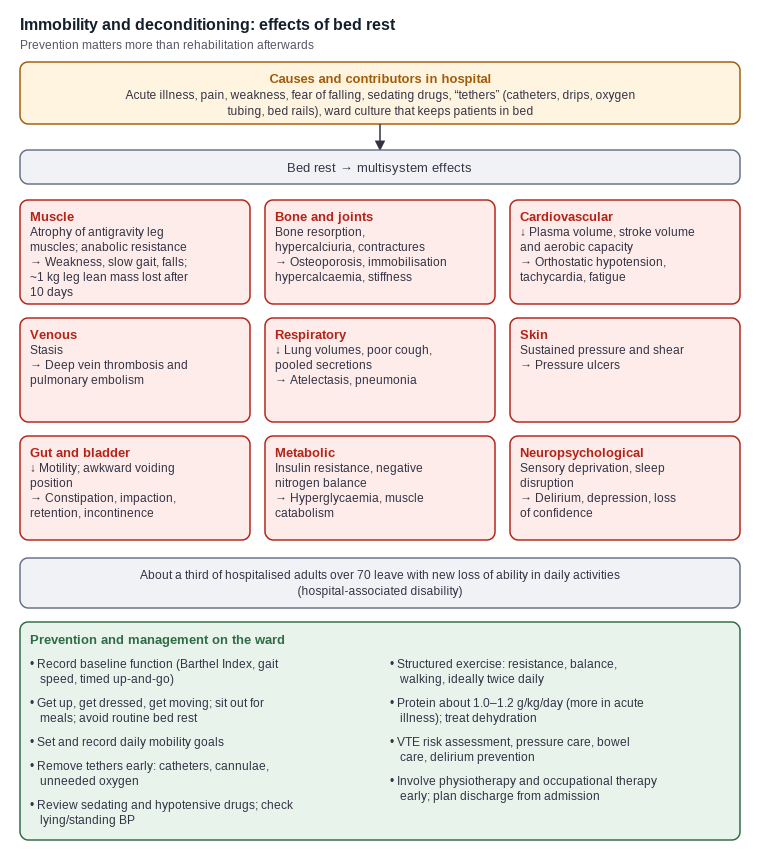
Immobility is a reduced ability to move independently; deconditioning is the loss of physiological reserve and function after inactivity, most striking in older adults confined to bed. Bed rest causes rapid loss of muscle mass and strength, reduced aerobic capacity, orthostatic intolerance, bone loss, atelectasis, venous thromboembolism, pressure ulcers, constipation, urinary retention, insulin resistance, delirium and low mood. About a third of adults over 70 leave hospital less able to perform daily activities than before admission (hospital-associated disability). Causes include the illness itself, pain, weakness, fear of falling, sedating drugs, 'tethers' such as catheters and drips, and a ward culture that keeps patients in bed. Prevention is the main treatment: record baseline function, get patients up, dressed and walking early, remove unnecessary lines, review drugs, prevent delirium, assess VTE risk, protect skin, optimise nutrition and involve therapists. Structured in-hospital exercise can reverse decline, and discharge planning starts on admission.
Patient case, mechanism, investigations, management, flashcards and exam-style questions.Open the lesson →
Key facts
- Hospital-associated disability (new loss of ability in activities of daily living) affects about a third of hospitalised adults over 70
- Older inpatients spend most of their time lying in bed even when able to walk
- Ten days of bed rest in healthy older adults caused loss of about 1 kg of leg lean mass and a marked fall in strength and aerobic capacity
- Immobility increases the risk of venous thromboembolism, pressure ulcers, pneumonia, constipation, urinary retention, delirium and falls
- Catheters, drips, oxygen tubing, bed rails and sedatives act as 'tethers' that restrict mobility
- A structured multicomponent exercise programme during acute admission improved function in very old patients in a randomised trial
- Assess VTE risk on admission for every medical inpatient and reassess when the clinical situation changes
- Measure baseline function (for example Barthel Index, gait speed or timed up-and-go) to recognise decline and plan rehabilitation
Differential diagnosis
| Condition | Clues | Key test |
|---|---|---|
| Hypoactive delirium | Sudden drowsiness, reduced intake and inattention | 4AT or CAM; search for cause |
| Occult hip or pelvic fracture | Unable to bear weight after a fall, pain on hip rotation | Hip and pelvic X-ray; CT or MRI if negative |
| Spinal cord compression | Back pain, leg weakness, sensory level, sphincter disturbance | Urgent MRI whole spine |
| Electrolyte or endocrine myopathy | Generalised weakness with low potassium, high calcium, hypothyroidism | U&E, calcium, magnesium, phosphate, TSH, CK |
| Drug-induced myopathy | Proximal weakness on statins or long-term corticosteroids | CK (statins); drug history |
| Guillain–Barré syndrome | Ascending weakness with areflexia after infection | Nerve conduction studies; CSF protein |
| Parkinsonism | Slowness, rigidity, shuffling gait; may follow antipsychotics or metoclopramide | Neurological examination; drug review |
| Depression or apathy | Low mood, withdrawal, refusing to mobilise | Screening questions; Geriatric Depression Scale |
Exam pearls
Guideline
WHO guidelines on physical activity and sedentary behaviour (2020), NICE NG89 Venous thromboembolism in over 16s (2018, updated 2019), NICE CG179 Pressure ulcers (2014) and the evidence base on hospital-associated disability
References
- Bull FC, Al-Ansari SS, Biddle S, et al.. World Health Organization 2020 guidelines on physical activity and sedentary behaviour. Br J Sports Med 2020.
- National Institute for Health and Care Excellence. Venous thromboembolism in over 16s: reducing the risk of hospital-acquired deep vein thrombosis or pulmonary embolism (NG89). NICE 2019.
- National Institute for Health and Care Excellence. Pressure ulcers: prevention and management (CG179). NICE 2014.
- Covinsky KE, Pierluissi E, Johnston CB.. Hospitalization-associated disability: 'She was probably able to ambulate, but I'm not sure'. JAMA 2011.
- Brown CJ, Friedkin RJ, Inouye SK.. Prevalence and outcomes of low mobility in hospitalized older patients. J Am Geriatr Soc 2004.
- Kortebein P, Ferrando A, Lombeida J, Wolfe R, Evans WJ.. Effect of 10 days of bed rest on skeletal muscle in healthy older adults. JAMA 2007.
Related topics
By Dr Khalid Seidi (B.Sc., M.D.) · MedEd World Clinical Knowledge library. Original teaching content checked against current guidelines (November 2026); confirm the latest local guidance before clinical use. Not a substitute for clinical judgement.