Clinical Knowledge › Internal medicine › Basics of internal medicine › Care of older adults
Elder abuse
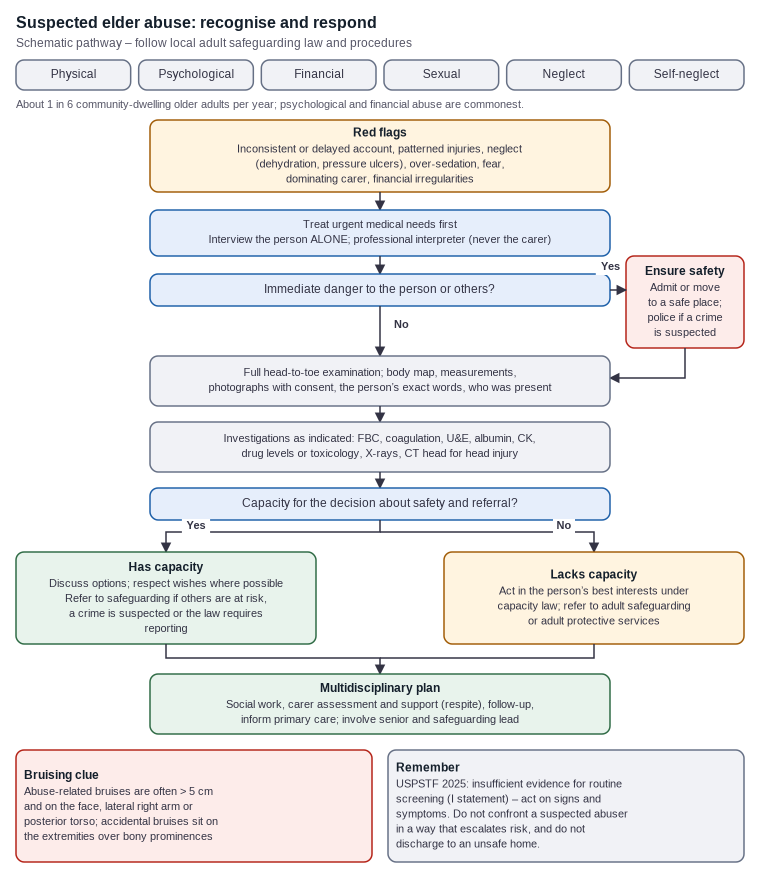
Elder abuse is a single or repeated act, or lack of appropriate action, occurring within a relationship where there is an expectation of trust, that causes harm or distress to an older person. It includes physical, psychological, financial, sexual abuse and neglect; many safeguarding frameworks also recognise self-neglect, organisational and discriminatory abuse. About one in six older people in the community experience some form of abuse each year, with psychological and financial abuse most common, and rates are higher in care institutions. Risk factors include dementia, dependency, social isolation, and a carer who is stressed, dependent on the victim or misusing alcohol or drugs. Abuse raises mortality yet is rarely disclosed. Doctors should recognise red flags (unexplained or patterned injuries, delayed presentation, neglect, over-sedation, financial changes), interview the patient alone, assess capacity, document precisely, treat injuries, ensure immediate safety and follow local adult safeguarding or protective services procedures, which differ between countries.
Patient case, mechanism, investigations, management, flashcards and exam-style questions.Open the lesson →
Key facts
- About 1 in 6 (15.7%) community-dwelling older adults experienced abuse in the past year in a WHO-led meta-analysis
- Psychological abuse is the most common type, followed by financial abuse and neglect
- In institutions, about two-thirds of staff in surveys report having committed some form of abuse in the past year
- Bruises from abuse are often large (over 5 cm) and on the face, lateral right arm or posterior torso
- Corroborated elder mistreatment is associated with about a threefold increase in risk of death
- Always interview the older person alone, with a professional interpreter if needed, never using the suspected abuser to translate
- The USPSTF (2025) found insufficient evidence to recommend routine screening of older adults for abuse (I statement), but clinicians must act on signs and symptoms
- Assess mental capacity for decisions about safety; a person with capacity may decline intervention, but risk to others and serious crime may still require action
Differential diagnosis
| Condition | Clues | Key test |
|---|---|---|
| Accidental falls | Bruises on extremities and bony prominences, consistent history, known gait problem | Falls history; examination; bruise location |
| Senile (actinic) purpura | Flat purple patches on sun-exposed forearms and hands in thin skin | Clinical; normal coagulation |
| Anticoagulant or antiplatelet bruising | Bruising with minor trauma on warfarin, DOACs or aspirin | Drug history; INR or anti-Xa where relevant |
| Coagulopathy or thrombocytopenia | Multiple bruises, petechiae, mucosal bleeding | FBC, coagulation screen, liver tests |
| Osteoporotic fragility fracture | Fracture after minimal trauma with low bone density | Imaging pattern; DXA; consistent history |
| Self-neglect from dementia or depression | Poor hygiene and nutrition without a carer, refuses help | Cognitive and mood assessment; home situation |
| Kennedy terminal ulcer or unavoidable pressure damage | Ulcers appearing rapidly at the end of life | Clinical course; documented care |
Exam pearls
Guideline
US Preventive Services Task Force Screening for Intimate Partner Violence and Caregiver Abuse of Older or Vulnerable Adults (2025), WHO priorities for tackling abuse of older people in the UN Decade of Healthy Ageing (2022), NICE NG189 Safeguarding adults in care homes (2021) and national adult safeguarding legislation
References
- US Preventive Services Task Force; Silverstein M, Wong JB, et al.. Screening for intimate partner violence and caregiver abuse of older or vulnerable adults: US Preventive Services Task Force recommendation statement. JAMA 2025.
- World Health Organization. Tackling abuse of older people: five priorities for the United Nations Decade of Healthy Ageing (2021–2030). WHO, Geneva 2022.
- National Institute for Health and Care Excellence. Safeguarding adults in care homes (NG189). NICE 2021.
- Lachs MS, Pillemer KA.. Elder abuse. N Engl J Med 2015.
- Yon Y, Mikton CR, Gassoumis ZD, Wilber KH.. Elder abuse prevalence in community settings: a systematic review and meta-analysis. Lancet Glob Health 2017.
- Yon Y, Ramiro-Gonzalez M, Mikton CR, Huber M, Sethi D.. The prevalence of elder abuse in institutional settings: a systematic review and meta-analysis. Eur J Public Health 2019.
Related topics
By Dr Khalid Seidi (B.Sc., M.D.) · MedEd World Clinical Knowledge library. Original teaching content checked against current guidelines (November 2026); confirm the latest local guidance before clinical use. Not a substitute for clinical judgement.