Clinical Knowledge › Internal medicine › Infectious diseases › Central nervous system infections
Encephalitis
Encephalitis is inflammation of the brain parenchyma causing altered mental status, often with fever, seizures and focal neurological signs. Herpes simplex virus type 1 is the commonest sporadic viral cause worldwide and is treatable, so intravenous aciclovir must start as soon as encephalitis is suspected, ideally within 6 hours of arrival, without waiting for results. Other causes include varicella zoster virus, enteroviruses, arboviruses such as Japanese encephalitis, West Nile and tick-borne encephalitis viruses, and rabies. Autoimmune encephalitis, particularly anti-NMDA receptor encephalitis in young women and LGI1 encephalitis in older men, presents with psychiatric symptoms, seizures, movement disorders or hyponatraemia and responds to immunotherapy. Investigation combines CSF PCR, MRI, EEG and neuronal antibody testing. Even with treatment, HSV encephalitis carries a mortality of about 10–20% and many survivors have memory, behavioural or seizure problems.
Patient case, mechanism, investigations, management, flashcards and exam-style questions.Open the lesson →
Key facts
- Encephalitis = altered mental status for at least 24 hours plus signs of brain inflammation such as fever, seizures, focal signs, CSF pleocytosis, or MRI or EEG abnormalities
- HSV-1 is the commonest sporadic viral cause; untreated mortality is about 70%, falling to about 10–20% with aciclovir
- Start IV aciclovir 10 mg/kg 8-hourly (adjusted for renal function) within 6 hours of arrival whenever encephalitis is suspected
- CSF typically shows lymphocytic pleocytosis, raised protein and normal glucose; CSF HSV PCR may be negative in the first 72 hours
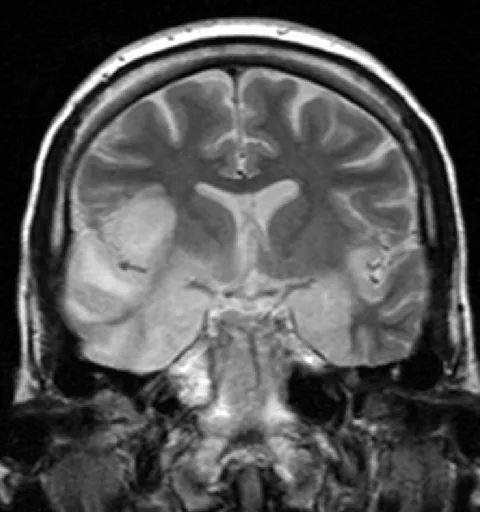
- MRI is the imaging of choice: HSV involves the medial temporal lobes, insula and orbitofrontal cortex, often asymmetrically
- Anti-NMDA receptor encephalitis: young woman, psychiatric onset, seizures, dyskinesias, autonomic instability, reduced consciousness; look for ovarian teratoma
- About a quarter of HSV encephalitis survivors develop secondary anti-NMDA receptor encephalitis within weeks to months
- Treat HSV encephalitis for at least 14 days (21 days in immunocompromised patients) and confirm CSF PCR negativity before stopping when indicated
Differential diagnosis
| Condition | Clues | Key test |
|---|---|---|
| Bacterial meningitis | Neck stiffness, neutrophilic CSF, low glucose | CSF Gram stain, culture, PCR |
| Septic or metabolic encephalopathy | Systemic infection, hypoglycaemia, uraemia, hepatic failure; no CSF pleocytosis | Bloods, normal CSF and MRI |
| Non-convulsive status epilepticus | Fluctuating consciousness, subtle twitching | EEG |
| Stroke or cerebral venous sinus thrombosis | Sudden focal deficit, headache, seizures | MRI with diffusion and MR venography |
| Brain abscess or tumour | Subacute focal deficit, raised ICP | Contrast MRI |
| Primary psychiatric illness | Psychosis without fever, seizures or dyskinesias | Normal CSF, MRI and EEG; consider antibody testing if atypical |
| Cerebral malaria | Fever and coma after travel | Blood films or rapid antigen test |
| Wernicke encephalopathy | Alcohol misuse, ophthalmoplegia, ataxia | Clinical; give IV thiamine |
Exam pearls
Guideline
ABN/BIA UK national guideline for management of suspected viral encephalitis in adults (2012), IDSA encephalitis guideline (2008), International Encephalitis Consortium case definitions (2013) and autoimmune encephalitis diagnostic criteria (Graus et al., 2016)
References
- Solomon T, Michael BD, Smith PE, et al.. Management of suspected viral encephalitis in adults – Association of British Neurologists and British Infection Association National Guidelines. J Infect 2012.
- Tunkel AR, Glaser CA, Bloch KC, et al.. The management of encephalitis: clinical practice guidelines by the Infectious Diseases Society of America. Clin Infect Dis 2008.
- Venkatesan A, Tunkel AR, Bloch KC, et al.. Case definitions, diagnostic algorithms, and priorities in encephalitis: consensus statement of the International Encephalitis Consortium. Clin Infect Dis 2013.
- Graus F, Titulaer MJ, Balu R, et al.. A clinical approach to diagnosis of autoimmune encephalitis. Lancet Neurol 2016.
- Armangue T, Spatola M, Vlagea A, et al.. Frequency, symptoms, risk factors, and outcomes of autoimmune encephalitis after herpes simplex encephalitis: a prospective observational study and retrospective analysis. Lancet Neurol 2018.
- Venkatesan A, Michael BD, Probasco JC, Geocadin RG, Solomon T. Acute encephalitis in immunocompetent adults. Lancet 2019.
Related topics
By Dr Khalid Seidi (B.Sc., M.D.) · MedEd World Clinical Knowledge library. Original teaching content checked against current guidelines (November 2026); confirm the latest local guidance before clinical use. Not a substitute for clinical judgement.