Clinical Knowledge › Internal medicine › Infectious diseases › Central nervous system infections
Rabies
Rabies is an acute, almost invariably fatal encephalomyelitis caused by lyssaviruses, chiefly rabies virus, transmitted in the saliva of infected mammals through bites, scratches or licks on broken skin or mucous membranes. Dogs cause up to 99% of the estimated 59,000 human deaths each year, mostly in Asia and Africa and often in children; bats are the main source in the Americas and Europe. After an incubation of usually 1–3 months, the virus travels along peripheral nerves to the brain and then outwards to the salivary glands. Illness starts with fever and pain or paraesthesia at the wound, then progresses either to furious (encephalitic) rabies with hydrophobia, aerophobia, agitation and autonomic instability, or to paralytic rabies resembling Guillain–Barré syndrome, followed by coma and death. Once symptoms begin there is no effective treatment, and care is palliative. Rabies is, however, almost entirely preventable: prompt wound washing, rabies vaccine and, for severe exposures, rabies immunoglobulin or monoclonal antibodies given after exposure, together with pre-exposure vaccination for people at risk and mass dog vaccination.
Patient case, mechanism, investigations, management, flashcards and exam-style questions.Open the lesson →
Key facts
- Rabies virus is a bullet-shaped, enveloped, negative-sense single-stranded RNA virus (Rhabdoviridae, genus Lyssavirus)
- Dogs cause up to 99% of human cases; children under 15 years account for a large share (often estimated at about 40%) of victims
- Incubation is usually 1–3 months but ranges from under 1 week to more than 1 year; bites on the head, neck and hands give shorter incubation
- Pain or paraesthesia at the healed bite site is an early specific symptom; hydrophobia is characteristic of furious rabies
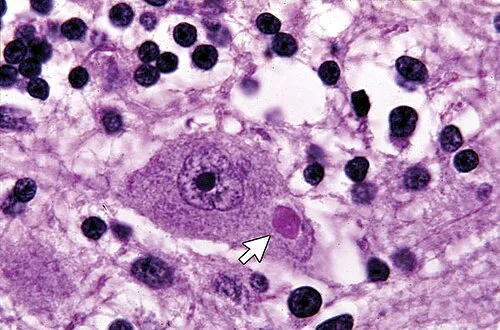
- Negri bodies (eosinophilic cytoplasmic inclusions) are seen in Purkinje cells and hippocampal neurons
- WHO exposure categories: I (licks on intact skin) no PEP; II (nibbles, minor scratches without bleeding) wound care plus vaccine; III (transdermal bites, licks on broken skin or mucosa, bat contact) wound care plus vaccine plus rabies immunoglobulin
- Previously vaccinated people need only 2 vaccine doses (days 0 and 3) after exposure and no immunoglobulin
- Once symptoms appear, rabies is almost always fatal; management is palliative
Differential diagnosis
| Condition | Clues | Key test |
|---|---|---|
| Herpes simplex or other viral encephalitis | Fever, confusion, seizures; no hydrophobia; no animal exposure | CSF HSV PCR, MRI temporal lobes |
| Anti-NMDA receptor encephalitis | Psychiatric symptoms, dyskinesias, autonomic instability in a young woman | CSF and serum NMDA receptor antibodies; look for ovarian teratoma |
| Guillain–Barré syndrome (mimics paralytic rabies) | Ascending weakness, no fever, preserved consciousness | CSF albuminocytological dissociation; nerve conduction studies |
| Tetanus | Trismus and spasms with clear consciousness, wound | Clinical; no hydrophobia or encephalopathy |
| Delirium tremens or drug intoxication | Agitation and autonomic overactivity | Alcohol or drug history; toxicology |
| Rabies hysteria (psychological reaction) | Anxiety after a bite with 'hydrophobia' but no progression | Normal neurological examination; time course |
| Japanese encephalitis or other arboviral encephalitis | Endemic area, movement disorders, no animal bite | CSF IgM serology |
Exam pearls
Guideline
WHO rabies vaccines position paper (2018) and WHO Expert Consultation on Rabies, third report (TRS 1012, 2018), with ACIP rabies PrEP recommendations (2022)
References
- World Health Organization. Rabies vaccines: WHO position paper – April 2018. Wkly Epidemiol Rec 2018.
- World Health Organization. WHO Expert Consultation on Rabies: third report (WHO Technical Report Series 1012). World Health Organization, Geneva 2018.
- Fooks AR, Cliquet F, Finke S, et al.. Rabies. Nat Rev Dis Primers 2017.
- Hemachudha T, Ugolini G, Wacharapluesadee S, et al.. Human rabies: neuropathogenesis, diagnosis, and management. Lancet Neurol 2013.
- Rao AK, Briggs D, Moore SM, et al.. Use of a modified preexposure prophylaxis vaccination schedule to prevent human rabies: recommendations of the Advisory Committee on Immunization Practices – United States, 2022. MMWR Morb Mortal Wkly Rep 2022.
- Rupprecht CE, Briggs D, Brown CM, et al.. Use of a reduced (4-dose) vaccine schedule for postexposure prophylaxis to prevent human rabies: recommendations of the Advisory Committee on Immunization Practices. MMWR Recomm Rep 2010.
Related topics
By Dr Khalid Seidi (B.Sc., M.D.) · MedEd World Clinical Knowledge library. Original teaching content checked against current guidelines (November 2026); confirm the latest local guidance before clinical use. Not a substitute for clinical judgement.