Clinical Knowledge › Internal medicine › Infectious diseases › Skin, soft-tissue, bone and joint infections
Gas gangrene
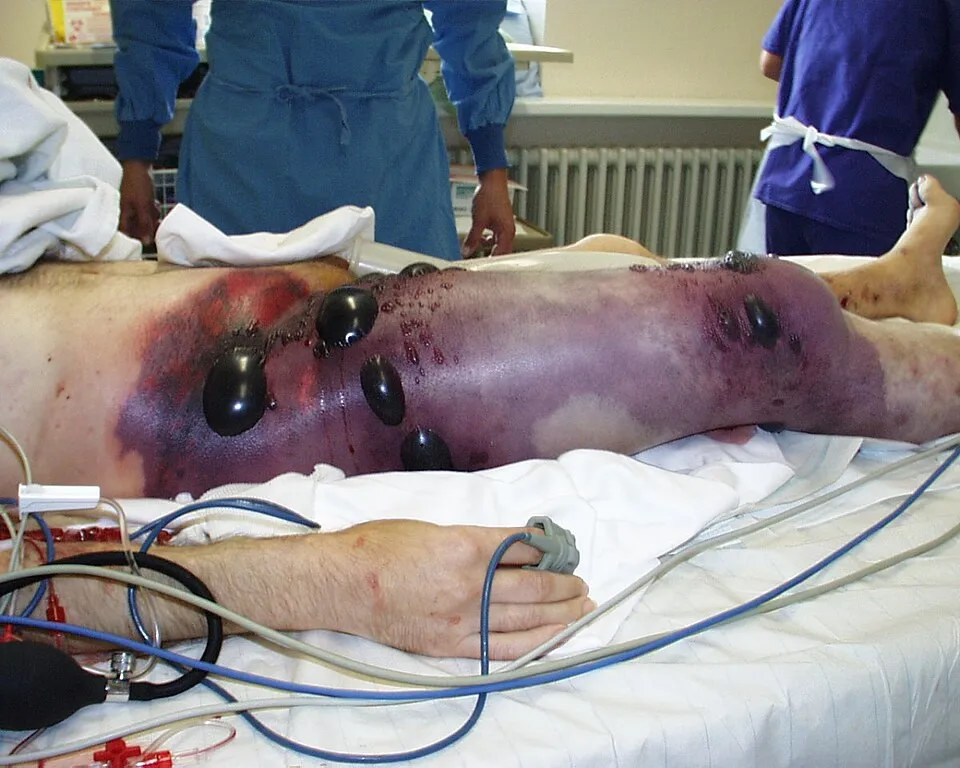
Gas gangrene (clostridial myonecrosis) is a fulminant, toxin-mediated necrotising infection of skeletal muscle caused by anaerobic Clostridium species. Traumatic gas gangrene follows deep, contaminated or crushing wounds, surgery or devitalised tissue and is usually caused by C. perfringens, whose alpha-toxin (a phospholipase C) and theta-toxin destroy muscle, cell membranes, red cells and the microcirculation. Spontaneous (non-traumatic) gas gangrene is caused by the aerotolerant C. septicum spreading from the gut, and is strongly associated with colorectal cancer, neutropenia and haematological malignancy. Severe pain out of proportion appears within hours to days, followed by bronze-to-purple skin, haemorrhagic bullae, crepitus, haemolysis and shock. Gram stain shows large Gram-positive bacilli with few neutrophils; imaging must not delay surgery. Treatment is emergency radical debridement or amputation with re-look, penicillin plus clindamycin (to suppress toxin) and intensive care; hyperbaric oxygen is only an adjunct.
Patient case, mechanism, investigations, management, flashcards and exam-style questions.Open the lesson →
Key facts
- Traumatic gas gangrene: C. perfringens in about 80–90%; spontaneous gas gangrene: C. septicum from the gut, linked to colorectal cancer and neutropenia
- Alpha-toxin (phospholipase C, lecithinase) causes myonecrosis, haemolysis, platelet–leucocyte aggregates and cardiovascular collapse
- Incubation is short: usually less than 24 hours to 3–4 days after injury
- Earliest symptom is sudden severe pain out of proportion; crepitus and skin discolouration are later signs
- Gram stain of exudate: large 'boxcar' Gram-positive rods with very few neutrophils
- Emergency surgical debridement (often amputation) with re-look within 24 hours is the single most important treatment
- Antibiotics: high-dose IV benzylpenicillin plus clindamycin; broad empirical cover (e.g. vancomycin plus piperacillin–tazobactam or a carbapenem, plus clindamycin) until the organism is known
- Hyperbaric oxygen may be considered after surgery but must never delay debridement; patients with C. septicum need colonoscopy after recovery
Differential diagnosis
| Condition | Clues | Key test |
|---|---|---|
| Necrotising fasciitis (type I polymicrobial or type II streptococcal) | Spreads along fascia; muscle usually viable; may also have gas (type I) | Surgical exploration: grey fascia, 'dishwater' fluid, positive finger test, muscle contracts |
| Non-clostridial gas-forming infection (E. coli, Klebsiella, anaerobes in diabetes) | Slower onset, diabetic foot or perineum, less toxaemia | Culture of tissue; Gram-negative rods |
| Streptococcal myositis | Severe muscle pain, toxic shock, no gas | Group A streptococcus on culture; CT or MRI muscle oedema |
| Pyomyositis | Subacute muscle abscess, often S. aureus, tropics or HIV | MRI or ultrasound shows intramuscular abscess |
| Acute compartment syndrome | Tense compartment, pain on passive stretch after fracture or crush, no infection | Compartment pressure measurement |
| Crush injury with rhabdomyolysis | Trauma history, very high CK, myoglobinuria, no gas or toxaemia | CK, urine myoglobin, imaging |
| Subcutaneous emphysema (air from wound or pneumothorax) | Crepitus without systemic toxicity or myonecrosis | Chest X-ray; clinical course |
Exam pearls
Guideline
IDSA practice guidelines for skin and soft tissue infections (2014), WSES/SIS-E consensus on skin and soft-tissue infections (2018), WSES/GAIS/WSIS/SIS-E/AAST global clinical pathways for skin and soft tissue infections (2022) and Surviving Sepsis Campaign guidelines (2021, updated 2026)
References
- Stevens DL, Bisno AL, Chambers HF, et al.. Practice guidelines for the diagnosis and management of skin and soft tissue infections: 2014 update by the Infectious Diseases Society of America. Clin Infect Dis 2014.
- Sartelli M, Guirao X, Hardcastle TC, et al.. 2018 WSES/SIS-E consensus conference: recommendations for the management of skin and soft-tissue infections. World J Emerg Surg 2018.
- Sartelli M, Coccolini F, Kluger Y, et al.. WSES/GAIS/WSIS/SIS-E/AAST global clinical pathways for patients with skin and soft tissue infections. World J Emerg Surg 2022.
- Evans L, Rhodes A, Alhazzani W, et al.. Surviving sepsis campaign: international guidelines for management of sepsis and septic shock 2021. Intensive Care Med 2021.
- Stevens DL, Bryant AE. Necrotizing soft-tissue infections. N Engl J Med 2017.
- Stevens DL, Aldape MJ, Bryant AE. Life-threatening clostridial infections. Anaerobe 2012.
Related topics
By Dr Khalid Seidi (B.Sc., M.D.) · MedEd World Clinical Knowledge library. Original teaching content checked against current guidelines (November 2026); confirm the latest local guidance before clinical use. Not a substitute for clinical judgement.