Clinical Knowledge › Internal medicine › Infectious diseases › Skin, soft-tissue, bone and joint infections
Septic arthritis
Septic arthritis is infection of a joint space, usually by bacteria, and is an orthopaedic and medical emergency because purulent synovitis destroys cartilage within days and carries an in-hospital mortality of about 10%. Most infections are haematogenous; Staphylococcus aureus is the commonest cause, then streptococci, with Neisseria gonorrhoeae in sexually active young adults (tenosynovitis, pustules, polyarthralgia), Gram-negative bacilli in older or immunocompromised people and Kingella kingae in young children. Risk factors include older age, rheumatoid arthritis, diabetes, prostheses, joint injection and injecting drug use. Any acute hot swollen joint, especially a monoarthritis, is septic until proven otherwise: aspirate the joint before antibiotics for Gram stain, culture, cell count and crystals, and take blood cultures. Crystals do not exclude infection. Treatment is prompt joint drainage (needle, arthroscopic or open) plus empirical antibiotics covering S. aureus and streptococci, refined by culture, for a total of about 2–6 weeks depending on organism and drainage.
Patient case, mechanism, investigations, management, flashcards and exam-style questions.Open the lesson →
Key facts
- An acute hot swollen joint is septic arthritis until proven otherwise; aspirate before antibiotics, but do not delay antibiotics in sepsis
- Staphylococcus aureus is the commonest cause; gonococcus in sexually active young adults; Gram-negatives in older, immunosuppressed or injecting drug users; Kingella kingae in under-4s
- The knee is involved in about half of cases, then hip, shoulder, ankle and wrist; polyarticular infection occurs in about 10–20%, especially with rheumatoid arthritis
- Synovial white cell count above 50 × 10⁹/L (50,000/µL) with more than 90% neutrophils is typical, but lower counts do not exclude infection
- Crystals in synovial fluid do not exclude infection; gout and sepsis can coexist
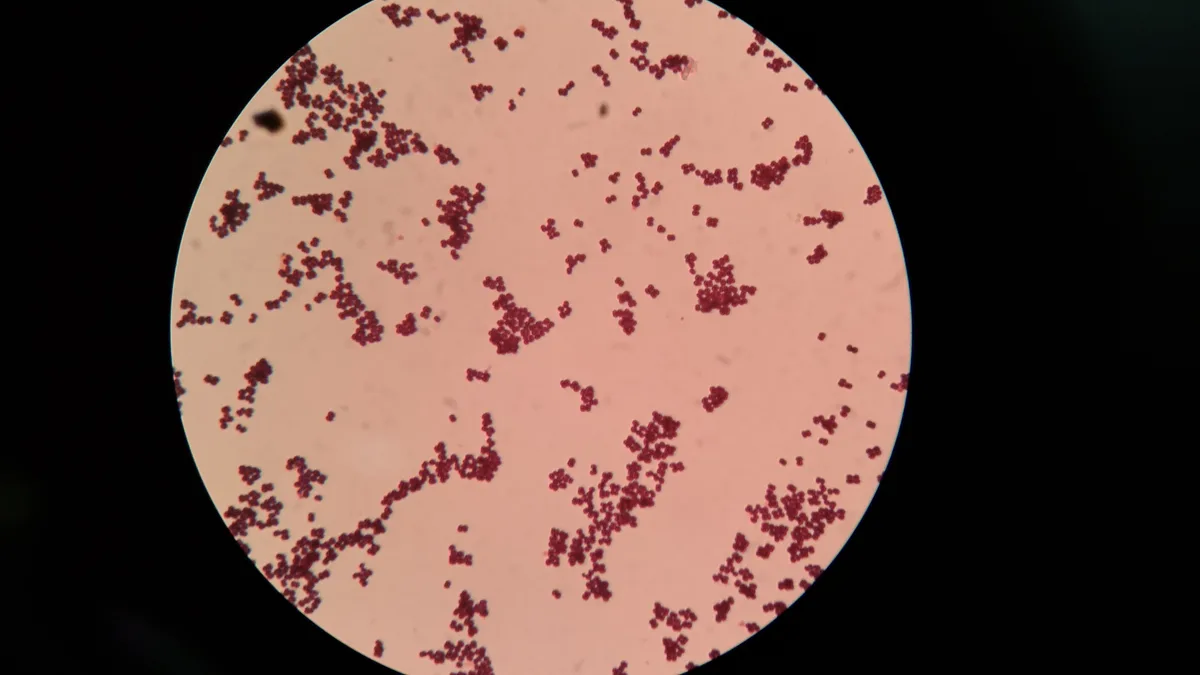
- Gram stain is positive in about half and culture in about 70–80% of non-gonococcal cases; gonococcal joint cultures are often negative, so take urogenital, rectal and pharyngeal NAAT
- Treatment = joint drainage plus antibiotics; a randomised trial supports 2 weeks of antibiotics after surgical drainage in uncomplicated native-joint arthritis
- Kocher criteria for a child with an irritable hip: non-weight-bearing, temperature above 38.5 °C, ESR above 40 mm/h and WCC above 12 × 10⁹/L
Differential diagnosis
| Condition | Clues | Key test |
|---|---|---|
| Gout | Recurrent first MTP or knee attacks, hyperuricaemia, diuretics | Negatively birefringent needle crystals (and still culture the fluid) |
| Pseudogout (CPPD) | Older person, knee or wrist, chondrocalcinosis | Weakly positively birefringent rhomboid crystals |
| Reactive arthritis | Asymmetric lower-limb oligoarthritis 1–4 weeks after urethritis or enteritis, conjunctivitis | Sterile synovial fluid; chlamydia NAAT, stool culture |
| Haemarthrosis | Trauma, anticoagulation or haemophilia | Bloody aspirate; coagulation screen |
| Rheumatoid arthritis flare | Symmetric polyarthritis, known RA | Synovial WCC usually below 50 × 10⁹/L; culture negative |
| Transient synovitis of the hip (child) | Well child after viral illness, can bear some weight | Kocher criteria low; ultrasound with or without aspiration |
| Lyme arthritis | Large knee effusion, tick exposure in endemic area | Lyme serology; synovial PCR |
| Cellulitis or prepatellar bursitis | Superficial swelling, joint movement preserved | Clinical; ultrasound; bursal aspirate |
Exam pearls
Guideline
BSR/BHPR/BOA/RCGP/BSAC guideline on the hot swollen joint in adults (2006); EBJIS/ESCMID-associated SANJO guideline for septic arthritis in native joints (2023); CDC STI Treatment Guidelines (2021) for gonococcal arthritis
References
- Coakley G, Mathews C, Field M, et al.. BSR & BHPR, BOA, RCGP and BSAC guidelines for management of the hot swollen joint in adults. Rheumatology (Oxford) 2006.
- Ravn C, Neyt J, Benito N, et al.. Guideline for management of septic arthritis in native joints (SANJO). J Bone Jt Infect 2023.
- Gjika E, Beaulieu JY, Vakalopoulos K, et al.. Two weeks versus four weeks of antibiotic therapy after surgical drainage for native joint bacterial arthritis: a prospective, randomised, non-inferiority trial. Ann Rheum Dis 2019.
- Mathews CJ, Weston VC, Jones A, Field M, Coakley G. Bacterial septic arthritis in adults. Lancet 2010.
- Margaretten ME, Kohlwes J, Moore D, Bent S. Does this adult patient have septic arthritis?. JAMA 2007.
- Li HK, Rombach I, Zambellas R, et al.. Oral versus intravenous antibiotics for bone and joint infection. N Engl J Med 2019.
Related topics
By Dr Khalid Seidi (B.Sc., M.D.) · MedEd World Clinical Knowledge library. Original teaching content checked against current guidelines (November 2026); confirm the latest local guidance before clinical use. Not a substitute for clinical judgement.