Clinical Knowledge › Internal medicine › Infectious diseases › Skin, soft-tissue, bone and joint infections
Measles and rubella
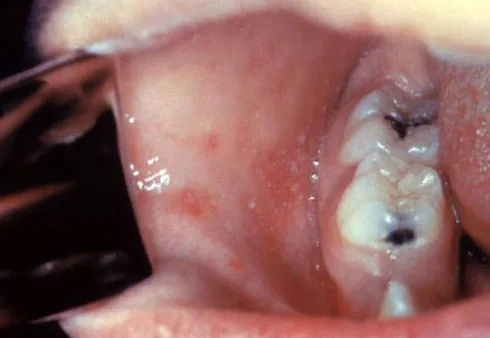
Measles and rubella are vaccine-preventable viral exanthems prevented by the same MMR (or MMRV) vaccine. Measles, caused by a paramyxovirus (Morbillivirus), is one of the most contagious human infections (R0 12–18). After about 10–12 days' incubation it causes high fever with cough, coryza and conjunctivitis, Koplik spots on the buccal mucosa and then a maculopapular rash that spreads from the hairline downwards. Complications include pneumonia (the main cause of death), otitis media, diarrhoea, encephalitis, blindness, 'immune amnesia' and, years later, subacute sclerosing panencephalitis. Rubella (a togavirus) is usually mild, with a short-lived pink rash, postauricular and suboccipital lymphadenopathy and arthralgia, but infection in early pregnancy causes congenital rubella syndrome (deafness, cataracts, heart defects). Both are notifiable and confirmed by PCR and IgM. Measles treatment is supportive with vitamin A; isolation, post-exposure MMR or immunoglobulin, and two-dose vaccine coverage of at least 95% control spread. Measles has resurged globally since 2023.
Patient case, mechanism, investigations, management, flashcards and exam-style questions.Open the lesson →
Key facts
- Measles: prodrome of fever and the '3 Cs' (cough, coryza, conjunctivitis), Koplik spots, then a maculopapular rash from the hairline and behind the ears spreading down the body
- Measles is infectious from 4 days before to 4 days after rash onset and spreads by the airborne route; a secondary attack rate of about 90% in susceptible contacts
- Pneumonia is the commonest cause of measles death; encephalitis occurs in about 1 in 1,000 cases and SSPE years later
- WHO recommends vitamin A (two doses 24 hours apart) for all children with measles; it reduces mortality and eye damage
- Post-exposure: MMR within 72 hours for susceptible people aged 6 months or more (not pregnant or immunosuppressed); human normal immunoglobulin within 6 days for those who cannot have vaccine
- Rubella: mild illness with pink rash for about 3 days, postauricular and suboccipital lymphadenopathy, arthralgia in adult women
- Congenital rubella syndrome is most likely after infection in the first 12 weeks: sensorineural deafness, cataracts, patent ductus arteriosus or pulmonary artery stenosis
- MMR and MMRV are live vaccines: contraindicated in pregnancy and severe immunosuppression; avoid pregnancy for 1 month after vaccination
Differential diagnosis
| Condition | Clues | Key test |
|---|---|---|
| Scarlet fever | Sandpaper rash, circumoral pallor, strawberry tongue, sore throat | Throat swab for group A streptococcus |
| Parvovirus B19 (erythema infectiosum) | Slapped cheek, lacy reticular limb rash, arthropathy in adults | Parvovirus IgM or PCR |
| Roseola (HHV-6) | Infant with high fever for 3 days, rash appears as fever resolves | Clinical; HHV-6 PCR rarely needed |
| Kawasaki disease | Fever 5 days or more, conjunctivitis without exudate, red lips, hand and foot changes | Clinical criteria, echocardiography |
| Infectious mononucleosis with drug rash | Pharyngitis, lymphadenopathy, rash after amoxicillin | Monospot or EBV serology |
| Dengue | Travel, fever, headache, myalgia, thrombocytopenia | NS1 antigen, dengue serology |
| Drug eruption | New drug, itch, eosinophilia, no prodrome | Drug history; resolution on withdrawal |
| Secondary syphilis | Rash on palms and soles, lymphadenopathy, mucous patches | Treponemal and non-treponemal serology |
Exam pearls
Guideline
WHO measles vaccines position paper (2017) and rubella vaccines position paper (2020); UKHSA Green Book chapters 21 (Measles) and 28 (Rubella) with the MMRV programme (January 2026); ACIP MMR recommendations (2013)
References
- World Health Organization. Measles vaccines: WHO position paper – April 2017. Wkly Epidemiol Rec 2017.
- World Health Organization. Rubella vaccines: WHO position paper – July 2020. Wkly Epidemiol Rec 2020.
- UK Health Security Agency. MMRV vaccination: information for healthcare professionals. UKHSA 2025.
- Moss WJ. Measles. Lancet 2017.
- Lambert N, Strebel P, Orenstein W, Icenogle J, Poland GA. Rubella. Lancet 2015.
- Mina MJ, Kula T, Leng Y, et al.. Measles virus infection diminishes preexisting antibodies that offer protection from other pathogens. Science 2019.
Related topics
By Dr Khalid Seidi (B.Sc., M.D.) · MedEd World Clinical Knowledge library. Original teaching content checked against current guidelines (November 2026); confirm the latest local guidance before clinical use. Not a substitute for clinical judgement.