Clinical Knowledge › Ear, nose and throat › Inner ear, hearing and balance
Hearing aids and cochlear implants
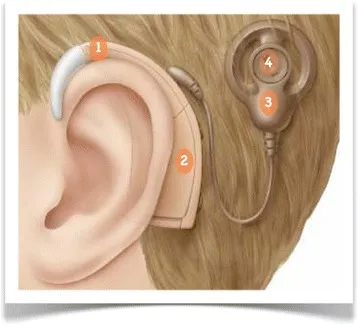
Hearing aids and implantable devices restore access to sound when hearing loss cannot be reversed. Air-conduction aids (behind-the-ear, receiver-in-canal and in-the-ear) amplify sound to match the audiogram and are first-line for most mild to severe losses. CROS aids, bone-conduction devices and middle-ear implants help single-sided deafness, atresia and chronically discharging ears. A cochlear implant bypasses damaged hair cells: an external processor sends coded signals through the skin to an internal receiver and an electrode array in the scala tympani, which stimulates the spiral ganglion directly. Candidates have severe to profound sensorineural loss and poor speech understanding despite optimal aids; NICE TA566 defines this as thresholds of 80 dB HL or worse at two or more frequencies and an aided phoneme score below 50%. An auditory brainstem implant is used when the cochlear nerve is absent, as in neurofibromatosis type 2. Key safety issues are facial nerve injury, meningitis (prevented by pneumococcal vaccination), device failure, MRI precautions and button batteries in children.
Patient case, mechanism, investigations, management, flashcards and exam-style questions.Open the lesson →
Key facts
- Hearing aid components: microphone, digital signal processor (amplifier), receiver (speaker), battery; directional microphones, noise reduction and feedback cancellation
- Bilateral fitting is preferred when both ears are aidable (better localisation and hearing in noise)
- CROS aids route sound from an unaidable ear to the better ear; bone-conduction devices transmit sound through the skull to the better cochlea
- Cochlear implant: external microphone and processor plus transmitter coil; internal receiver–stimulator and electrode array in the scala tympani
- NICE TA566 (2019): severe to profound deafness = thresholds ≥80 dB HL at 2 or more of 500–4000 Hz; inadequate aid benefit = AB word phoneme score <50% at 70 dBA (adults)
- Children with severe to profound deafness: bilateral simultaneous implants, ideally before about 12–18 months
- Implant recipients need pneumococcal vaccination because of meningitis risk
- Auditory brainstem implant for absent or non-functioning cochlear nerves (NF2, cochlear nerve aplasia)
Differential diagnosis
| Condition | Clues | Key test |
|---|---|---|
| Air-conduction hearing aid | Mild to severe SNHL with usable speech discrimination | Audiogram and speech testing; fitting to prescriptive targets |
| CROS / BiCROS aid | Single-sided deafness (or asymmetric loss with poor ear unaidable) | Unilateral profound SNHL on audiogram |
| Bone-conduction device (percutaneous or transcutaneous) | Conductive or mixed loss with atresia, microtia or chronic discharge; SSD | Bone conduction thresholds within device range; trial on softband |
| Active middle-ear implant | Moderate to severe loss unable to wear conventional aids | Specialist audiological and surgical assessment |
| Cochlear implant | Severe to profound SNHL with poor aided speech understanding | Thresholds ≥80 dB HL, aided phoneme score <50%, MRI showing cochlear nerve |
| Auditory brainstem implant | Absent cochlear nerve or bilateral vestibular schwannomas (NF2) | MRI; specialist neurotology centre |
| Surgical correction instead of a device | Otosclerosis, ossicular discontinuity, perforation | Stapedotomy, ossiculoplasty or tympanoplasty may restore hearing |
Exam pearls
Guideline
NICE TA566 Cochlear implants for children and adults with severe to profound deafness (2019), NICE NG98 Hearing loss in adults (2018) and AAO-HNSF Age-Related Hearing Loss guideline (2024)
References
- National Institute for Health and Care Excellence. Cochlear implants for children and adults with severe to profound deafness (TA566). NICE, London 2019.
- National Institute for Health and Care Excellence. Hearing loss in adults: assessment and management (NG98). NICE, London 2018.
- Tsai Do BS, Bush ML, Weinreich HM, et al.. Clinical Practice Guideline: Age-Related Hearing Loss. Otolaryngol Head Neck Surg 2024.
- Carlson ML. Cochlear implantation in adults. N Engl J Med 2020.
- Ferguson MA, Kitterick PT, Chong LY, et al.. Hearing aids for mild to moderate hearing loss in adults. Cochrane Database Syst Rev 2017.
- World Health Organization. World report on hearing. WHO, Geneva 2021.
Related topics
By Dr Khalid Seidi (B.Sc., M.D.) · MedEd World Clinical Knowledge library. Original teaching content checked against current guidelines (November 2026); confirm the latest local guidance before clinical use. Not a substitute for clinical judgement.