Clinical Knowledge › Ear, nose and throat › Inner ear, hearing and balance
Sudden sensorineural hearing loss
Sudden sensorineural hearing loss (SSNHL) is a loss of at least 30 dB over three consecutive frequencies developing within 72 hours. It usually affects one ear, with tinnitus, fullness and sometimes vertigo. About 90% of cases are idiopathic, with viral, vascular and immune mechanisms proposed, but vestibular schwannoma, stroke in the anterior inferior cerebellar artery territory, Ménière disease, autoimmune disease, syphilis, trauma and ototoxic drugs must be considered. It is an otological emergency: the first task is to separate sensorineural from conductive loss, because wax or middle-ear fluid can mimic it. NICE advises same-day ENT or emergency referral for loss within the past 30 days. Audiometry confirms the diagnosis, and MRI looks for retrocochlear causes; routine head CT and blanket blood tests are not useful. Systemic corticosteroids within 2 weeks, intratympanic steroid as primary or salvage therapy, and hyperbaric oxygen combined with steroids are options. About half recover some hearing; profound loss, vertigo, older age and delay predict a worse outcome.
Patient case, mechanism, investigations, management, flashcards and exam-style questions.Open the lesson →
Key facts
- Definition: SNHL of at least 30 dB at 3 consecutive frequencies developing within 72 hours
- Incidence about 5–27 per 100,000 per year; peak 40–60 years; usually unilateral
- About 90% idiopathic; vestibular schwannoma is found in a small minority, so MRI is needed in all
- Bedside: Weber lateralises AWAY from the affected ear; Rinne positive in the affected ear (false negative if profound)
- NICE NG98: refer immediately (within 24 hours) to ENT or emergency services if sudden loss started within the last 30 days
- Oral prednisolone about 1 mg/kg/day (max 60 mg) for about 7 days, ideally started within 2 weeks (teaching dose; check local formulary)
- Intratympanic steroid is a primary option when systemic steroids are unsuitable and a salvage option at 2–6 weeks
- Hearing loss with vertigo and any neurological sign may be an AICA stroke: urgent stroke assessment
Differential diagnosis
| Condition | Clues | Key test |
|---|---|---|
| Earwax or otitis media with effusion | Muffled hearing, abnormal otoscopy | Weber to affected ear; Rinne negative; type B tympanogram |
| AICA or vertebrobasilar stroke | Vertigo, ataxia, facial numbness or weakness, vascular risk | HINTS examination; urgent MRI with diffusion |
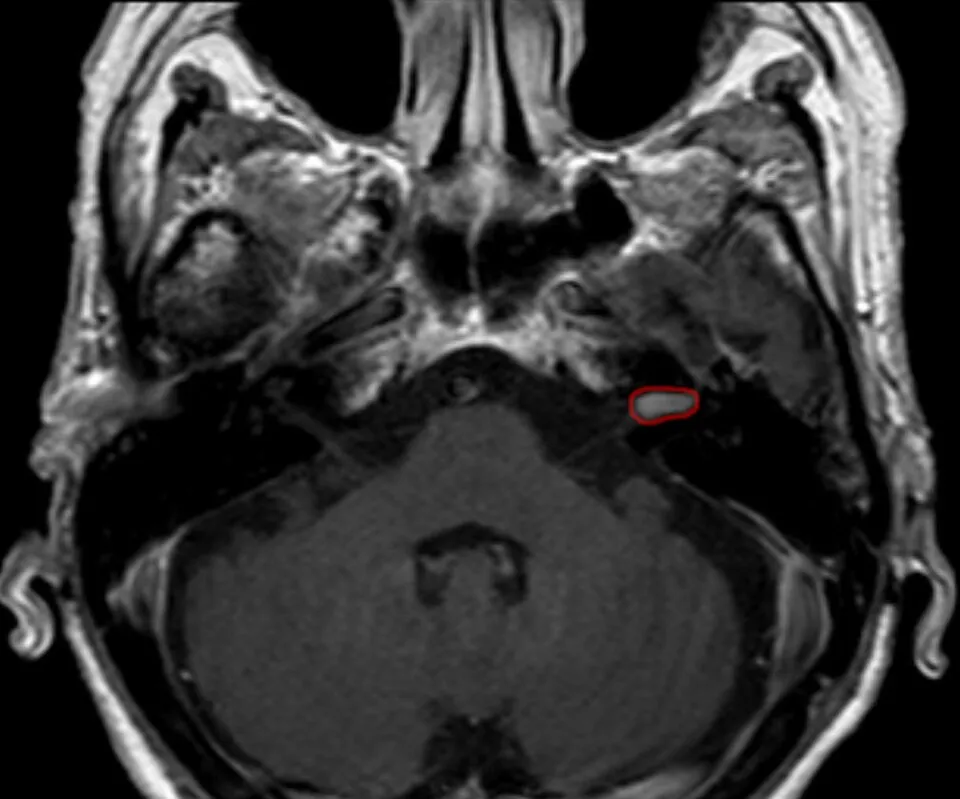
| Vestibular schwannoma | Unilateral tinnitus, may present suddenly | Gadolinium-enhanced MRI internal auditory meati |
| Ménière disease | Recurrent attacks with vertigo and low-frequency loss | Fluctuating low-frequency SNHL; Bárány criteria |
| Autoimmune inner ear disease | Bilateral or sequential rapidly progressive loss | Systemic features; inflammatory markers; steroid response |
| Otosyphilis | Fluctuating or bilateral loss, risk factors | Treponemal and non-treponemal serology |
| Perilymph fistula or barotrauma | Onset with straining, diving, flying or head injury | History; fistula test; CT temporal bone |
| Ototoxicity | Recent aminoglycoside, cisplatin or high-dose loop diuretic | Drug history; bilateral high-frequency loss |
Exam pearls
Guideline
AAO-HNSF Clinical Practice Guideline: Sudden Hearing Loss (Update 2019), NICE NG98 Hearing loss in adults (2018) and ENT UK sudden SNHL guidance
References
- Chandrasekhar SS, Tsai Do BS, Schwartz SR, et al.. Clinical Practice Guideline: Sudden Hearing Loss (Update). Otolaryngol Head Neck Surg 2019.
- National Institute for Health and Care Excellence. Hearing loss in adults: assessment and management (NG98). NICE, London 2018.
- Rauch SD, Halpin CF, Antonelli PJ, et al.. Oral vs intratympanic corticosteroid therapy for idiopathic sudden sensorineural hearing loss: a randomized trial. JAMA 2011.
- Plontke SK, Girndt M, Meisner C, et al.. High-dose glucocorticoids for the treatment of sudden hearing loss (HODOKORT trial). NEJM Evid 2024.
- Schreiber BE, Agrup C, Haskard DO, Luxon LM. Sudden sensorineural hearing loss. Lancet 2010.
- Papadakis MA, Rabow MW, McQuaid KR, eds.. CURRENT Medical Diagnosis & Treatment 2026 (chapter 8: Ear, nose and throat disorders). McGraw Hill 2026.
Related topics
By Dr Khalid Seidi (B.Sc., M.D.) · MedEd World Clinical Knowledge library. Original teaching content checked against current guidelines (November 2026); confirm the latest local guidance before clinical use. Not a substitute for clinical judgement.