Clinical Knowledge › Ear, nose and throat › Inner ear, hearing and balance
Noise-induced hearing loss
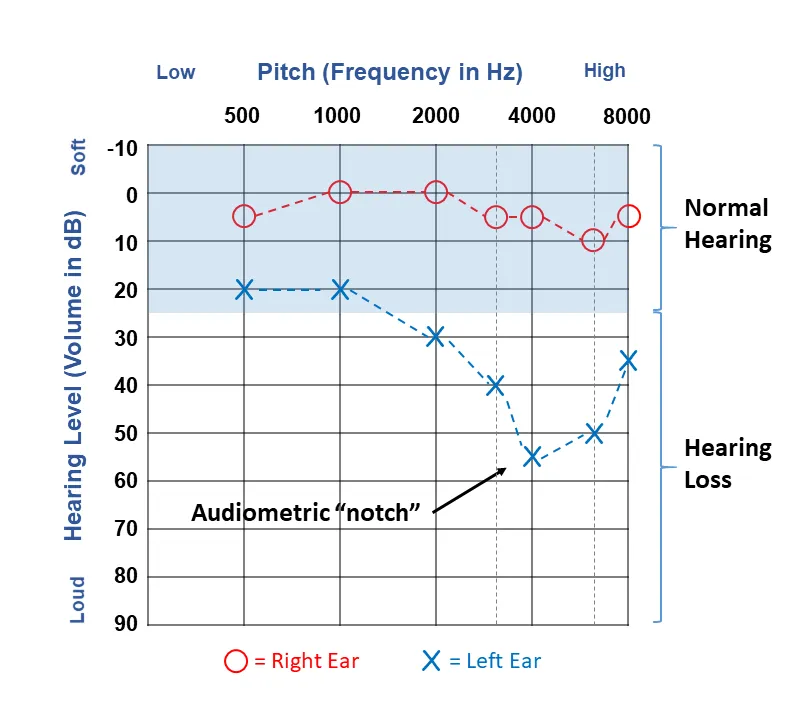
Noise-induced hearing loss (NIHL) is sensorineural hearing loss caused by sound energy that overwhelms the cochlea. Long-term exposure above about 85 dB(A), from industry, construction, the military, music venues and personal listening devices, damages outer hair cells and cochlear synapses; a single impulse such as a gunshot or explosion can cause acoustic trauma. Early exposure produces a temporary threshold shift with muffled hearing and tinnitus that recovers within a day or two; repeated injury becomes a permanent threshold shift. The hallmark audiogram is a notch at 3–6 kHz, classically 4 kHz, with partial recovery at 8 kHz, usually bilateral and symmetrical for workplace noise and worse on one side after firearms. Loss stabilises when exposure stops. There is no proven drug treatment, so prevention is everything: engineering and administrative noise control, properly worn hearing protection, audiometric surveillance in hearing conservation programmes and safe-listening habits. Hearing aids and tinnitus support help those affected; unilateral, sudden or post-exposure progressive loss needs another explanation.
Patient case, mechanism, investigations, management, flashcards and exam-style questions.Open the lesson →
Key facts
- Leading preventable cause of adult sensorineural hearing loss and among the commonest occupational diseases worldwide
- Risk rises with level and duration: 85 dB(A) for 8 hours is roughly equal in dose to 88 dB(A) for 4 hours (3-dB exchange rate)
- Audiogram: notch (bulge) at 3–6 kHz, often 4 kHz, with recovery at 8 kHz; low frequencies spared
- Temporary threshold shift recovers within 24–48 hours; repeated shifts lead to permanent loss
- Workplace NIHL is bilateral and symmetrical; firearm loss is often worse in the ear nearer the muzzle (left ear in right-handed rifle shooters)
- Loss does not progress once exposure stops; further decline is from ageing or another cause
- UK Noise at Work Regulations 2005: action values 80 and 85 dB(A), limit 87 dB(A) (allowing for protection)
- WHO: up to 80 dB for 40 hours a week is a safe weekly dose for adults; venues should keep below 100 dB LAeq over 15 minutes
Differential diagnosis
| Condition | Clues | Key test |
|---|---|---|
| Presbycusis | Older age, no noise history | Down-sloping audiogram without 8 kHz recovery |
| Sudden sensorineural hearing loss | Unilateral loss over hours to 3 days, no clear noise event | Urgent audiogram; MRI internal auditory meati |
| Vestibular schwannoma | Unilateral tinnitus and asymmetric SNHL | MRI with gadolinium |
| Ototoxicity | Aminoglycoside or cisplatin exposure | High-frequency loss including 8 kHz; drug history |
| Ménière disease | Episodic vertigo with fluctuating low-frequency loss | Low-frequency SNHL; Bárány criteria |
| Perilymph fistula or barotrauma | Blast, diving or flying with vertigo | Fistula test, otoscopy, CT temporal bone |
| Non-organic hearing loss | Compensation claim, inconsistent responses | Otoacoustic emissions, auditory brainstem responses, Stenger test |
Exam pearls
Guideline
ACOEM Occupational Noise-Induced Hearing Loss statement (2012), UK Control of Noise at Work Regulations 2005 (HSE L108, 3rd ed 2021), NIOSH criteria (1998) and WHO safe listening standards (2022)
References
- Kirchner DB, Evenson E, Dobie RA, et al.. Occupational noise-induced hearing loss: ACOEM Task Force on Occupational Hearing Loss. J Occup Environ Med 2012.
- Health and Safety Executive. Controlling noise at work. The Control of Noise at Work Regulations 2005: guidance on regulations (L108). HSE Books 2021.
- National Institute for Occupational Safety and Health. Criteria for a recommended standard: occupational noise exposure (revised criteria 1998). NIOSH, Cincinnati 1998.
- World Health Organization. WHO global standard for safe listening venues and events. WHO, Geneva 2022.
- World Health Organization. World report on hearing. WHO, Geneva 2021.
- Basner M, Babisch W, Davis A, et al.. Auditory and non-auditory effects of noise on health. Lancet 2014.
Related topics
By Dr Khalid Seidi (B.Sc., M.D.) · MedEd World Clinical Knowledge library. Original teaching content checked against current guidelines (November 2026); confirm the latest local guidance before clinical use. Not a substitute for clinical judgement.