Clinical Knowledge › Ear, nose and throat › Inner ear, hearing and balance
Ménière disease
Ménière disease is a chronic inner-ear disorder of recurrent spontaneous vertigo attacks with fluctuating sensorineural hearing loss, tinnitus and aural fullness in the affected ear. Its histological hallmark is endolymphatic hydrops, although the cause of attacks remains uncertain and genetic, autoimmune and migraine-related factors contribute. Typical attacks begin with fullness and roaring tinnitus, followed by rotatory vertigo with vomiting lasting 20 minutes to 12 hours, and settle completely between episodes early in the disease. The Bárány Society criteria require at least two spontaneous attacks and audiometrically documented low- to mid-frequency SNHL in the affected ear. Hearing loss fluctuates at first, then becomes permanent; up to a third develop bilateral disease. MRI excludes vestibular schwannoma; vestibular migraine is the main mimic. Management combines short-term vestibular suppressants for attacks, education, salt reduction, and stepwise escalation to intratympanic steroids, intratympanic gentamicin or surgery for disabling vertigo. Betahistine is widely used but the BEMED trial found no benefit over placebo.
Patient case, mechanism, investigations, management, flashcards and exam-style questions.Open the lesson →
Key facts
- Triad plus one: episodic vertigo, fluctuating SNHL, tinnitus and aural fullness in the same ear
- Definite Ménière disease (Bárány 2015): ≥2 spontaneous vertigo episodes lasting 20 minutes to 12 hours plus audiometric low- to mid-frequency SNHL
- Onset usually 40–60 years; unilateral at first, bilateral in up to a third over time
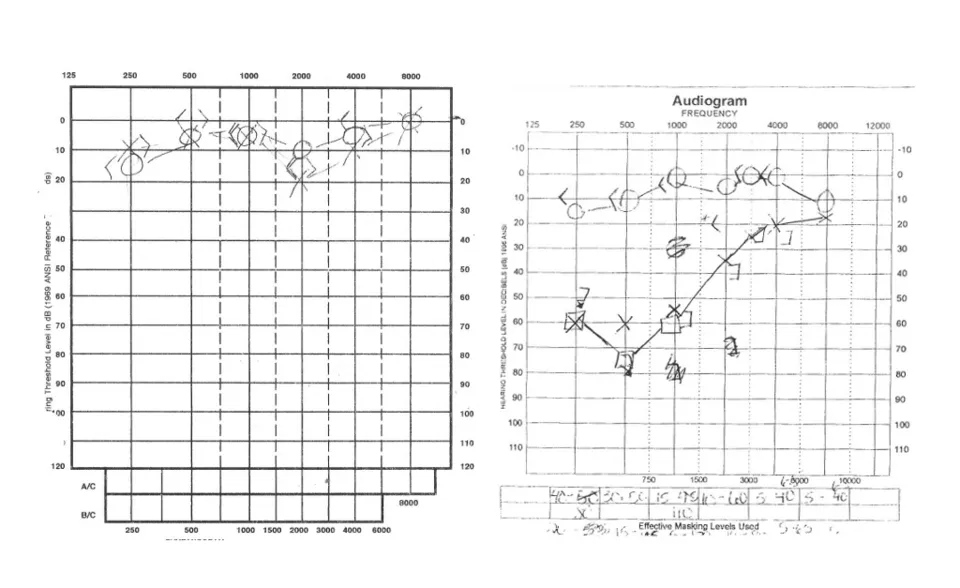
- Audiogram: low-frequency (up-sloping) SNHL early, becoming flat and permanent
- Vertigo lasting seconds suggests BPPV; days suggests vestibular neuritis; minutes to hours with headache or photophobia suggests vestibular migraine
- Tumarkin otolithic crises: sudden drop attacks without loss of consciousness in later disease
- BEMED trial (2016): betahistine no better than placebo for attack frequency
- Intratympanic gentamicin ablates vestibular function and controls vertigo in most refractory cases but risks hearing loss
Differential diagnosis
| Condition | Clues | Key test |
|---|---|---|
| Vestibular migraine | Attacks 5 minutes to 72 hours, migraine features, often normal hearing | Bárány/IHS criteria; audiogram usually normal or mildly symmetrical |
| Vestibular schwannoma | Progressive asymmetric SNHL and tinnitus; imbalance rather than episodic vertigo | Gadolinium-enhanced MRI internal auditory meati |
| BPPV | Brief vertigo with head position change; no hearing change | Dix–Hallpike positive |
| Vestibular neuritis or labyrinthitis | Single prolonged attack over days; hearing loss only in labyrinthitis | Abnormal head impulse; no recurrence pattern |
| Autoimmune inner ear disease | Bilateral rapidly progressive fluctuating SNHL | Systemic features; steroid response |
| Otosyphilis | Fluctuating SNHL and vertigo, risk factors | Treponemal serology |
| Perilymph fistula or superior canal dehiscence | Sound- or pressure-induced vertigo (Tullio, Hennebert) | High-resolution CT temporal bone; VEMP |
| Posterior circulation TIA | Brief vertigo with vascular risk and neurological symptoms | Neurological examination; vascular imaging |
Exam pearls
Guideline
AAO-HNSF Clinical Practice Guideline: Ménière's Disease (2020) and Bárány Society diagnostic criteria (2015)
References
- Basura GJ, Adams ME, Monfared A, et al.. Clinical Practice Guideline: Ménière's Disease. Otolaryngol Head Neck Surg 2020.
- Lopez-Escamez JA, Carey J, Chung WH, et al.. Diagnostic criteria for Menière's disease. J Vestib Res 2015.
- Adrion C, Fischer CS, Wagner J, et al.. Efficacy and safety of betahistine treatment in patients with Meniere's disease: primary results of a long term, multicentre, double blind, randomised, placebo controlled, dose defining trial (BEMED trial). BMJ 2016.
- Patel M, Agarwal K, Arshad Q, et al.. Intratympanic methylprednisolone versus gentamicin in patients with unilateral Ménière's disease: a randomised, double-blind, comparative effectiveness trial. Lancet 2016.
- Nakashima T, Pyykkö I, Arroll MA, et al.. Meniere's disease. Nat Rev Dis Primers 2016.
- Lempert T, Olesen J, Furman J, et al.. Vestibular migraine: diagnostic criteria (update). J Vestib Res 2022.
Related topics
By Dr Khalid Seidi (B.Sc., M.D.) · MedEd World Clinical Knowledge library. Original teaching content checked against current guidelines (November 2026); confirm the latest local guidance before clinical use. Not a substitute for clinical judgement.