Clinical Knowledge › Ear, nose and throat › Inner ear, hearing and balance
Presbycusis
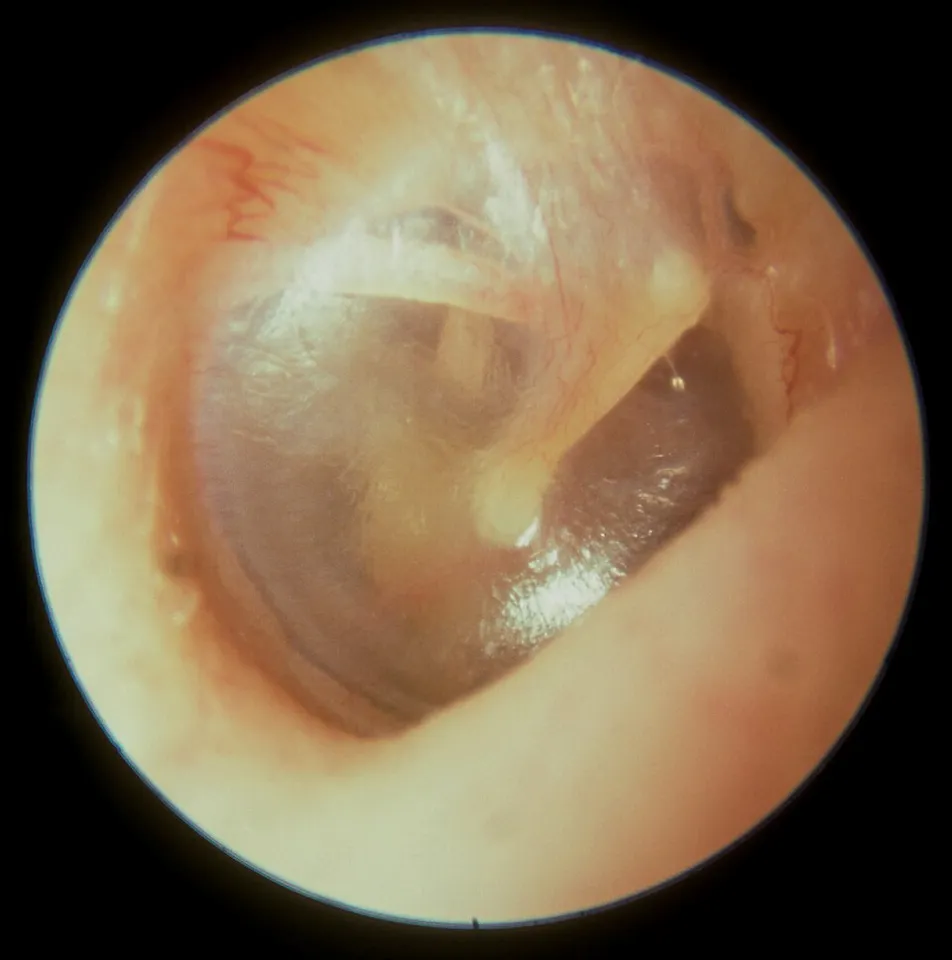
Presbycusis (age-related hearing loss) is the gradual, bilateral, broadly symmetrical sensorineural hearing loss that accumulates with ageing. It is the commonest sensory deficit in older adults. Degeneration of outer hair cells at the cochlear base, the stria vascularis and spiral ganglion neurones produces a high-frequency, down-sloping audiogram, so consonants are lost first and people complain that speech is loud enough but unclear, especially in background noise. Noise exposure, genetics, diabetes, smoking, vascular disease and ototoxic drugs add to the age effect. Diagnosis rests on otoscopy to exclude wax or middle-ear disease, tuning forks and pure tone audiometry; asymmetry, sudden change, unilateral tinnitus, conductive or mixed loss or poor word recognition need ENT assessment and often MRI. Treatment is rehabilitation: appropriately fitted hearing aids, communication tactics, assistive listening devices and referral for cochlear implantation when aids no longer give useful speech understanding. Untreated loss is linked with isolation, depression, falls and dementia.
Patient case, mechanism, investigations, management, flashcards and exam-style questions.Open the lesson →
Key facts
- Commonest cause of hearing loss in adults; prevalence roughly doubles each decade after 50
- Typical audiogram: bilateral symmetrical sensorineural loss sloping down at high frequencies (2–8 kHz), air and bone conduction together
- Classic complaint: 'I can hear people but cannot understand them', worse in noise and with high-pitched voices
- Tuning forks: Rinne positive both ears (air > bone), Weber central in symmetrical loss
- Red flags needing ENT: asymmetry, sudden onset, unilateral tinnitus, conductive or mixed loss, poor word recognition, vertigo or neurological signs
- NICE NG98: asymmetry of 15 dB or more at 2 adjacent frequencies warrants MRI of the internal auditory meati
- Hearing aids are first-line; refer for cochlear implant assessment when aided speech understanding stays poor
- The 2024 Lancet Commission lists midlife hearing loss as one of the largest modifiable dementia risk factors (about 7% of cases)
Differential diagnosis
| Condition | Clues | Key test |
|---|---|---|
| Earwax impaction | Gradual muffling, often after hearing aid or cotton-bud use | Otoscopy; conductive component that resolves after removal |
| Noise-induced hearing loss | Occupational or recreational noise history; tinnitus | Audiogram notch at 3–6 kHz with recovery at 8 kHz |
| Otosclerosis | Younger onset, family history, conductive loss | Rinne negative; air–bone gap with Carhart notch at 2 kHz; As tympanogram |
| Vestibular schwannoma | Asymmetric loss, unilateral tinnitus, imbalance | MRI internal auditory meati with gadolinium |
| Ménière disease | Episodic vertigo, fluctuating low-frequency loss, aural fullness | Audiogram low-frequency SNHL; Bárány criteria |
| Ototoxic hearing loss | Aminoglycoside, cisplatin or loop diuretic exposure | Serial high-frequency audiometry; drug history |
| Chronic otitis media or cholesteatoma | Discharge, perforation or retraction | Otoscopy; conductive or mixed loss; CT temporal bone |
| Cognitive impairment | Communication difficulty with memory complaints | Cognitive testing after hearing is optimised; normal audiogram |
Exam pearls
Guideline
AAO-HNSF Clinical Practice Guideline: Age-Related Hearing Loss (2024), NICE NG98 Hearing loss in adults (2018) and WHO World report on hearing (2021)
References
- Tsai Do BS, Bush ML, Weinreich HM, et al.. Clinical Practice Guideline: Age-Related Hearing Loss. Otolaryngol Head Neck Surg 2024.
- National Institute for Health and Care Excellence. Hearing loss in adults: assessment and management (NG98). NICE, London 2018.
- World Health Organization. World report on hearing. WHO, Geneva 2021.
- Krist AH, Davidson KW, Mangione CM, et al.. Screening for hearing loss in older adults: US Preventive Services Task Force recommendation statement. JAMA 2021.
- Livingston G, Huntley J, Liu KY, et al.. Dementia prevention, intervention, and care: 2024 report of the Lancet standing Commission. Lancet 2024.
- Lin FR, Pike JR, Albert MS, et al.. Hearing intervention versus health education control to reduce cognitive decline in older adults with hearing loss in the USA (ACHIEVE): a multicentre, randomised controlled trial. Lancet 2023.
Related topics
By Dr Khalid Seidi (B.Sc., M.D.) · MedEd World Clinical Knowledge library. Original teaching content checked against current guidelines (November 2026); confirm the latest local guidance before clinical use. Not a substitute for clinical judgement.