Clinical Knowledge › Internal medicine › Gastroenterology and hepatology › Liver failure, cirrhosis and liver tumours
Hepatic encephalopathy
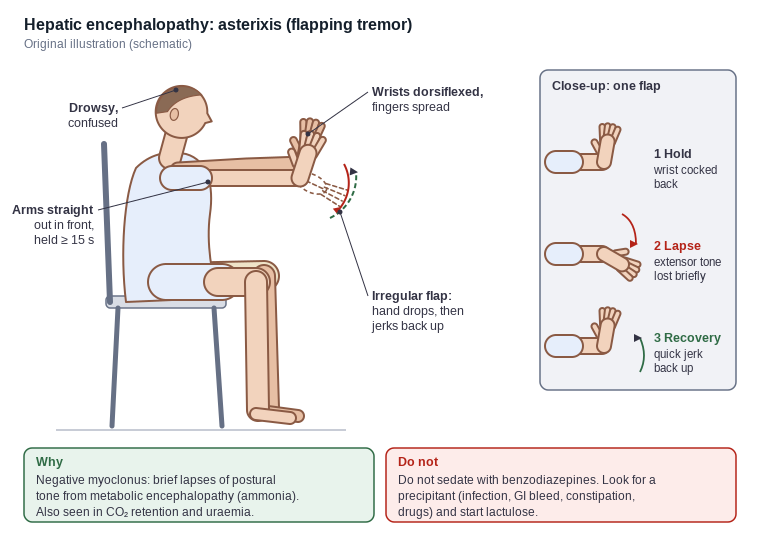
Hepatic encephalopathy (HE) is brain dysfunction caused by liver insufficiency and/or portosystemic shunting. It ranges from covert HE, detectable only with psychometric tests yet enough to impair driving and work, to overt HE with confusion, asterixis, drowsiness and coma. Gut-derived ammonia that escapes hepatic clearance is taken up by astrocytes and converted to glutamine, causing astrocyte swelling and altered neurotransmission, amplified by systemic inflammation, infection and sarcopenia. Most episodes in cirrhosis are precipitated by infection, gastrointestinal bleeding, constipation, dehydration or diuretics, electrolyte disturbance, kidney injury or sedatives. Diagnosis is clinical and by exclusion: check glucose, look for the trigger and other causes of confusion, and use a normal ammonia mainly to question the diagnosis. Treatment is to protect the airway, correct the precipitant and give lactulose titrated to two or three soft stools a day; rifaximin is added to prevent recurrence. Overt HE predicts poor survival and should prompt transplant assessment.
Patient case, mechanism, investigations, management, flashcards and exam-style questions.Open the lesson →
Key facts
- Hepatic encephalopathy is a reversible neuropsychiatric syndrome caused by liver failure and/or portosystemic shunting
- Graded by West Haven criteria: covert HE (minimal and grade 1) and overt HE (grades 2–4)
- Ammonia is central: astrocytes convert it to glutamine, causing cell swelling and neuroinflammation
- Look for a precipitant in every episode: infection, bleeding, constipation, dehydration or diuretics, hypokalaemia, hyponatraemia, AKI, sedatives
- Diagnosis is clinical; a normal ammonia makes HE unlikely, but ammonia levels should not be used alone to diagnose, grade or guide treatment
- Lactulose titrated to 2–3 soft stools per day treats overt HE and prevents recurrence
- Rifaximin added to lactulose after a recurrence reduces further episodes and admissions
- Do not restrict protein: aim for 1.2–1.5 g/kg/day with a late-evening snack
Differential diagnosis
| Condition | Clues | Key test |
|---|---|---|
| Hypoglycaemia | Sweating, rapid onset; common in liver failure and alcohol use | Capillary glucose immediately |
| Wernicke encephalopathy | Ataxia, ophthalmoplegia, confusion in alcohol use or malnutrition | Clinical diagnosis; give IV thiamine before glucose |
| Alcohol intoxication or withdrawal | Smell of alcohol, tremor, sweating, hallucinations, tachycardia | History, blood alcohol, CIWA score |
| Subdural haematoma | Falls, coagulopathy, fluctuating drowsiness, focal signs | CT head |
| Sepsis-associated delirium | Fever, hypotension, source of infection | Cultures, lactate, diagnostic paracentesis |
| Drug toxicity (benzodiazepines, opioids) | Miosis, respiratory depression; recent prescription | Medication review; trial of naloxone or flumazenil only in specific situations |
| Hyponatraemia or uraemia | Gradual confusion, seizures with severe hyponatraemia | Sodium, urea, creatinine |
| Non-convulsive status epilepticus | Fluctuating consciousness, subtle twitching | EEG |
Exam pearls
Guideline
EASL Clinical Practice Guidelines on hepatic encephalopathy (2022), ACG Clinical Guideline: Hepatic encephalopathy (2026), AASLD/EASL practice guideline (2014) and Baveno VIII (2026)
References
- European Association for the Study of the Liver. EASL Clinical Practice Guidelines on the management of hepatic encephalopathy. J Hepatol 2022.
- Bajaj JS, et al.. ACG Clinical Guideline: Hepatic Encephalopathy. Am J Gastroenterol 2026.
- Vilstrup H, Amodio P, Bajaj J, et al.. Hepatic encephalopathy in chronic liver disease: 2014 Practice Guideline by the American Association for the Study of Liver Diseases and the European Association for the Study of the Liver. Hepatology 2014.
- Bass NM, Mullen KD, Sanyal A, et al.. Rifaximin treatment in hepatic encephalopathy. N Engl J Med 2010.
- Baveno VIII Faculty. Baveno VIII – Advancing consensus in portal hypertension. J Hepatol 2026.
- Rahimi RS, Singal AG, Cuthbert JA, Rockey DC.. Lactulose vs polyethylene glycol 3350–electrolyte solution for treatment of overt hepatic encephalopathy: the HELP randomized clinical trial. JAMA Intern Med 2014.
Related topics
By Dr Khalid Seidi (B.Sc., M.D.) · MedEd World Clinical Knowledge library. Original teaching content checked against current guidelines (November 2026); confirm the latest local guidance before clinical use. Not a substitute for clinical judgement.