Clinical Knowledge › Internal medicine › Gastroenterology and hepatology › Liver failure, cirrhosis and liver tumours
Hepatocellular carcinoma
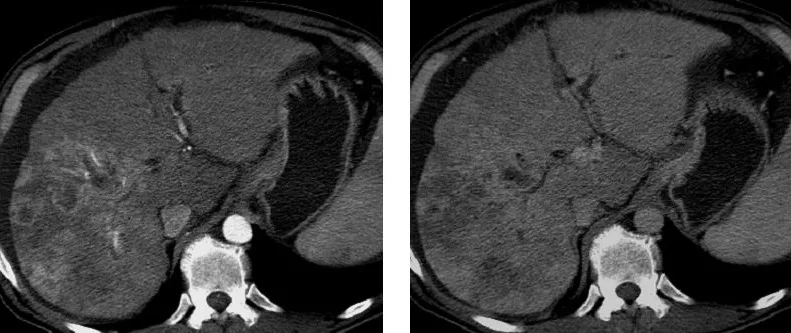
Hepatocellular carcinoma (HCC) is the commonest primary liver cancer and a leading cause of cancer death worldwide. Most cases arise in cirrhosis, and hepatitis B can cause HCC even without cirrhosis; alcohol and MASLD are growing causes. Because early tumours are silent and curable, patients with cirrhosis and high-risk hepatitis B carriers should have ultrasound surveillance every 6 months, usually with alpha-fetoprotein. In a cirrhotic liver, a lesion of 1 cm or more with arterial-phase hyperenhancement and washout on multiphase CT or MRI is diagnostic without biopsy. Treatment follows the Barcelona Clinic Liver Cancer (BCLC) system, which combines tumour burden, liver function and performance status: ablation, resection or transplantation for early disease, transarterial chemoembolisation for intermediate disease, and immunotherapy combinations (atezolizumab–bevacizumab, durvalumab–tremelimumab, nivolumab–ipilimumab) for advanced disease. Prevention (hepatitis B vaccination, antivirals, less alcohol and obesity) is most effective.
Patient case, mechanism, investigations, management, flashcards and exam-style questions.Open the lesson →
Key facts
- About 80–90% of HCC arises in cirrhosis; hepatitis B can cause HCC without cirrhosis
- Surveillance: ultrasound every 6 months (with or without AFP) in cirrhosis and high-risk hepatitis B carriers
- In cirrhosis, a lesion 1 cm or larger with arterial hyperenhancement and portal venous or delayed washout (LI-RADS 5) is diagnostic; no biopsy needed
- BCLC staging combines tumour burden, liver function (Child–Pugh, ALBI) and ECOG performance status to choose treatment
- Curative options for early disease: ablation, resection (no clinically significant portal hypertension) or transplantation within Milan criteria
- Milan criteria: one tumour up to 5 cm or up to three tumours each up to 3 cm, without vascular invasion or extrahepatic spread
- First-line systemic therapy is immunotherapy-based: atezolizumab–bevacizumab, durvalumab–tremelimumab or nivolumab–ipilimumab; TKIs (lenvatinib, sorafenib) if immunotherapy is unsuitable
- Screen for and treat varices before bevacizumab because of bleeding risk
Differential diagnosis
| Condition | Clues | Key test |
|---|---|---|
| Liver metastases | Multiple lesions in a non-cirrhotic liver, known primary (colorectal, breast, lung) | CT chest/abdomen/pelvis, CEA, biopsy |
| Intrahepatic cholangiocarcinoma | Progressive arterial enhancement without washout, capsular retraction, raised CA 19-9 | Multiphase MRI, biopsy |
| Haemangioma | Peripheral nodular enhancement with centripetal fill-in; usually non-cirrhotic | Contrast MRI or contrast-enhanced ultrasound |
| Focal nodular hyperplasia | Young woman, central scar, normal liver | MRI with hepatobiliary contrast |
| Hepatocellular adenoma | Young woman on oral contraception, risk of bleeding and malignant change | MRI, biopsy with subtyping |
| Regenerative or dysplastic nodule in cirrhosis | No arterial hyperenhancement or washout | Multiphase MRI follow-up (LI-RADS 2–3) |
| Hepatic abscess | Fever, raised inflammatory markers, rim enhancement | Ultrasound or CT, aspiration and culture |
Exam pearls
Guideline
EASL Clinical Practice Guidelines on the management of hepatocellular carcinoma (2025), AASLD Practice Guidance on HCC (2023), BCLC 2022 update and ESMO Clinical Practice Guideline (2025)
References
- European Association for the Study of the Liver (EASL). EASL Clinical Practice Guidelines on the management of hepatocellular carcinoma. J Hepatol 2025.
- Singal AG, Llovet JM, Yarchoan M, et al.. AASLD Practice Guidance on prevention, diagnosis, and treatment of hepatocellular carcinoma. Hepatology 2023.
- Reig M, Forner A, Rimola J, et al.. BCLC strategy for prognosis prediction and treatment recommendation: the 2022 update. J Hepatol 2022.
- European Society for Medical Oncology (ESMO). Hepatocellular carcinoma: ESMO Clinical Practice Guideline for diagnosis, treatment and follow-up. Ann Oncol 2025.
- Finn RS, Qin S, Ikeda M, et al.. Atezolizumab plus bevacizumab in unresectable hepatocellular carcinoma. N Engl J Med 2020.
- Abou-Alfa GK, Lau G, Kudo M, et al.. Tremelimumab plus durvalumab in unresectable hepatocellular carcinoma. NEJM Evid 2022.
Related topics
By Dr Khalid Seidi (B.Sc., M.D.) · MedEd World Clinical Knowledge library. Original teaching content checked against current guidelines (November 2026); confirm the latest local guidance before clinical use. Not a substitute for clinical judgement.