Clinical Knowledge › Internal medicine › Gastroenterology and hepatology › Liver failure, cirrhosis and liver tumours
Portal vein thrombosis
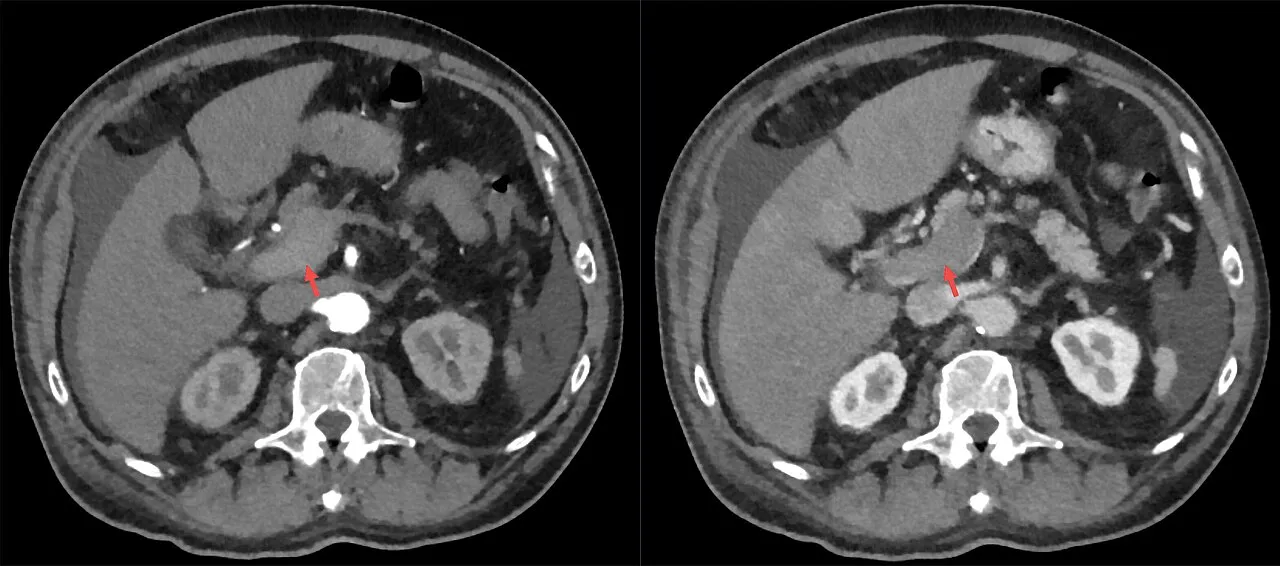
Portal vein thrombosis (PVT) is occlusion of the portal vein or its branches by thrombus, sometimes extending into the splenic or superior mesenteric veins. It occurs in two main settings. In cirrhosis it is common, found in roughly 10–25% of patients with advanced disease, and is driven by slow portal flow; it is often found incidentally on surveillance ultrasound. Without cirrhosis it usually reflects a systemic prothrombotic state, especially myeloproliferative neoplasms with the JAK2 V617F mutation, or a local cause such as pancreatitis, appendicitis, diverticulitis or abdominal surgery. Recent PVT may cause abdominal pain, fever and, if the mesenteric veins are involved, life-threatening intestinal ischaemia. Chronic PVT forms a collateral cavernoma and presents with portal hypertension, varices and splenomegaly with preserved liver function. Doppler ultrasound is the first test and contrast CT or MRI confirms extent and excludes tumour thrombus. Treatment is anticoagulation for recent PVT and selected cirrhotic patients, management of varices, and TIPS in selected cases.
Patient case, mechanism, investigations, management, flashcards and exam-style questions.Open the lesson →
Key facts
- PVT is common in cirrhosis (about 10–25% in advanced disease) and is mostly caused by slow portal flow plus local factors
- In non-cirrhotic PVT, a systemic prothrombotic factor is found in most patients; myeloproliferative neoplasms (often JAK2 V617F) are the commonest
- Local causes include pancreatitis, appendicitis, diverticulitis, cholangitis, abdominal surgery, umbilical catheterisation in neonates and tumours
- Recent PVT presents with abdominal pain and fever; persistent pain, bloody diarrhoea or peritonism suggests mesenteric venous infarction
- Chronic PVT forms a portal cavernoma and presents with variceal bleeding, splenomegaly and normal liver function
- Doppler ultrasound is first-line; contrast CT or MRI defines extent, chronicity and whether the thrombus is bland or tumour
- Recent non-cirrhotic PVT: start anticoagulation immediately and continue at least 6 months, indefinitely if a permanent prothrombotic factor is present
- Cirrhotic PVT: anticoagulate recent occlusive or progressing thrombus, main portal vein or mesenteric involvement and transplant candidates; DOACs may be used in Child-Pugh A and with caution in B
Differential diagnosis
| Condition | Clues | Key test |
|---|---|---|
| Tumour thrombus from hepatocellular carcinoma | Expanded portal vein with a liver mass in cirrhosis; rising AFP | Arterial-phase enhancement of the thrombus on multiphase CT or MRI |
| Budd-Chiari syndrome | Ascites and tender hepatomegaly; hepatic veins rather than portal vein occluded | Doppler ultrasound or CT of hepatic veins and IVC |
| Acute pancreatitis without venous thrombosis | Epigastric pain radiating to back; very high lipase | Contrast CT shows pancreatic inflammation with patent veins |
| Acute mesenteric arterial ischaemia | Sudden severe pain out of proportion to signs, atrial fibrillation | CT angiography showing SMA occlusion |
| Porto-sinusoidal vascular disorder | Varices and splenomegaly with patent or partly thrombosed portal vein and normal liver stiffness | Liver biopsy |
| Cirrhosis with slow (not thrombosed) portal flow | Reduced flow velocity or hepatofugal flow on Doppler | Contrast CT shows a patent, enhancing portal vein |
Exam pearls
Guideline
EASL Clinical Practice Guidelines on vascular diseases of the liver (2025), Baveno VII (2022) with Baveno VIII (2026), AGA Clinical Practice Update on portal vein thrombosis in cirrhosis (2025) and AASLD practice guidance on portal hypertension and varices (2024)
References
- European Association for the Study of the Liver. EASL Clinical Practice Guidelines on vascular diseases of the liver. J Hepatol 2025.
- de Franchis R, Bosch J, Garcia-Tsao G, Reiberger T, Ripoll C; Baveno VII Faculty. Baveno VII - Renewing consensus in portal hypertension. J Hepatol 2022.
- Davis JPE, Lim JK, Francis FF, Ahn J.. AGA Clinical Practice Update on management of portal vein thrombosis in patients with cirrhosis: expert review. Gastroenterology 2025.
- Kaplan DE, Ripoll C, Thiele M, et al.. AASLD Practice Guidance on risk stratification and management of portal hypertension and varices in cirrhosis. Hepatology 2024.
- European Association for the Study of the Liver. EASL Clinical Practice Guidelines: Vascular diseases of the liver. J Hepatol 2016.
- Baveno VIII Faculty. Baveno VIII – Advancing consensus in portal hypertension. J Hepatol 2026.
Related topics
By Dr Khalid Seidi (B.Sc., M.D.) · MedEd World Clinical Knowledge library. Original teaching content checked against current guidelines (November 2026); confirm the latest local guidance before clinical use. Not a substitute for clinical judgement.