Clinical Knowledge › Internal medicine › Gastroenterology and hepatology › Liver failure, cirrhosis and liver tumours
Liver transplantation
Liver transplantation replaces a failing or cancer-bearing liver with a whole or partial graft from a deceased or living donor, and is the only cure for end-stage liver disease. The main indications are decompensated cirrhosis (ascites, variceal bleeding, encephalopathy, jaundice or hepatorenal syndrome), hepatocellular carcinoma within accepted criteria such as Milan, acute liver failure meeting poor-prognosis criteria, and selected metabolic, cholestatic and oncological conditions. A multidisciplinary team assesses need, benefit and risk; candidates are prioritised by severity scores such as MELD (MELD 3.0 in the US) or UKELD. Absolute contraindications include uncontrolled sepsis, active extrahepatic cancer, severe cardiopulmonary disease and ongoing harmful substance use without engagement in treatment. After surgery, lifelong immunosuppression, usually tacrolimus-based, prevents rejection but causes kidney injury, diabetes, infection and cancer. One-year survival is about 90% and five-year survival 70–80%; late deaths are mainly from cardiovascular disease and cancer.
Patient case, mechanism, investigations, management, flashcards and exam-style questions.Open the lesson →
Key facts
- Refer for transplant assessment at the first decompensating event or when MELD reaches about 15; transplant gives a survival benefit above this level
- MELD uses bilirubin, INR and creatinine; MELD-Na adds sodium; MELD 3.0 adds female sex and albumin and caps creatinine at 3.0 mg/dL
- Milan criteria for hepatocellular carcinoma: one tumour up to 5 cm, or up to three tumours each up to 3 cm, with no vascular invasion or extrahepatic spread
- Acute liver failure: list urgently if King's College (or Clichy) criteria are met, for example arterial pH below 7.30 after resuscitation in paracetamol overdose
- Tacrolimus (a calcineurin inhibitor) is the backbone of immunosuppression, usually with mycophenolate and a short course of corticosteroids
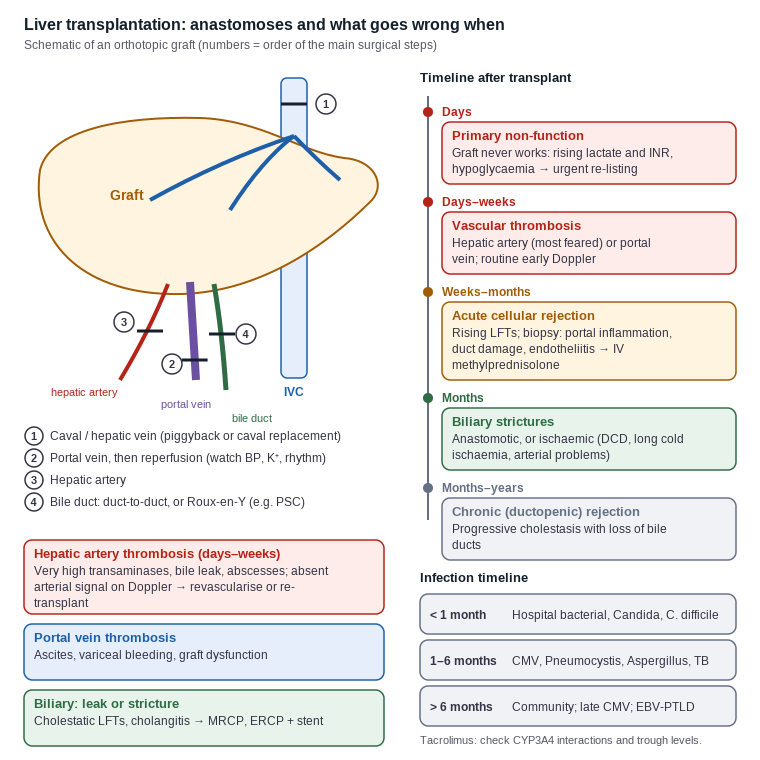
- Hepatic artery thrombosis is the most feared early vascular complication; routine Doppler ultrasound screens for it and early thrombosis often needs re-transplantation
- Acute cellular rejection usually occurs in the first weeks to months, is confirmed on biopsy and is treated with pulses of IV methylprednisolone
- Long-term care targets kidney disease, metabolic syndrome, cardiovascular risk, skin cancer and lymphoproliferative disorders caused by lifelong immunosuppression
Differential diagnosis
| Condition | Clues | Key test |
|---|---|---|
| Decompensated cirrhosis | Ascites, variceal bleed, encephalopathy, jaundice or MELD 15 or more | MELD/UKELD, ultrasound with Doppler, upper endoscopy |
| Hepatocellular carcinoma | Cirrhosis with arterial-phase hyperenhancement and washout | Multiphase CT or MRI (LI-RADS), AFP; assess Milan or extended criteria |
| Acute liver failure | Coagulopathy and encephalopathy without prior liver disease | INR, lactate, pH, creatinine; King's College or Clichy criteria |
| Cholestatic disease (PBC, PSC) | Recurrent cholangitis, intractable pruritus or decompensation | MRCP, alkaline phosphatase, MELD; exception points where allowed |
| Metabolic liver disease (Wilson, alpha-1 antitrypsin, hyperoxaluria) | Liver is the source of the defect; transplant cures it | Caeruloplasmin, AAT phenotype, genetic testing |
| Hepatopulmonary syndrome | Platypnoea and hypoxaemia in cirrhosis | Contrast (bubble) echocardiography, arterial blood gas (PaO2 below 60 mmHg) |
| Portopulmonary hypertension | Breathlessness, raised right ventricular pressure on echo | Right heart catheterisation; severe uncontrolled disease contraindicates transplant |
Exam pearls
Guideline
EASL Clinical Practice Guidelines on liver transplantation (2024) and AASLD/AST Practice Guidelines on adult liver transplantation (2025: candidate evaluation, graft-related and non-graft-related complications)
References
- European Association for the Study of the Liver. EASL Clinical Practice Guidelines on liver transplantation. J Hepatol 2024.
- Dove L, Chadha RM, Lai JC, et al.. AASLD AST Practice Guideline on adult liver transplantation: Candidate evaluation. Hepatology 2025.
- Sharma P, Izzy M, Ghabril MS, et al.. AASLD AST Practice Guideline on adult liver transplantation: Diagnosis and post-transplant management of non-graft-related complications. Liver Transpl 2025.
- Martin P, DiMartini A, Feng S, Brown R, Fallon M.. Evaluation for liver transplantation in adults: 2013 practice guideline by the American Association for the Study of Liver Diseases and the American Society of Transplantation. Hepatology 2014.
- Kim WR, Mannalithara A, Heimbach JK, et al.. MELD 3.0: The Model for End-Stage Liver Disease Updated for the Modern Era. Gastroenterology 2021.
- Mazzaferro V, Regalia E, Doci R, et al.. Liver transplantation for the treatment of small hepatocellular carcinomas in patients with cirrhosis. N Engl J Med 1996.
Related topics
By Dr Khalid Seidi (B.Sc., M.D.) · MedEd World Clinical Knowledge library. Original teaching content checked against current guidelines (November 2026); confirm the latest local guidance before clinical use. Not a substitute for clinical judgement.