Clinical Knowledge › Internal medicine › Haematology and oncology › Relevant pharmacology
Hormonal cancer therapies
Hormonal (endocrine) cancer therapies starve hormone-dependent tumours by lowering the hormone or blocking its receptor. In oestrogen receptor (ER)-positive breast cancer, tamoxifen (a selective oestrogen receptor modulator), aromatase inhibitors (anastrozole, letrozole, exemestane), ovarian function suppression and selective oestrogen receptor degraders (fulvestrant and newer oral SERDs) reduce recurrence and death; CDK4/6 inhibitors are added for high-risk and advanced disease. In prostate cancer, androgen deprivation therapy with GnRH agonists or antagonists, or orchidectomy, is the backbone, intensified with androgen receptor pathway inhibitors (abiraterone, enzalutamide, apalutamide, darolutamide) and sometimes docetaxel. Each class has predictable effects: tamoxifen causes venous thromboembolism and endometrial cancer, aromatase inhibitors cause arthralgia and bone loss, GnRH agonists cause a testosterone flare that can precipitate spinal cord compression, abiraterone causes mineralocorticoid excess, and androgen deprivation causes flushes, bone loss and metabolic harm.
Patient case, mechanism, investigations, management, flashcards and exam-style questions.Open the lesson →
Key facts
- Endocrine therapy works only if the tumour expresses the receptor: ER (and PR) in breast cancer, androgen receptor in prostate cancer
- Tamoxifen is an ER antagonist in breast but a partial agonist in endometrium, bone and liver: VTE, endometrial cancer and hot flushes; it is a prodrug activated by CYP2D6
- Aromatase inhibitors block peripheral conversion of androgens to oestrogen and are used only in postmenopausal women or with ovarian function suppression; arthralgia and osteoporosis are the main toxicities
- Adjuvant breast endocrine therapy lasts at least 5 years; extension to 7–10 years is considered in higher-risk disease
- GnRH (LHRH) agonists first cause a testosterone flare for 1–2 weeks; cover with an antiandrogen (bicalutamide or cyproterone) when metastases threaten the spine or ureters
- GnRH antagonists (degarelix, oral relugolix) lower testosterone within days without flare
- Abiraterone inhibits CYP17A1; give with prednisolone to prevent mineralocorticoid excess (hypertension, hypokalaemia, oedema) and monitor liver tests
- Metastatic hormone-sensitive prostate cancer: ADT plus an androgen receptor pathway inhibitor, with docetaxel in selected fit patients
Differential diagnosis
| Condition | Clues | Key test |
|---|---|---|
| Tamoxifen-associated endometrial pathology | Postmenopausal bleeding on tamoxifen | Transvaginal ultrasound and endometrial biopsy or hysteroscopy |
| Aromatase inhibitor arthralgia | Symmetrical hand and joint stiffness weeks to months after starting | Clinical; exclude inflammatory arthritis (CRP, RF, anti-CCP) if synovitis |
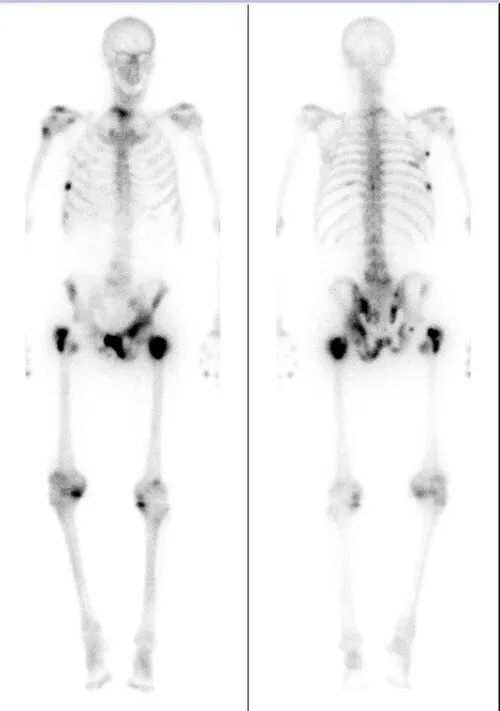
| Bone metastases | Localised progressive bone pain, raised ALP or calcium | Bone scan or MRI; PSMA PET in prostate cancer |
| Tumour flare with spinal cord compression | Back pain, leg weakness days after starting a GnRH agonist | Urgent whole-spine MRI |
| Venous thromboembolism | Unilateral leg swelling or pleuritic pain on tamoxifen | Doppler ultrasound or CTPA |
| Mineralocorticoid excess on abiraterone | Hypertension, hypokalaemia, oedema | BP, potassium; check prednisolone adherence |
| Castration-resistant progression | Rising PSA despite castrate testosterone | Testosterone below 1.7 nmol/L (50 ng/dL) with PSA rise or imaging progression |
Exam pearls
Guideline
ESMO 2024 early breast cancer guideline and EAU-EANM-ESTRO-ESUR-ISUP-SIOG prostate cancer guidelines (2024 update)
References
- Loibl S, André F, Bachelot T, et al.. Early breast cancer: ESMO Clinical Practice Guideline for diagnosis, treatment and follow-up. Ann Oncol 2024.
- Tilki D, van den Bergh RCN, Briers E, et al.. EAU-EANM-ESTRO-ESUR-ISUP-SIOG guidelines on prostate cancer. Part II–2024 update: treatment of relapsing and metastatic prostate cancer. Eur Urol 2024.
- Early Breast Cancer Trialists' Collaborative Group (EBCTCG). Aromatase inhibitors versus tamoxifen in early breast cancer: patient-level meta-analysis of the randomised trials. Lancet 2015.
- James ND, de Bono JS, Spears MR, et al.. Abiraterone for prostate cancer not previously treated with hormone therapy. N Engl J Med 2017.
- Shore ND, Saad F, Cookson MS, et al.. Oral relugolix for androgen-deprivation therapy in advanced prostate cancer. N Engl J Med 2020.
- Cornford P, van den Bergh RCN, Briers E, et al.. EAU-EANM-ESTRO-ESUR-ISUP-SIOG guidelines on prostate cancer–2024 update. Part I: screening, diagnosis, and local treatment with curative intent. Eur Urol 2024.
Related topics
By Dr Khalid Seidi (B.Sc., M.D.) · MedEd World Clinical Knowledge library. Original teaching content checked against current guidelines (November 2026); confirm the latest local guidance before clinical use. Not a substitute for clinical judgement.