Clinical Knowledge › Internal medicine › Haematology and oncology › Relevant pharmacology
Tranexamic acid and haemostatic agents
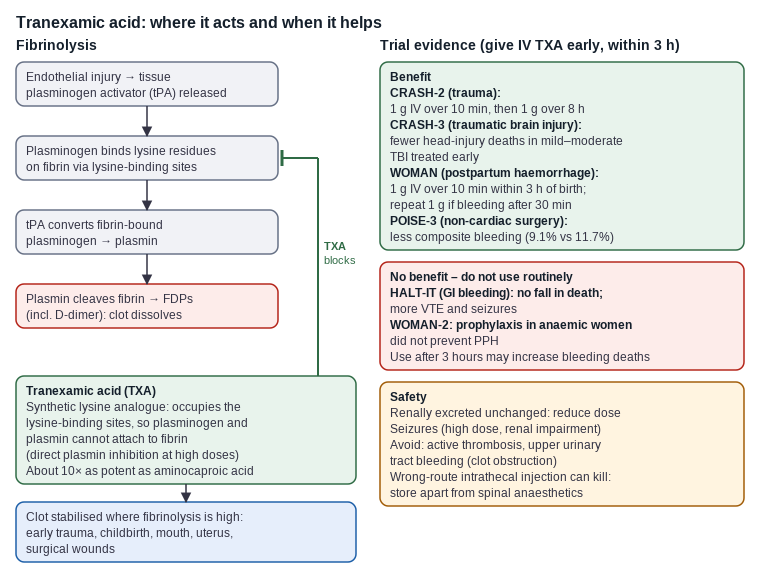
Haemostatic agents reduce bleeding by inhibiting fibrinolysis, boosting clotting factors or platelets, or sealing a bleeding surface. Tranexamic acid (TXA), a synthetic lysine analogue, blocks the lysine-binding sites on plasminogen so that plasmin cannot bind to and break down fibrin. Large trials showed that early IV TXA reduces death from bleeding in trauma (CRASH-2), traumatic brain injury (CRASH-3) and postpartum haemorrhage (WOMAN) when given within 3 hours, and reduces perioperative bleeding (POISE-3); it did not help gastrointestinal bleeding (HALT-IT), where it increased venous thrombosis and seizures, or prevention of postpartum haemorrhage in anaemic women (WOMAN-2). Oral TXA treats heavy menstrual bleeding and mucosal bleeding in haemophilia and von Willebrand disease. Other haemostatic agents include desmopressin, fibrinogen concentrate and cryoprecipitate, prothrombin complex concentrate, recombinant factor VIIa, vitamin K and topical sealants. Key safety points are wrong-route (intrathecal) errors, renal dose reduction, seizures and active thrombosis.
Patient case, mechanism, investigations, management, flashcards and exam-style questions.Open the lesson →
Key facts
- TXA is a lysine analogue that blocks plasminogen binding to fibrin; it is about 10 times more potent than aminocaproic acid
- Trauma (CRASH-2): 1 g IV over 10 minutes then 1 g over 8 hours, within 3 hours of injury; later use may harm
- PPH (WOMAN): 1 g IV over 10 minutes within 3 hours of birth, repeat 1 g if bleeding continues after 30 minutes
- HALT-IT (2020): TXA did not reduce death from GI bleeding and increased venous thromboembolism and seizures
- TXA is renally excreted unchanged: reduce the dose in renal impairment
- Desmopressin (0.3 micrograms/kg IV/SC) releases VWF and factor VIII from endothelium: use in type 1 VWD and mild haemophilia A; watch for hyponatraemia
- Fibrinogen replacement (cryoprecipitate or concentrate) is guided by fibrinogen levels (e.g. below 1.5 g/L in major haemorrhage, higher thresholds in PPH)
- Accidental intrathecal TXA causes seizures, arrhythmias and death: store and label separately from spinal anaesthetics
Differential diagnosis
| Condition | Clues | Key test |
|---|---|---|
| Tranexamic acid | Antifibrinolytic for mucosal, surgical, trauma and obstetric bleeding | Clinical; viscoelastic testing may show hyperfibrinolysis |
| Desmopressin | Type 1 VWD, mild haemophilia A, uraemic or antiplatelet-related platelet dysfunction | Trial (test) dose with VWF and FVIII response |
| Fibrinogen concentrate or cryoprecipitate | Hypofibrinogenaemia in major haemorrhage, PPH or DIC | Clauss fibrinogen or viscoelastic FIBTEM |
| Prothrombin complex concentrate with vitamin K | Warfarin-associated major bleeding | INR |
| Recombinant factor VIIa | Haemophilia with inhibitors, Glanzmann thrombasthenia, FVII deficiency | Inhibitor titre; specialist haemophilia advice |
| Topical haemostats and fibrin sealants | Localised surgical oozing, dental or epistaxis bleeding | Direct inspection of bleeding site |
| Platelet transfusion | Thrombocytopenia or severe platelet dysfunction with bleeding | Platelet count; PFA or aggregation studies |
Exam pearls
Guideline
BSH Haematological management of major haemorrhage (2022), European guideline on management of major bleeding and coagulopathy following trauma (6th edition, 2023), ESAIC guideline on management of severe perioperative bleeding (2022, published 2023) and WHO recommendation on tranexamic acid for postpartum haemorrhage (2017)
References
- Stanworth SJ, Dowling K, Curry N, et al.. Haematological management of major haemorrhage: a British Society for Haematology guideline. Br J Haematol 2022.
- Rossaint R, Afshari A, Bouillon B, et al.. The European guideline on management of major bleeding and coagulopathy following trauma: sixth edition. Crit Care 2023.
- Kietaibl S, Ahmed A, Afshari A, et al.. Management of severe peri-operative bleeding: guidelines from the European Society of Anaesthesiology and Intensive Care: second update 2022. Eur J Anaesthesiol 2023.
- World Health Organization. WHO recommendation on tranexamic acid for the treatment of postpartum haemorrhage. WHO 2017.
- CRASH-2 trial collaborators. Effects of tranexamic acid on death, vascular occlusive events, and blood transfusion in trauma patients with significant haemorrhage (CRASH-2). Lancet 2010.
- CRASH-3 trial collaborators. Effects of tranexamic acid on death, disability, vascular occlusive events and other morbidities in patients with acute traumatic brain injury (CRASH-3). Lancet 2019.
Related topics
By Dr Khalid Seidi (B.Sc., M.D.) · MedEd World Clinical Knowledge library. Original teaching content checked against current guidelines (November 2026); confirm the latest local guidance before clinical use. Not a substitute for clinical judgement.