Clinical Knowledge › Internal medicine › Endocrinology › Calcium and bone disorders
Hypocalcaemia
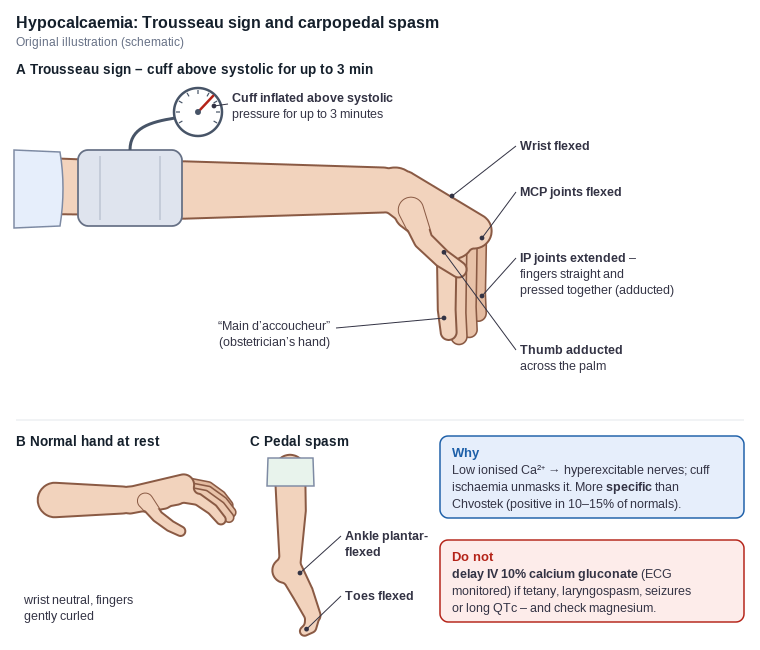
Hypocalcaemia is an albumin-adjusted serum calcium below about 2.10–2.20 mmol/L (8.4–8.8 mg/dL) or an ionised calcium below about 1.10 mmol/L. Because ionised calcium stabilises nerve and muscle membranes, a low level causes perioral and fingertip tingling, carpopedal spasm, Chvostek and Trousseau signs, laryngospasm, seizures and a prolonged QT interval. The commonest causes are hypoparathyroidism (usually after neck surgery), vitamin D deficiency, chronic kidney disease, magnesium depletion and acute illness such as pancreatitis, sepsis or massive transfusion. First confirm true hypocalcaemia, then read PTH with phosphate, magnesium, 25-hydroxyvitamin D and creatinine. Severe or symptomatic hypocalcaemia is an emergency treated with IV calcium gluconate under ECG monitoring, followed by magnesium replacement and treatment of the cause. Chronic hypoparathyroidism is managed with oral calcium and active vitamin D, with PTH replacement (palopegteriparatide) when control is poor.
Patient case, mechanism, investigations, management, flashcards and exam-style questions.Open the lesson →
Key facts
- Albumin-adjusted calcium (mmol/L) = measured calcium + 0.02 × (40 − albumin in g/L); in mg/dL add 0.8 for every 1 g/dL that albumin is below 4
- Ionised calcium is the physiologically active fraction (about 45%); alkalosis lowers it and can cause tetany with a normal total calcium
- Low calcium with high phosphate and low or inappropriately normal PTH = hypoparathyroidism; most often after neck surgery
- Low calcium with low phosphate and high PTH = vitamin D deficiency (secondary hyperparathyroidism)
- Magnesium below about 0.4 mmol/L impairs PTH secretion and action: hypocalcaemia will not correct until magnesium is replaced
- Severe or symptomatic hypocalcaemia (adjusted calcium below 1.9 mmol/L, tetany, seizures, QT prolongation): IV 10% calcium gluconate 10–20 mL over 10 minutes with ECG monitoring, then an infusion (teaching dose; check local formulary)
- Chronic hypoparathyroidism: oral calcium plus alfacalcidol or calcitriol, aiming for low-normal calcium without hypercalciuria; PTH replacement for those poorly controlled
- Prolonged QTc (long ST segment) is the classic ECG change; severe hypocalcaemia can cause torsades de pointes and reversible cardiomyopathy
Differential diagnosis
| Condition | Clues | Key test |
|---|---|---|
| Pseudohypocalcaemia (low albumin) | Low total calcium but no symptoms; low albumin from liver disease, nephrotic syndrome or illness | Albumin-adjusted or ionised calcium is normal |
| Hypoparathyroidism | Recent thyroid or parathyroid surgery or autoimmune disease; high phosphate | Low or inappropriately normal PTH |
| Vitamin D deficiency | Little sun exposure, dark skin, covered clothing, malabsorption; bone pain, low phosphate | Low 25-hydroxyvitamin D with raised PTH and ALP |
| Chronic kidney disease | High phosphate, high PTH, low calcitriol | eGFR and phosphate |
| Hypomagnesaemia | PPIs, diuretics, alcohol, diarrhoea, cisplatin; refractory to calcium | Serum magnesium below 0.7 mmol/L (often below 0.4) |
| Pseudohypoparathyroidism | Short 4th and 5th metacarpals, short stature, round face; high phosphate | High PTH with hypocalcaemia and normal kidney function; GNAS testing |
| Acute pancreatitis | Epigastric pain radiating to the back; calcium saponification in fat necrosis | Lipase or amylase above 3 times normal |
| Respiratory alkalosis (hyperventilation) | Panic, tingling and carpopedal spasm with normal total calcium | Low PaCO2 and normal adjusted calcium; ionised calcium transiently low |
Exam pearls
Guideline
Society for Endocrinology Endocrine Emergency Guidance on acute hypocalcaemia (2016), European Society of Endocrinology hypoparathyroidism guideline (2015) and the Second International Workshop on Hypoparathyroidism guidelines (2022)
References
- Turner J, Gittoes N, Selby P.. Society for Endocrinology Endocrine Emergency Guidance: Emergency management of acute hypocalcaemia in adult patients. Endocr Connect 2016.
- Bollerslev J, Rejnmark L, Marcocci C, et al.. European Society of Endocrinology Clinical Guideline: Treatment of chronic hypoparathyroidism in adults. Eur J Endocrinol 2015.
- Khan AA, Bilezikian JP, Brandi ML, et al.. Evaluation and management of hypoparathyroidism summary statement and guidelines from the Second International Workshop. J Bone Miner Res 2022.
- Khan AA, Rubin MR, Schwarz P, et al.. Efficacy and safety of parathyroid hormone replacement with TransCon PTH in hypoparathyroidism: 26-week results from the phase 3 PaTHway trial. J Bone Miner Res 2023.
- Cooper MS, Gittoes NJ.. Diagnosis and management of hypocalcaemia. BMJ 2008.
- Ketteler M, Block GA, Evenepoel P, et al.. Executive summary of the 2017 KDIGO Chronic Kidney Disease-Mineral and Bone Disorder (CKD-MBD) Guideline Update: what's changed and why it matters. Kidney Int 2017.
Related topics
By Dr Khalid Seidi (B.Sc., M.D.) · MedEd World Clinical Knowledge library. Original teaching content checked against current guidelines (November 2026); confirm the latest local guidance before clinical use. Not a substitute for clinical judgement.