Clinical Knowledge › Internal medicine › Endocrinology › Calcium and bone disorders
Vitamin D deficiency and osteomalacia
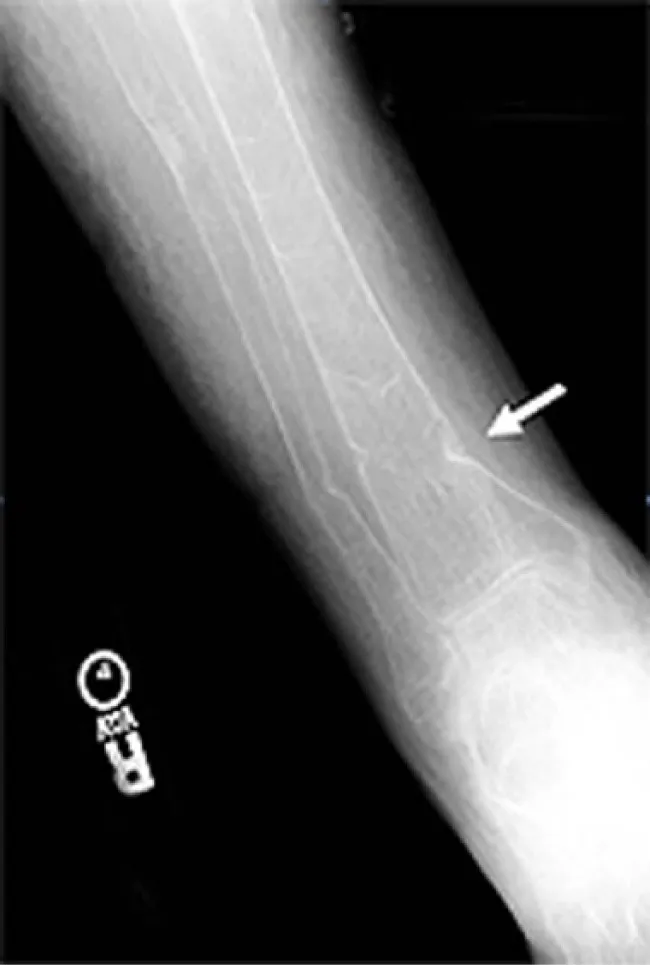
Vitamin D deficiency is a low serum 25-hydroxyvitamin D (25-OH D), the best marker of body stores; most bone-health guidelines call levels below 25–30 nmol/L (10–12 ng/mL) deficient and above 50 nmol/L (20 ng/mL) sufficient. It is very common worldwide, especially in people with dark skin, little sun exposure, covered clothing, obesity, malabsorption, liver or kidney disease, and in older adults living in care homes. Prolonged deficiency lowers calcium absorption, raises PTH (secondary hyperparathyroidism) and causes phosphate loss, so new bone matrix (osteoid) is not mineralised. In children this causes rickets; in adults it causes osteomalacia, with diffuse bone pain, proximal muscle weakness, a waddling gait and Looser zones (pseudofractures). Typical biochemistry is low or low-normal calcium, low phosphate, raised alkaline phosphatase and raised PTH. Treatment is a cholecalciferol loading course followed by daily maintenance, with adequate calcium. Hypophosphataemic causes such as X-linked hypophosphataemia and tumour-induced osteomalacia need different treatment.
Patient case, mechanism, investigations, management, flashcards and exam-style questions.Open the lesson →
Key facts
- Measure 25-hydroxyvitamin D (not 1,25-dihydroxyvitamin D) to assess vitamin D stores
- Bone-health thresholds: below 25–30 nmol/L deficient, 30–50 nmol/L possibly inadequate, above 50 nmol/L sufficient (divide nmol/L by 2.5 for ng/mL)
- Osteomalacia = defective mineralisation of osteoid in adults; rickets = the same plus defective growth-plate mineralisation in children
- Classic osteomalacia biochemistry: low or normal calcium, low phosphate, high ALP, high PTH, low 25-OH D
- Looser zones (pseudofractures) are bilateral, symmetrical, perpendicular lucent bands at the femoral neck, pubic rami, ribs and lateral scapula
- Treat deficiency with a loading regimen (about 300 000 units cholecalciferol over 6–10 weeks), then 800–2000 units daily (teaching dose; check local formulary)
- Check calcium about one month after loading: it can unmask primary hyperparathyroidism
- Correct vitamin D deficiency before starting IV bisphosphonates or denosumab to avoid severe hypocalcaemia
Differential diagnosis
| Condition | Clues | Key test |
|---|---|---|
| Osteoporosis | Painless until fracture; normal muscle strength | Normal calcium, phosphate, ALP and PTH; low BMD on DXA |
| Polymyalgia rheumatica | Shoulder and hip girdle pain and stiffness in over-50s | High ESR/CRP, normal ALP and phosphate; rapid steroid response |
| X-linked hypophosphataemia | Childhood rickets, short stature, dental abscesses, family history | Low phosphate, high FGF23, normal 25-OH D; PHEX testing |
| Tumour-induced osteomalacia | Adult-onset bone pain and weakness, severe hypophosphataemia | High FGF23; somatostatin receptor PET to find the tumour |
| Primary hyperparathyroidism | High calcium with high PTH | Calcium raised (not low); vitamin D usually normal or mildly low |
| Paget disease of bone | Raised ALP, bone pain, deformity in older adults | Normal calcium and phosphate; isotope bone scan and X-ray |
| Bone metastases or myeloma | Bone pain, weight loss | Calcium often high; imaging; electrophoresis |
| Fibromyalgia | Widespread pain, fatigue | Normal biochemistry |
Exam pearls
Guideline
Endocrine Society clinical practice guideline: Vitamin D for the prevention of disease (2024), Global consensus recommendations on prevention and management of nutritional rickets (2016) and the UK National Osteoporosis Society (Royal Osteoporosis Society) vitamin D and bone health guideline
References
- Demay MB, Pittas AG, Bikle DD, et al.. Vitamin D for the prevention of disease: an Endocrine Society clinical practice guideline. J Clin Endocrinol Metab 2024.
- Munns CF, Shaw N, Kiely M, et al.. Global consensus recommendations on prevention and management of nutritional rickets. J Clin Endocrinol Metab 2016.
- Aspray TJ, Bowring C, Fraser W, et al.. National Osteoporosis Society vitamin D guideline summary. Age Ageing 2014.
- Scientific Advisory Committee on Nutrition (SACN). Vitamin D and Health. Public Health England, London 2016.
- Holick MF.. Vitamin D deficiency. N Engl J Med 2007.
- Haffner D, Emma F, Eastwood DM, et al.. Clinical practice recommendations for the diagnosis and management of X-linked hypophosphataemia. Nat Rev Nephrol 2019.
Related topics
By Dr Khalid Seidi (B.Sc., M.D.) · MedEd World Clinical Knowledge library. Original teaching content checked against current guidelines (November 2026); confirm the latest local guidance before clinical use. Not a substitute for clinical judgement.